Tuesday, February 24, 2015

Why building smart cities is not a smart idea


Why building smart cities is not a smart idea
Instead of trying to build 100 new cities with doubtful futures, the government should attend to the many places in India that are on the verge of becoming important urban centres.


In the 2014 Union budget, finance minister Arun Jaitley allocated Rs 7,060 crore to the development of 100 new cities in India. This was in keeping with the BJP manifesto for the Lok Sabha election this year.

“We will initiate building 100 new cities,” it promised, “enabled with the latest in technology and infrastructure – adhering to concepts like sustainability, walk to work etc, and focused on specialized domains.”

If the budget allocation is divided equally, each potential new city will get around Rs 70 crore. This amount does not build a city, but can presumably allow a feasibility study.

The refrain of “one hundred” had to be a rhetorical device. In the budget speech, this number became a mantra, with a number of projects given Rs 100 crore of funding. Then came the announcement that 100 new cities would be built.

What background data or realities of our country is this based on? There are eight metropolises in India, 26 Tier-II cities, 33 Tier-III cities and more than 5,000 Tier-IV towns. Current villages with the potential for future urbanisation number more than 638,000. All these are already in existence. These are not the new cities being referred to.

Those fresh, dynamic, extremely smart cities are greenfield developments, laid on land previously untouched. Development would, therefore, be swift, smooth and unhindered by the pesky and cantankerous citizenry that resides in every existing urban set-up.

The potential new cities are to be “based on integrated habitat development – building on concepts like twin cities and satellite towns”. Custom-built cities, emerging in the shadow of older towns, can be sterling examples of progress and best practice, undertaken, no doubt through the currently favored mode of public-private partnerships.

Will this simultaneously breathe new life into the older city, while helping the new one reach its stated potential? As one possible answer, consider Mumbai’s favorite means of redevelopment – hire a developer, erect a shining tower, sell it at market rates. Accommodate in afterthought the original users in a runt, a lesser endowed cousin to the skyscraper built in one corner. Now imagine this at the level of a city.

Urban Renewal
Does urban renewal have to be imagined only in terms of new cities? Such an approach gives up on any possible transformation of existing cities from within as too difficult and unlikely to yield the lucrative returns envisaged in any outsourced enterprise.

The reverse does not stand: if existing cities are to be developed well, then given the number of present urban settlements in India, new cities are not needed at all. All that land that is now rolling nature can remain just that. The new city can only be at the expense of the old.

New cities are designed swathes of infrastructure, imaginary spaces awaiting occupation. What attractors do they offer as potential? In our liberalized, liquidity-based, aspiration-fuelled present, their primary potential would be as investment, not occupation.

I overheard a commuter describing his acquisitions in the upmarket node in Navi Mumbai. “We have three flats in Kharghar”, he said, “but we've never once been there”. Spaces with market rather than social potential are built for instant gentrification, displaying all the hallmarks of new Edens and Elysian Fields, but keeping out Babel. They lack for nothing except life.

Mutant Impositions
New towns are fundamentally unnatural entities. They are vast, mutant super-impositions on landscapes devoid of habitation. Historically, cities grow organically, through accumulation and accommodation, where people come first, not infrastructure. Over time, through largely iterative processes, common law practices coalesce into traditions of urban behavior, remaining inclusive, and then through osmosis with other cities turning cosmopolitan. First settlement, then design. Every great metropolis is testament to this, located next to bodies of water, along caravan trails, next to natural resources. They grow by attracting migrants who see the value in those who have come before them, and learn from it.

Even new cities need a reason for their existence. Jamshedpur and Bokaro Steel had heavy industry to attract workers in the socialist 1950s. Chandigarh, Gandhinagar and Bhubaneshwar were new capitals. Navi Mumbai, on the other hand, envisioned as a twin city to the grand metropolis, took more than three decades to become viable. Lavasa and Amby Valley, exclusive by their very mandate, and despite their large publicity budgets, hardly appear to be urban transformers.

Smart City, Sim City
Planned cities take as much time to come into their own as unplanned towns. In the same manner of towns that grow organically, the individual potential of a planned urban settlement will be reliant on regional transformations, socio-economic and political processes and sheer blind luck.

You might remember Sim City, a vastly popular video game in the 1990s, where you played the mayor of a city. A large part of your time was spent laying out the city – its roads, networks and infrastructure, its public buildings and amenities. You then allowed users to move in, who came like ants chasing honey. Soon you would receive either praise and accolades from your citizens, or – if they did not like your layout – you would face strikes, rioting and arson. Good intentions are never enough.

Why not focus on the urban centers that already are? If only the government could overcome the fear of resistance and inertia from existing populations, overcome the desperation to show instant results, be patient, work for the long-haul well beyond their terms in office, then existing towns, from Tier IV to Tier I can be transformed – first through public participation, then through inclusive policies and the provision of social infrastructure, and finally through “enabling technology and infrastructure, and specialized domains”.

No one can deny that our big cities are overburdened. But for every one of those, there are already a dozen more on the cusp of becoming future cities with potential. If attention is lavished on these instead of the chimeras of a hundred new cities with doubtful futures, new India, with its changing demographics, may still benefit.

As Rahul Mehrotra, architect, academic and urban conservationist recently remarked in a discussion on urban change: “We do not need 100 new cities. What we need are 100 great cities.”


First published in scroll.in, Jul 19, 2014 • 07:00 am

Thursday, January 15, 2015

New Spaces in Old Cities


New Spaces in Old Cities

After a considerable hiatus, after the late 1980s really, we now have a few public institutions chosen from international designs.

Ralph Lerner's monumental IGNCA design in Lutyens' Delhi was greeted with a lot of fanfare in 1986. Its blueprints were displayed in several parts of the country and a coffee table sized book made of the whole competition. That was, of course before the internet age. The project itself was later subject to various dilutions and what has now come up can hardly be called monumental. Lerner's built edifice is a shadow of its own pale shadow.
Ralph Lerner's Design of the IGNCA, New Delhi
There were lessons to be learnt then. Unlike several other cities where a contemporary public project has had a transformative influence, this kind of imposed internationalism seems to have a limited currency in our country. Lerner's design in the late 80's was textbook PoMo (in its least complimentary sense), using the colours and materials of the Delhi's other grand buildings in a kitschy pastiche, and having little to do with the life of the city. Gautam Bhatia's second prize winning design did a much better job localizing the design, conceiving the complex as a promenade.

The IGNCA, New Delhi, today
Projects like Lerner have become exclusionary, both at an urban and at a cultural level. A foreign firm, bringing in a foreign form in a city filled with the architecture of the past has inherent contradictions. Unlike Chandigarh, Delhi is no tabula rasa.

In the past two years, two projects, one, museum and the other an extension to a well-known city edifice, also a museum, have awarded to 'starchitects'. The Patna Museum and the extension to the Bhau Daji Lad Museum in Bombay are both updated expressions of contemporary internationalism, that in the very act of their conception (the result of international competitions) exude the virtues of fair play and transparency.

The New Museum, worldwide is metonymous with contemporary presence and awareness, much as the New Town had been iconic marker with the post war generation of the 1950s. Projects with this kind of public profile also offer the potential for future footfalls, an enhanced cultural scene in both cities and a chance to parade global credentials in from of literati and glitterati alike. Criticism would be churlish, but some issues emerge from both projects that need consideration, even debate.

The Design for the new Bihar Museum was won by the Japanese firm (Fumihiko) Maki and Associates, along with Opolis Architects from Bombay. The new museum is now being developed at the Bailey Road in Patna and has a far more ambitious brief than its predecessor. The older Patna Museum was built in 1917 in the Indo Saracenic style, which at the time was riding the wave of short lived dominance in architectural fashion. The new site for the new museum is already contentious, as it entails the razing of several colonial bungalows from the early 1900s, and even the relocation of the well-known Mulana Mazhar ul Haq Arabic and Persian University.
Maki & Associate's design for the new Bihar Museum in Patna
The older Patna museum is still the place to go to today to see the wealth of Buddhist and Jain bronzes and terracottas from Nalanda and Gaya and other Ancient and medieval historical sites. By far the most important piece in the museum has to be the Didarganj Yakshi, a creation that, in my opinion is the single most beautiful sculpture in the world. This five and a half foot tall monolithic polished sandstone female form holding a whisk is the best example of Mauryan Art we have and dates back to the 3rd century BCE. This and some of the other Buddha figurines are, apparently, to be poached from the Patna Museum to grace the space of the new museum. But has the new museum been designed with the knowledge of specific artifacts to be displayed within its walls? Or will the lovely Yakshi have to comfort herself with whatever corner is allotted to her?

Consider this: the Venus de Milo has an entire room in the Louvre to herself, and is the focus of a long corridor. The Winged Victory of Samothrace has pride of place at the peak of a grand stairway and dominates the space. Any one of these sculptures could have an entire museum dedicated only to them. But cultural relevance can only be achieved with the knowledge and specificity of the museum's collection. Otherwise as many contemporary museums do, the focus is entirely on the event, on temporary and passing collections on tour, and on other spaces like restaurants, amphitheatres and souvenir shops, while the permanent collection is either not on display or collected together like the ajayabghar of the past.

The Bhau Daji Museum, Mumbai
The Bhau Daji Lad Museum in Bombay was already an ajayabghar or House of Wonders. Conceived as a City Museum in 1872, formerly the Victoria and Albert Museum, it was built in fin de siecle decorative neo-Renaissance styling. The international competition for the new wing was won by New York based architect Steven Holl, with Opolis Architects once again as associates. The new design is made of red Agra stone and white concrete interior spaces. The building is made to bring in light through a series of diagonals and curved cutouts evoking calligraphic flourishes. Looking nothing like the older museum in whose direct proximity it is planned, the new wing is a Steven Holl building in Bombay, rather than a Bombay building designed by Steven Holl.
Steven Holl's design for the proposed extension of the Bhau Daji Museum in Mumbai
Here too internationalism triumphs over the local, creating fresh semantics where none existed. What implications will the changed context bode for the surroundings, for Byculla to the West, and the zoo to the East? Will the new building be seen behind fencing, available for all to look at but not touch (not without a ticket, at least)? And what is the collection that is to be displayed within its vast modernist caverns?

The old museum has a complicated presence that the new just does not seem to acknowledge. Built to celebrate the former queen and consort, it chose sides in the ongoing Battle of the Styles. The flavour of the age was the Indo Saracenic, in Bombay at least. Being a city museum, it was populated with contemporary (manufactured) artifacts, commissioned to the Sir JJ School of Art. These were both dioramas of everyday life in Bombay in the late 19th century, as well as several figurines depicting through colonial eyes and essentializations the several denizens of the city, differentiated by caste and religion. In a sense, this museum of Bombay was already a meta-project to start with. After nearly a century and a half it takes on several interpretations as artifacts as seen through post-colonial perspectives. How does this context square up with the current design that seems to operate in a cultural amnesia?

This, then is the problem of the new productions of space in old cities- the larger ecology of redevelopment that the State, not so metaphorically both Centre and State, are presently obsessed with. Change is brought in irrespective of context and in spite of history. Even if we keep heritage values aside for the moment, these new buildings erase rather than encompass urban memory. They impose their presence on us.

Our cities are left the poorer for it.

(This essay was published in an edited form in Architect and Interior India, Vol. 6, Issue 10, January 2015)

Sunday, September 28, 2014

Bo0mbay- in conversation with Kamu Iyer


Bo0mbay: from Precincts to Sprawl- 
in conversation with Kamu Iyer

Architect Kamu Iyer’s most recent book is ‘Bo0mbay: from Precincts to Sprawl’, in which he dispels the notions of the city growing only organically. Right from early childhood, he talks of growing up in a ‘planned precinct’, where the city held back its chaos, while order, inclusivity and contemplation ruled. In these areas of Bombay, planning order and social order went hand in hand. This allowed for the absorption of migrants from several parts of the Indian sub-continent to come to the megapolis to seek a life. The buildings which came up in these several precincts defined the urban fabric of the city for almost fifty years, until very recently; where they are being systematically undermined by what Rahul Mehrotra has called ‘impatient capital’. But in their heyday, from the late twenties to the late fifties, the architecture that emerged was open and expressive and self-similar, not hidden behind gates, watchmen and CCTV’s.

Iyer’s childhood, as he describes in his book, was spent in the areas of the Hindu and Parsee Colonies in middle Bombay. In the fifties, he went to architecture school, where he was taught and later worked with the very architects whose designs made these precincts. The 'planned city' that emerged from the initiatives of the City Improvement Trust was a tram ride away from the imperial piles of South Bombay. The colonial expressions in and around the erstwhile Fort had run out of steam by the first decade of the last century. In a sense, it is urban design, rather than architecture that forms the final contribution of the colonial state to the city of Bombay.

In 2000, Iyer edited ‘Buildings that Shaped Bombay’, a monograph on the work of G. B. Mhatre, whom he had as a teacher in college and whom he briefly worked with. Mhatre was perhaps the best architect whose canvas was the planned precinct, whether the Oval Maidan stretch, the Marine Drive, the Pherozeshah Mehta Road or indeed the Five Garden developments. Iyer has lived in a G. B. Mhatre designed building for the large part of his life, and the lessons learnt, both subliminally and through active critiques and debates on what architecture is appropriate have governed his professional life and his practice.

His education stood at the cusp of change from the slow decline of (locally adapted) Beaux Arts practices, when the architectural education was still ensconced in the Art School, to the emerging Modernist possibilities being explored by the various practices prolific at the time. Iyer’s practice continues in the present, more than half a century after he started his firm ‘architects’ combine’ with friends from architecture school. He is both prolific and critical in his designs. He has, in this book, several sharp observations about the present, the city turning from a fabric of precincts to the bo0m of sub-urban sprawl, where real estate monetization and self-help appropriations exist side by side.

I am very pleased to engage Kamu Iyer in the conversation that follows where he elaborates on several of the themes I have mentioned. While his new book tells us the tale of the Bombay of over three quarters of the last hundred years through his perspective and reminisces, his observations also present us with an alternative genealogy to understand the city as it is today.

Published by Popular Prakashan, 2014

“I have always lived in apartment buildings that stood on individual plots but I had friends who lived in other types of houses. Arun Ranade lives in a chawl at Girgaum, Vinodini Gajaria ,till her end, lived in a chawl among a group of them in a gated community called Halai Bhatia Mahajan Wadi, Jehangir Choksi lived at Cusrow Baugh, a housing enclave for Parsees and J.B.Fernandes, an architect associated with Ridley Abbot the designer of  New Empire and Liberty cinemas, lived at Khotachi Wadi, an urban village in the heart of Girgaum. 

The variety in house typologies, all of which exist even now, make layers that add to the richness of the city. Bombay is a palimpsest in which the imprints of successive typologies of housing and their individual histories overlap. They did not evolve in a sequence. Most grew independently and simultaneously. But the apartment building which, appeared first in Bombay, has changed the most. It is constantly outgrowing it's form.” 
(excerpted from ‘Bo0mbay: from Precincts to Sprawl’)

The Dadar Matunga planned precincts, from Google Earth
DALVI:
What are your earliest memories of Bombay? We take a lot of its urban fabric, especially the developments of the thirties and the forties for granted. Even today, they form the backdrop of our lived experience. Was that also true for your growing-up years or do you have memories of the city 'filling up', as it were?

IYER:
My earliest memories are from 1938 when I was six years old. I lived in Hindu Colony at Dadar till my ninth year after which I lived at the northern end of Parsi Colony. Both areas were part of a planned neighborhood. The areas I lived and studied in were planned but many parts of Bombay that I saw from an early age sitting in a tram appeared crowded and disorderly. Buildings were close to one another and there was little or no space between them. The streets were sometimes winding and buildings were higher than in my neighborhood.

In contrast both Hindu and Parsi colonies had houses and spaces between them placed regularly. Houses stood on individual plots and there was space outside the house to play in. This made me feel that the city was not the same all over and there was more to it than what I was used to in my locality. What Bombay might have been before the thirties is, for me, a matter of speculation.


DALVI:
You studied architecture in the Sir JJ School at a time when the most prolific and significant architects in Bombay were also its faculty and driving force. There has perhaps never been a time in the city when academia and practice were so synonymous. What do you think has been the lasting legacy of the Sir JJ School?

IYER:
In the 50's, when we were students, the school of architecture itself was small and it was a part of the Art school. The number of professionally qualified architects was also small- there were more engineers practicing as architects, because you needed only a surveyor’s license from the Bombay Municipal Corporation to sign building plans for approval. I read many years later that the school was always short of teachers and Foster King, during his tenure as (acting) head of the school, encouraged senior students to help their juniors in their studies. He also sought the help of professional architects to teach in the school. Whether it was for survival in a profession inundated with engineers or love for architecture, most felt duty bound to teach.

The profession, represented by the Indian Institute of Architects, also took interest in students because most of its prominent members were teaching at the school. The Institute also had its nominees in the RIBA (Royal Institute of British Architects) examination board. The institute's concerns were largely with the profession, unlike the present day when the emphasis is on conference jamborees.

As students, we got the benefit of the experience of the practicing architects of the city. The school, from its inception, had luminaries like George Wittet, Claude Batley , Foster King and in later years G. B. Mhatre, Durga Bajpai , Jehangir Billimoria and a host of others. The situation in other professional colleges was similar, especially the medical colleges attached to hospitals. The best doctors were 'honorary' in public hospitals and their services were available both to students and patients who could not have otherwise afforded it. Over the years the custom of having practicing professionals teach ceased but fortunately the school of architecture continues the tradition of inducting professionals in design studios, juries and lectures. This is good for the school.


DALVI:
Was Modernism taught by default when you were in architecture school? It certainly was when I studied in Sir JJ in the eighties. The Modernist agendas and processes, fueled by the works of the Modern masters and their manifestos had got normalized by then. Was there debate over what architecture was appropriate when you were a student?

IYER:
When I was a student, the Beaux Arts system adapted to Indian conditions by Claude Batley was prevalent. Teaching was centered on the study of classical and Indian orders, their proportions and details and drawing them up skillfully. There was also study of historical styles. For instance, there was a subject called composition in which you composed on sheet elements of a style and rendered it to make an attractive drawing. The emphasis was on drawing and rendering and little else which was frustrating to most of us. We found it easier to understand what we were drawing only when we actually saw the building. We could understand the Doric Order only when we saw the Town Hall.
'Study of the Basilica of Maxentius' History Composition at the Sir JJ School of Art, circa, 1940, by G. S. Kalkundri

We realized that drawing had limitations and there was more to a building than what appeared on its front. In the design studios elevations carried more weight than plans and if there was mismatch between the inside and outside it did not matter as long as the elevations were attractive. The elevation had to have 'elevation features', which meant embellishment. This system was done away with in my second year at school.

By the time we came to the third year, though the earlier method of teaching was discontinued, the approach to design continued in which the plan and elevation of a building were different elements designed separately. We also had a studio in the third year called Specialized History in which you had to design a building for a modern use but adapt and modify, if need be, a traditional style of architecture for the design of the facade. This was a dichotomy difficult to comprehend.
'Design for a Small Museum' Specialized History Drawing at the Sir JJ School of Art, circa, 1940, by N. D. Desai

We were a group of friends who felt differently though we did not quite understand Modernism. But examples of early modern architecture in books then, reading about the Bauhaus, Howard Robertson's books and seeing Frank Lloyd Wright's work in magazines convinced us that we needed to understand Modernism as a movement. We realized soon that a movement becomes one only when people also think similarly in their respective fields. We looked around us. In the Art section of the school some students were moving away from pictorial art, a set of artists formed the Progressive Group and exhibited their work in the city. T.S. Eliot was a departure from the romantic poets on whose works we grew up and J. Krishnamurthy, who used to give public lectures in the school compound during winters, was telling us to set aside all gurus and their teachings and instead find out for ourselves.

Le Corbusier at the High Court, Chandigarh

DALVI:
You were witness to Le Corbusier’s buildings coming up in Chandigarh. What kind of influence did his work have on students of architecture in Bombay?

IYER:
The biggest impact was Le Corbusier. His design for the Chandigarh High Court stunned us all because it was a major departure from the 'box' and the modernism of the Bauhaus which we had by then become familiar with. We argued among ourselves whether a building can be seen as an object by itself or as a part of a larger picture of the street and the city. To find out we spent time walking around the city and cycling in the suburbs looking at buildings and streets, market places and other commonly used places and discussing in the canteen. This taught us more than making drawings in the studios.

There were debates but these were more between those in favor of Frank Lloyd Wright's organic architecture and those supporting the International style. Le Corbusier appealed only to a few and his work was a topic for discussion among them. The transition in the school was gradual. At the same time, modern architecture was also emerging in the city.


DALVI:
There has not been an adequate assessment of the architecture of the sixties and the seventies. The influence of architects in Bombay as a dominant force nationally was already in decline by the end of the fifties. Delhi and Ahmedabad had become the new capitals of modernist expression. 

IYER:
On the contrary, Bombay in the sixties and seventies saw a boom in building activity. The high rise buildings in Nariman Point, industrial complexes with sophisticated buildings for advanced processes and apartment and office buildings for ownership were all coming up at a brisk pace. The typologies of the apartment building and the high rise towers are ' Bombay Firsts'. Delhi and Ahmedabad appear as leaders of modernist expression but buildings that came up there were mostly institutional, built for the government and public bodies. Most architects were heavily influenced by Le Corbusier at first and Louis Kahn later. The buildings that came up were monumental, each vying with the other for attention.

In Bombay, the situation was different. Clients were demanding. They insisted on strict adherence to programme, cost and time schedules. They also said that a building had not only to be good to look at but also to live in, the latter being more important. In other words their demands were exactly what modern architecture exhorted- the rational use of space, structural clarity and no mismatch between interior space and external expression.


DALVI:
These decades also witnesses the withering of the post-independence/republic euphoria. Your practice was already into its second decade by then. How do you remember those times, and in retrospect today how do you assess their influence?

IYER:
The spurt in building activity in the 60's gave young architects work. Clients recognized the need for an architect's services in a project. That itself was a departure from the past when an architect was appointed only to ' beautify' the facade. Young architects got projects for designing interiors or industrial buildings or for apartments promoted by developers. As young practitioners we got industrial projects which instilled in us a discipline of keeping to time and cost schedules. We also did some houses in Ahmedabad and Bangalore as also a residential school and many small projects. The variety of work and interaction with clients added to our 'experience bank'. We discussed our work in the studio and we learnt soon enough that every project, regardless of its size, had its own complexities and no job was too small for the office to handle.

The sixties and seventies were still idealistic and euphoric though it started waning towards the late 70's. Cynicism crept in when some architects saw architecture more as a business than as a profession. Developers were largely responsible for this perception. Architects who looked at their projects as a search and introspected on them when they were completed could not reconcile with the commercialization of architecture that was getting rampant.

Modernism took different forms. In Delhi and Ahmedabad architects educated at CEPT and SPA did serious work though most of them adapted the language of Le Corbusier and Louis Kahn. In Bombay, commercially oriented architects blindly copied western models without thinking about the suitability of such buildings to Indian conditions while the others plodded on, attempting to create architecture that evolved from past understanding of materials and ways of handling them, construction methods and forms suitable for the context in which they were situated.

CIDCO Low Income Group Housing, Vashi, New Bombay, 1991 by architect's combine

DALVI:
The constant clamor today is that the housing stock in the city is inadequate. But there have been mass housing projects in the past, generated by the state accommodating all levels of housing. You have designed mass housing projects in New Bombay as well as in Karnataka. Is there still a future for projects of this kind?

IYER:
Housing is generally affordable if it is done by public bodies because developers and their architects are not interested in housing other than that for the affluent. Their argument is that land costs are high due to scarcity and it does not make economic sense to construct smaller flats. Architects who are on the bandwagon argue that since land is scarce FSI has to be high and buildings tall. This puts those needing affordable housing out of the reckoning. So it becomes the responsibility of government and public bodies to supply housing for the have-nots.

Unfortunately the housing authority does not have enough land since almost all land is owned privately. Despite that there is a future for public housing, cooperative ownership and self help groups. But for this to happen there must be concerted effort and political will. Providing affordable housing is a daunting task but it is not insurmountable but the political class and bureaucracy need to know that just as a society is only as strong as its weakest section, a city's quality depends on how its poor live.


DALVI:
How do you assess the decline of both the rental paradigm as well as the cooperative movement on housing in Bombay?

IYER:
Affordable rental housing is nonexistent and is not likely to revive even if the Rent Act, which is always unfairly blamed for the shortfall, is repealed. Today cooperative ownership of property which, again, is a Bombay First, is a viable solution. In this system either a cooperative society is formed before a site is purchased and a building is built on it or is formed after a developer hands over a building to individual buyers of flats in the building. Flats become more affordable when a society is formed before a building is constructed because it eliminates the developer's profit margin. Moreover he bases his price on the current cost of land which keeps varying all the time. Forming societies before construction has declined in recent years because all land in the city is cornered by developers and getting approvals is time consuming and cumbersome.


DALVI:
How would you address the symptom of swift gentrification that seems at affect inclusive growth in the city? I see aspiration fulfillment through ownership and the inevitable influence of the developer/ speculator as the main factors. Would you agree?

IYER:
Gentrification is a recent phenomenon.
It is a part of a vicious cycle of inflated land prices, a typology of housing that is inherently expensive to construct, maintain and live in and a marketing strategy that lists exclusivity as one of the unique features of a project.

Gentrification is in built into the way housing projects are designed, which basically are gated communities containing stand-alone, high-rise towers with large floor plates. The open space in these gated communities is developed as gardens for the exclusive use of the community. The contrast between these high end towers and Dadar/Parsi Colony is palpable. In the Parsi Colony most of the apartment blocks are exclusively for the Parsis. Yet segregation is imperceptible because the streets, gardens and spaces around the buildings are for all. In earlier developments gated communities were for people belonging to a caste or religion or a sub culture group but within the wadi or Baugh there was no class division. The rule was “you are welcome to stay here if you belong to my caste or religion" now the rule is “you are welcome to live here if you have the money".

Gentrification distorts social balance. Bombay, unlike New Delhi, was not stratified. It was more egalitarian than most cities and gentrification does not fit in Bombay's ethos. Interestingly, when the Greater Bombay Plan was being drafted the British Government appointed a panel to advise on housing. The panel, in which Claude Batley was a member, stressed that neighborhoods should be inclusive and segregation of people into income or social groups should not be encouraged. Planning should provide for mixed housing in neighborhoods. The suggestion has been overlooked; instead distorted land prices and investable surplus funds with a few have resulted in ample built space for investors but not for housing the majority of the people living in the city.


DALVI:
Your book ‘Bo0mbay: from Precincts to Sprawl’ has been several years in the making. I have been privileged to read some of its early drafts. Could you describe the processes that went into settling upon its final form? 

IYER:
My book has taken years to write. I had no intention to write because my observations of the city over the years were subjective and I did not think anyone would be interested. I used to share them with friends now and then. People would tell me to put down what I saw or knew in some form or other. My friend Shekhar Krishnan and Vaishnavi Chandrashekhar planned a series of conversations which would be recorded and made available as oral history. This did not happen.  Charles Correa was largely responsible for taking it further. He insisted on my writing a book. That is how I started.

The first version was structured around three frames through which I looked at the city. It was illustrated in the usual manner. People I showed it to said that the book was a personal view, yet I was in the background. I was not sure if a first person account would be taken seriously. That doubt took a long time to resolve.

When I started, I wondered what type of book would convey my view without a bias. I also found that books about Bombay were either coffee table books with nostalgic imagery or academic books with references and substantiation of every other thing. Most of those books were awfully boring because only words do not tell the story of a city. Likewise, pictures alone cannot tell you why a city looked the way it did. A city as a living entity consists of so many things which have to be lived through. The ideas I was putting down were also visual and I thought the book should have both words and pictures to tell the story. The difference would have to be that the words and pictures tell the same story. It would be parallel narrative.


DALVI:
I find this most interesting as it is a book that defies genres, being a document, a chronology, a critical assessment and a subjective viewpoint all in one.

IYER:
Since I was writing in the first person it was easy to structure it like a journey through different stages of my life. It takes you from my schoolboy days to my time in architecture school and later, my professional life. I thought it is important to find out why and how a city grows or metamorphoses. I could do that through analysis, diagrams, maps and sketches. That is what makes it difficult to classify the book. It is like the Bombay Bhel that has a little of everything.


(interview with Mustansir Dalvi, October 2014)
© Mustansir Dalvi, 2014, all rights reserved.

Priya Sarukkai Chabria, Noorul Hasan, Athena Kashyap- 3 book reviews

Bombay/Mumbai: Immersions
Priya Sarukkai Chabria and Christopher Taylor 
Niyogi Books, 2013

The central display at my favourite Bombay bookshop, Kitab Khana, is creaking under the weight of new books on the city. It is difficult to know just what else can be added to the oeuvre before it collapses completely. I remember a time when the only books on Bombay that were available were Gillian Tindall’s history, City of Gold (1982) and Dom Moraes’ contemporary – and then, controversial – account Bombay (1979), commissioned by Time/ Life books. And then, apres Mehrotra/Dwivedi, le déluge.

On a slightly nativist note, I think any new book on Mumbai should pass muster with Mumbaikars first. Priya Sarukkai Chabria and Christopher Taylor’s immersive account – history, travelogue, ethnography, picture book and prose-poem does so, giving us a sense of Mumbai as it is today. Poet and photographer, both accepting the version of Indian time as a kaalchakra, retread and retrace the city to reclaim it: “What one saw at noon must be seen again in starlight; that which was seen in summer reveals another aspect in the monsoon.” This appreciation of multi-dimensionality, both in time and in space, articulates what Chabria calls the hard and the soft city – the city of data and materiality and of imagining and desire. Immersion is the wearing down of shoe soles, going forth to meet its very many “yesterday’s outsiders and today’s natives” (a phrase from Ranjit Hoskote’s preface) and submerging into the known and unknown to be ultimately renewed, much like the city’s annual Ganesh visarjan.

Using this “cross-genre” approach allows the reader to make a non-linear journey through the city, observing many simultaneities and palimpsest layers, the initial southern heart and the developing northern and eastern limbs, using voices from the past (Chitre, Dhasal, Surve, Pasolini and Paz are all evoked) and the voices of the present from the streets, bylanes, chawls and slums. Chabria narrates the many lives with gentleness and honesty bringing “all its denizens together” like the city at low-tide, who “all alike smell its tidal spoor”.

The book is a pas de deux between text and images, and co-author Christopher Taylor’s photographs, taken the old fashioned way using negative film to make silver gelatin prints, bring out the texture, grittiness and veracity of this mad megalopolis. His images punctuate the narrative and carry it forward, not with panoramas but vignettes of a city largely unseen. Not an underbelly, really (we’ve had enough of faux noir-imaginings of the big, bad Mumbai Nagariya) but more a quotidian presence. Taylor’s is a visual account of the occupied city.

Chabria un-riddles the city’s various etymologies, which become the access to some of the oldest and now dwindling communities and their physical artifacts: homes, religious places, cemeteries as with the Chinese, the Armenian Jews, the Irani Shias all centred around Mazgaon. Taylor photographs the newer communities – the drivers of “kaali-peelis”, the service industry that accommodates migrants “like the city accommodates high tide”. The vast, unlamented backroom industry that forms the bulwark for the Hindi film world is explored, as are some of the city’s geographies that we do not talk about much – the ferries and the forests. Chabria ends with a prose poem, “Cab ride through Bombay/Mumbai”. Here, like the book, ruminations, memories and the views outside meld together like a seething traffic jam, filling the senses like exhaust, making the eyes blink and water – and ultimately clear the vision.

-Reviewed by Mustansir Dalvi in Time Out Mumbai


Meena Kumari: The Poet 
A Life Beyond Cinema
Noorul Hasan
Roli Books, 2014

During the golden age of vinyl, when shelves of record stores were filled with albums of songs from Hindi films, a patronizingly small space was accorded to the “non-filmy” album. I remember two of these—one was the eponymously titled Bachchan Recites Bachchan, the other I Write, I Recite, an album of recordings of Meena Kumari reciting her own poetry with music by Khayyam. In her sonorous, somewhat breathless voice, she spoke of love and loneliness. Quite like the tragedy queen she was in her films. That was 1972.

Now, Noorul Hasan, a former professor of English with interests from Thomas Hardy to Firaq Gorakhpuri, has brought together several of Meena Kumari’s verses, published in English translation for the first time. Most of her poems share the themes commonly found in Urdu ghazals and nazms—loss, solitude, the contemplation of death, the futility of words. Meera Kumari’s enduring reputation is that of a tragic doyenne. Her poems are not rooted in specifics, and are written in a rhetorical style that does not offer a reader much to hold on to. One is therefore obliged to juxtapose this with the context of her life for a full appreciation of the poems.

Hasan has also curated additional material that includes essays on her verse and several appendices with archival interviews and reminiscences that range from the fanboy thrill of meeting the Garboesque diva (by Afsar Jamshed) to the raking up of a mildly salacious past. Naushad Ali’s short biography, Actress Meena Kumari: From The Cradle To The Grave, summarizes her life—her beginnings as a child actor, her debut in the stunt movie called (of all things) Leatherface, her rise to fame as an adult actor with Baiju Bawra, her unrequited love for a leading man, her marriage with, and divorce from, a leading director, her slide into isolation and alcoholism, and the fixing of her image as a tragedienne with Pakeezah, all allow one to indulge in reading these into her poems: “Life is a scattered tale of grief/ And my story is nearing its end.” Hasan’s translations are accompanied by Roman transliterations that allow the multilingual (but Urdu-challenged) reader access to Meena Kumari’s original words, and these are very welcome: “Din doobe hai ya doobi baraat liye kashti/ Sahil pe magar koi kohram nahi hota” (Is it sunset or has the wedding barge capsized/ There is no hue and cry on the shore all the same).

Meena Kumari’s poems are steeped in melancholy, rarely allowing even a spark of cheer or good humour. She often acknowledges her own self-indulgence: “I sit and brood for hours/ About which heartbeat/ I should turn into poetry”. Out of her accumulated outpourings of angst she is on occasion able to convey an image of some beauty: “This night/ Was merciful like/ Miriam’s warm cloak/ And like a dreaming Christ/ Drowned in sleep—innocent”. While several of her ghazals tread familiar landscapes, it is her nazms, short and long, that yield the most. Here, she is at her most confessional: “My own dreams poisoned me/ My own imaginings stung me to death.”

Few books subvert their own title. Meena Kumari The Poet: A Life Beyond Cinema is one. In a sense that is what makes the book most engaging. Approached with the full awareness that this is a collection of poems by a famous actor of the Hindi screen whose image surpasses her performances and her life, these verses add to and sustain her persona. Her poems become enjoyable reading, evoking the many visual memories we have of Meena Kumari. Indeed, the book has several iconic images from her films. I would take issue with the opening essay, where Philip Bounds and Daisy Hasan describe her poetry as a critique of popular culture. Asserting that “her poems tell us as much about Bollywood as they do about herself” is clearly overstating the case, as their defence is entirely rooted in her life in cinema.

It is her later chroniclers, it would seem, who cannot let go of the baggage of her “filmy” career, instead of attempting to read her verses for what they are. Meena Kumari herself puts it best. The best of the “bonus features” that enrich this book is “My Likes And Dislikes”, a throwaway interview that she seems to have given to some film magazine. “A closed book is very enticing because it is silent”, she says, “but once you start reading it its entire character begins changing slowly and imperceptibly.” Like the famous Kuleshov effect of cinematic montage, this book, like the actor herself, cannot escape its proximity to Meena Kumari’s films, her times, and the long shadow she casts as an eternally suffering doyenne.

-Reviewed by Mustansir Dalvi in Mint Lounge, Sat, Jun 28 2014


Crossing Black Waters
Athena Kashyap
Stephen F. Austin University Press, 2012

In her debut collection of poetry, author Athena Kashyap references “black waters” to evoke two separate “crossings”: the first, when the author moved to the United States from the country/city of her formative years, and the second, when her great-grandfather uprooted his family from Lahore and made the crossing to India.

Embedded in the poems, which move back and forth between the Indian subcontinent and America, is a longing for “home” that is realized in the mind. However, when the poet finally returns to her abandoned family home in Pakistan, she finds that what was left behind is just “half of everything.” Even the fulfillment of her longing is faltering, uncertain: “Of all the seeds planted / by great-grandfather in Lahore, / only trees remain— / clinging on.”

The backdrop of San Francisco, on the other hand, represents a more abstract existence, an occupation rather than a belonging, a perpetual halfway house. Kashyap declares her position succinctly: “I am knot.” There is a sense of slow loss in her America-centered poems, in a country where, according to the poet, she is so free that she floats away: “I am diluted, having left one world to live and travel in / others. My skin grows permeable, breathable.” It is at this plane of osmosis, of skin as filter, that the experience of America occurs. Her poems situated beyond the black waters absorb the local, but the specifics of a home left behind intrude: the taste of tandoori, of sweet Gujarati food, snippets of Hindi film songs, and the memories of Mumbai trains all collide with the present.

The poem “Zero Generation” addresses immigrant loneliness as a collective experience, in that it speaks to those who “long to belong, but also long to return / back to where we once belonged.” The desire for making a world in a foreign land is inherent, but described here is an immigrant experience that just does not settle, and Kashyap’s poems simmer at this cusp. She references a popular line from a film song, “Aye dil, hai mushkil jeena yahaan,” which translates to, “My poor heart, how difficult it is to live here!” While the “here” in the context of the song refers to Bombay, the author borrows the expression to refer to life in America. This move by the author achieves the effect of making the hard reality of urban living there—or here—universal.

Kashyap writes of sundering, separations, crossings, reunions, and uncertain reconciliations. The break with an imagined home is never forever; return is always a possibility yet remains unsatisfying whenever it occurs. Crossing Black Waters is a many-layered book about the simultaneity of multiple existence that is becoming more frequent in our modern world, where all our online networks are no substitute for being “there,” and being there is no longer an end in itself.

-Reviewed by Mustansir Dalvi in Jaggery Lit, Issue 1, Fall 2013

Friday, August 15, 2014

Nehru's speech, enjambed


Redeeming our Pledge
by 
Jawaharlal Nehru

1.
Long years ago 
we made a tryst with destiny.
Now comes the time
when we shall redeem our pledge, 
not wholly or in full measure, 
but very substantially. 

At the stroke of the midnight hour, 
as the world sleeps, 
India will awake 
to life and freedom. 

A moment comes, 
which comes but rarely in history, 
when we step out 
from the old to the new, 
when an age ends, 
when the soul of a nation, 
long suppressed, finds utterance.

2.
At the dawn of history 
India started on her unending quest.

Trackless centuries 
are filled with her striving,
the grandeur of her success 
and her failures. 
Through good and ill 
she never lost sight 
of that quest, nor forgot
the ideals that gave her strength. 

Today, we end 
a period of ill fortune.
India discovers herself,
again.

3.
The appointed day has come.
The day appointed by destiny.
India stands forth again, 
after long slumber and struggle, 
awake, vital, free. 

The past clings on to us 
in some measure.
We have much to do 
before we redeem pledges 
so often taken. 
Yet the turning point is past, 
history begins anew, 
history, which we shall live and act,
history, others will write about.

4.
The future beckons. 
Whither do we go?
What shall be our endeavor-
to bring freedom and opportunity 
to the common man, 
to the peasants and workers of India,
to fight and end poverty 
end ignorance, end disease,
to build up 
a prosperous, a democratic, a progressive nation, 
to create 
social, economic and political institutions,
to ensure justice and the fullness of life 
to every woman 
to every man.

And to India, 
much-loved motherland, 
ancient, eternal, ever-new, 
our reverent homage.
We bind ourselves
afresh, to her service. 


Excerpts from the speech made by India's first prime minister Jawaharlal Nehru in the parliament to the constituent assembly, on August 14th 1947,'at the stroke of the midnight hour'. 

The transcript of the full speech can be read here.
And here, you can hear a sound recording of Nehru's 'Tryst with Destiny' speech in HIndi, recorded on All India Radio.


Tuesday, July 22, 2014

Time Out Mumbai- Slow City


This piece was published in an edited version in the latest issue of Time Out Mumbai


Slow City

We must concoct a new name for the extreme sport of sitting in the path of whooshing traffic on Mohammed Ali Road with your back to it. Limb and possibly life is risked for a plate of saffron-hued firni outside Suleman Mithaiwala, but one spoonful is all that is needed to make the risk worthwhile. Above and beyond your head, long haul cars speed past nonchalantly on the snaking flyover with many names, the one that connects the Sir JJ School to the Sir JJ Hospital. At the Al-Madinah, plastic chairs and makeshift tables are always full at this time of year, occupied, quite comfortably by growling bellies in need of satiation.

Once upon a time, when Ramadhan was pronounced Ramzan, the all-denominational greeting ‘Khuda Haafiz’ had not yet been essentialized to ‘Allah Haafiz’, indeed when the concrete reptile flyover under whose grimy underbelly we now cheat death in order to gain the Kingdom of Culinary Heaven was not even imagined, eateries on the cross lane to Minara Masjid and beyond would lay their spread out nearly across the busy Mohammaed Ali Road,. For a month, at dawn and at dusk, vehicular lanes would be re-imagined as food plazas. Bombay’s hordes would descend on Saarvi, Shalimar and Noor Mohammadi, full of piety and perfume in time for Sehri and Iftaar. The moments before sunrise would pass swiftly, suffused with prayer and humility but the nights were long, filled with loud conversation and conviviality.

Life did take a downturn after the unimaginable events of the early nineties, but then life does find a way. Today, Allah be praised, even in its relatively constricted circumstances haleem, nalli nihaari, and a variety of char grilled kebabs occupy the mind as much as firni and maalpua, assorted barfis and the awe-inspiring aflatoon (the word by which the Arabs knew Plato). Elsewhere in the city, politicians hold Iftaar parties to stem the erosion of their flock, while the food corner between the Suleman and Zam Zam confectionaries requires no agenda to flourish.

Ramzan in Mumbai is a month of charity and fasting, but also thirty days of collegiality and general bonhomie. The fasting hours these days are quieter, given a summer that has stretched longer than usual, but evenings, despite the delayed monsoon go on and on, full of good cheer and loud humour. Does fasting make our city a warmer place? We should all try it then. Our city’s streets are used particularly well, transforming into spaces for eating, shopping and prayer. If the rains do not play spoilsport, each lane outside overflowing mosques accommodate the faithful. Azaad Maidaan on the day of Eid becomes a vast makeshift Idgaah.

Unlike other parts of the Muslim world that have taken the more rational path, using calendars to determine the times of fasting, India is still fixated on mandatory sightings of the sliver of moon for beginning the cycle of rozas and, especially for ending them. As children, this was a time for one-upmanship, running up to the terrace and trying to spot the Chaand. This year, the chaand was attested to by several reliable witnesses on Facebook, a public service act that was, in turn duly liked and shared. Whatever works.

In the days before television, Muslim neighbourhoods of Bombay would be woken by a volunteer walking from street to street like a town crier calling the faithful to rise for Fajr prayers. Today, times for commencement and breaking of fasts are easily regulated by downloadable Android and IoS Apps, loaded with alarms that indicate various times of prayer. But the crier’s sonorous voice, often using popular tunes of the day resonates in my memory decades after this tradition gave way to loudspeakers and recorded calls.

We live in a world of punctuated chaos, a term coined by Bill Gates. He alludes to our current times as one of constant upheaval marked by brief respites, unsettling to those who experiencing them. There was a time (that Gates calls punctuated equilibrium) when we believed the world would never change, at least not much, when the full enjoyment of a month that brought the city together was enjoyed at a slower, more deliberate pace.

For me, this pace is represented by tongawallahs and Victoria drivers, those urban transporters who played a crucial role in short-distance commuting in Bombay right until the late seventies. Plying a beat that extended from Colaba to Jacob Circle, these horse carriages could carry four or five persons along Bombay’s North-South roads. After stuffing myself silly at Minara Masjid, staring up at starlit skies unencumbered by flyovers, sky walks or luxury housing, I could slide into satisfied somnolence to the offbeat clipclopping of the horse’s hooves, nodding my head to a rhythm that would take me home. It this slow city that I miss the most.


Wednesday, July 9, 2014

My FIFA moment

My vantage

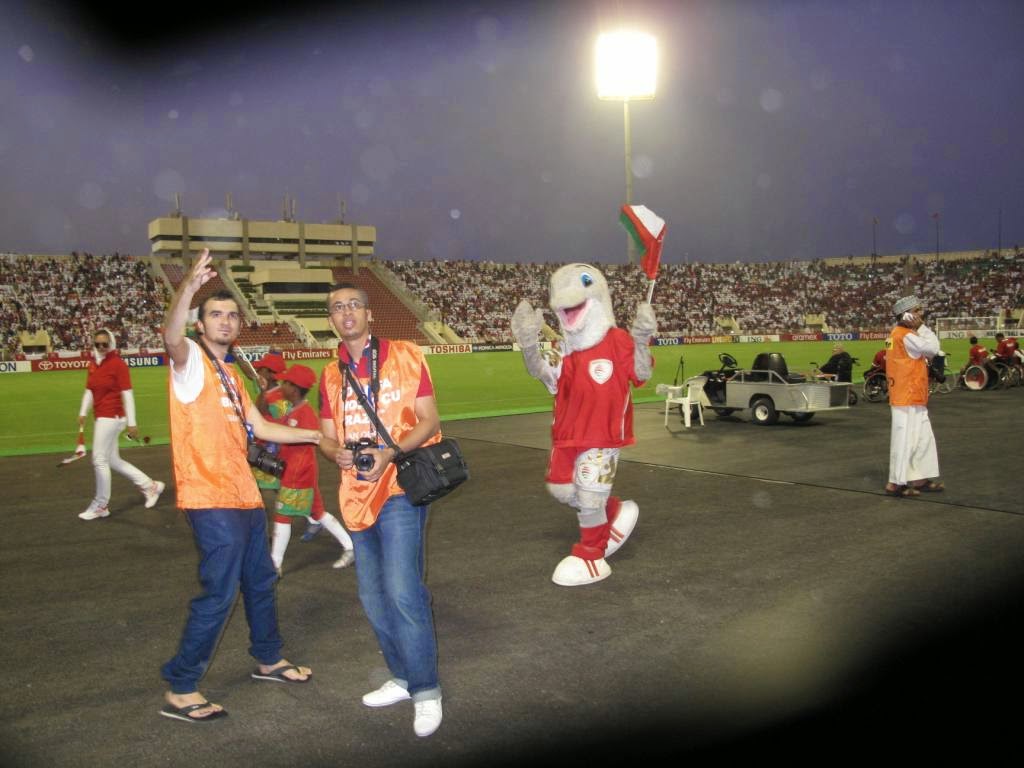
The beautifully ornamented skywalk at Al Khwair catches the first rays of the sun as we drive down to Muttrah, the old port of the old city. On either side of the road, scores of banners announce a football match at the Sultan Qaboos Sports Complex. This match is between Oman and Jordan, a FIFA World Cup 2014 Brazil- Asian Qualifier. We are in Muscat, Sanjay Austa and I as part of a National Geographic Traveller India assignment to cover the best of Oman. He is a professional photographer, armed with his camera and other weapons. I am armed with my wits, mostly.

Banners, banners everywhere

Each day, as we move through the city and cover the sights, the port, the Grand Mosque, the Royal Opera House, these banners intrude on our consciousness. Oman versus Jordan. Until we can take it no more and  ask Joe, our host rather tentatively, if we can do something about it. ‘Khallas!’ he replies, as he has for our every request over the last three days. Consider it done.
 
Official press badge

At night, in our rooms, we are surprised to receive, not a ticket to the game, but a Press Card. It is encased in a plastic pocket, complete with a lanyard a quarter inch thick with FIFA 2014 BRAZIL stamped in tickertape fashion on it. It takes a while for this to sink in. I take a photo with my mobile phone, just in case the card dissolves in front of my eyes. We are going to go to a FIFA match! Not Brazil, but the next best thing.

The next evening, despite our efforts to complete our assignments on time, we are late as we arrive at the Sultan Qaboos. Soon after noon, large groups of people make their boisterous way in the general direction of the stadium. Some are dressed in red, the colours of the Omani team, others in the very comfortable national dress- a flowing white dishdasha, a turban, with a sheathed khanjar, or ceremonial dagger.

Before the match

The evening is just turning the shade of Syrah Rose and loud noises are already emanating from the bleachers. Joe tells us that every Omani in the city can be expected to turn up. Shouldn’t we hurry then, we ask? ‘Khallas!’ Joe responds, and we are transported into the complex, and as if on a magic carpet that does not quite know where it is supposed to land, hastily shunted through a side door, and deposited, not in the stands, but on the playing pitch.
 
Location, location, location

And so it comes to pass that, ten minutes after the kickoff at 17:00 hours, on the 16th of October 2012, I find myself planted squarely on the playing field of a FIFA World Cup qualifier, not twenty feet away from the Omani goalpost, a member of the Press. We are ceremoniously given press vests to put on over our shirts, and warned to return them at the end of the game. Like the players, I feel the weight of 26,500 spectators on my back. I walk up and down the sidelines, the best place to watch this match, with other members of the press, the photographers, the coaches and support staff. 

There is an incessant roaring in my ears, and from my vantage I hear cheers in 5.1 Surround Sound. A goal is missed on the Jordanian side, and, as if immersed in a Dolby universe, I hear the practiced genuflection of a Mexican wave whoosh past me, left to right. The sound a Mexican wave makes is much more impressive than just watching it, I can tell you that. It goes round the stadium two or three times before it dies out.

Putttroo, men!

The match, such as it is, is fraught with injury. Players make their mandatory dives and feints, everyone seems to be inspired by Arjen Robben. The injury cart is regularly trotted up the playing green and prone players are removed from the proceedings for triage and diagnostics. I have decided to become a partisan Oman supporter. Puttroo, men! I shout, several times, but my voice is drowned out in the general hubbub.

the injury cart

Before I know it, it is half time. 
Oman nil, Jordan, nil.
half time

half time

The match resumes, and just when the proceedings threaten to become dreary, at 62 minutes into the game, No 12, Ahmed converts a corner kick. Oman one, Jordan nil. General pandemonium and hot air ensues. The crowds are vocal, but not unruly. At 87 minutes, Darwish of the Omani National Team put in a second one. Congratulations and Celebrations. Much head banging. Someone in the far stand lights fireworks. Smoke billows, an unnerving sight, for a bit. But the beautiful game goes on. At 89 minutes Jordan equalises. Not a peep from the stadium. The silence of the dead, with hovering white shrouds everywhere. The crowd is as partisan as I am.
The moment Darwish of Oman puts the second one in
Oman two, Jordan one.

Soon 90 minutes are over and three minutes of injury time commence. Incredibly, Jordan scores. The referee declares offside. No goal. From every stand a high pitch whistling rises. Screeeeeee! Like a legion of bats has descended into the stadium. In the melee, the last minutes tick by.

Game over. 
Oman two, Jordan one. 
I am happy to report that my newly adopted team, Oman wins. They will go on to play Japan in the next round, and be soundly trounced. Bleddy!

The Omani National Team celebrates on the pitch. The crowds celebrate as they leave the stadium. Roads  fill with cheering supporters. Makeshift musical instruments appear out of nowhere. Some vigorous dancing is punctuated by the ululating tongues. Some of the players themselves join in the dancing with the punters. It is a small country.

While returning to the changing rooms, one of the last players in, Abdul Aziz, I think, gets into serial handshaking mode with the enthusiastic crowd. One thing leads to another, and soon, clutching handfuls reach out to divest him of him team jersey. Off it goes and, in a blink, it is swallowed by the general populace. Poor Aziz has to go and face his team mates, half naked.
 
Aziz dis-vested

And now the hurlyburly’s done, and the battle lost and won. We are able, for few last moments, to walk on the playing field itself.  I cut a lonely figure on the FIFA pitch, take a photo of myself with one hand. All around my feet lie the debris of the match.

After the hurlyburly’s done
Joe and Sanjay