Tuesday, July 22, 2014

Time Out Mumbai- Slow City


This piece was published in an edited version in the latest issue of Time Out Mumbai


Slow City

We must concoct a new name for the extreme sport of sitting in the path of whooshing traffic on Mohammed Ali Road with your back to it. Limb and possibly life is risked for a plate of saffron-hued firni outside Suleman Mithaiwala, but one spoonful is all that is needed to make the risk worthwhile. Above and beyond your head, long haul cars speed past nonchalantly on the snaking flyover with many names, the one that connects the Sir JJ School to the Sir JJ Hospital. At the Al-Madinah, plastic chairs and makeshift tables are always full at this time of year, occupied, quite comfortably by growling bellies in need of satiation.

Once upon a time, when Ramadhan was pronounced Ramzan, the all-denominational greeting ‘Khuda Haafiz’ had not yet been essentialized to ‘Allah Haafiz’, indeed when the concrete reptile flyover under whose grimy underbelly we now cheat death in order to gain the Kingdom of Culinary Heaven was not even imagined, eateries on the cross lane to Minara Masjid and beyond would lay their spread out nearly across the busy Mohammaed Ali Road,. For a month, at dawn and at dusk, vehicular lanes would be re-imagined as food plazas. Bombay’s hordes would descend on Saarvi, Shalimar and Noor Mohammadi, full of piety and perfume in time for Sehri and Iftaar. The moments before sunrise would pass swiftly, suffused with prayer and humility but the nights were long, filled with loud conversation and conviviality.

Life did take a downturn after the unimaginable events of the early nineties, but then life does find a way. Today, Allah be praised, even in its relatively constricted circumstances haleem, nalli nihaari, and a variety of char grilled kebabs occupy the mind as much as firni and maalpua, assorted barfis and the awe-inspiring aflatoon (the word by which the Arabs knew Plato). Elsewhere in the city, politicians hold Iftaar parties to stem the erosion of their flock, while the food corner between the Suleman and Zam Zam confectionaries requires no agenda to flourish.

Ramzan in Mumbai is a month of charity and fasting, but also thirty days of collegiality and general bonhomie. The fasting hours these days are quieter, given a summer that has stretched longer than usual, but evenings, despite the delayed monsoon go on and on, full of good cheer and loud humour. Does fasting make our city a warmer place? We should all try it then. Our city’s streets are used particularly well, transforming into spaces for eating, shopping and prayer. If the rains do not play spoilsport, each lane outside overflowing mosques accommodate the faithful. Azaad Maidaan on the day of Eid becomes a vast makeshift Idgaah.

Unlike other parts of the Muslim world that have taken the more rational path, using calendars to determine the times of fasting, India is still fixated on mandatory sightings of the sliver of moon for beginning the cycle of rozas and, especially for ending them. As children, this was a time for one-upmanship, running up to the terrace and trying to spot the Chaand. This year, the chaand was attested to by several reliable witnesses on Facebook, a public service act that was, in turn duly liked and shared. Whatever works.

In the days before television, Muslim neighbourhoods of Bombay would be woken by a volunteer walking from street to street like a town crier calling the faithful to rise for Fajr prayers. Today, times for commencement and breaking of fasts are easily regulated by downloadable Android and IoS Apps, loaded with alarms that indicate various times of prayer. But the crier’s sonorous voice, often using popular tunes of the day resonates in my memory decades after this tradition gave way to loudspeakers and recorded calls.

We live in a world of punctuated chaos, a term coined by Bill Gates. He alludes to our current times as one of constant upheaval marked by brief respites, unsettling to those who experiencing them. There was a time (that Gates calls punctuated equilibrium) when we believed the world would never change, at least not much, when the full enjoyment of a month that brought the city together was enjoyed at a slower, more deliberate pace.

For me, this pace is represented by tongawallahs and Victoria drivers, those urban transporters who played a crucial role in short-distance commuting in Bombay right until the late seventies. Plying a beat that extended from Colaba to Jacob Circle, these horse carriages could carry four or five persons along Bombay’s North-South roads. After stuffing myself silly at Minara Masjid, staring up at starlit skies unencumbered by flyovers, sky walks or luxury housing, I could slide into satisfied somnolence to the offbeat clipclopping of the horse’s hooves, nodding my head to a rhythm that would take me home. It this slow city that I miss the most.


Wednesday, July 9, 2014

My FIFA moment

My vantage

The beautifully ornamented skywalk at Al Khwair catches the first rays of the sun as we drive down to Muttrah, the old port of the old city. On either side of the road, scores of banners announce a football match at the Sultan Qaboos Sports Complex. This match is between Oman and Jordan, a FIFA World Cup 2014 Brazil- Asian Qualifier. We are in Muscat, Sanjay Austa and I as part of a National Geographic Traveller India assignment to cover the best of Oman. He is a professional photographer, armed with his camera and other weapons. I am armed with my wits, mostly.

Banners, banners everywhere

Each day, as we move through the city and cover the sights, the port, the Grand Mosque, the Royal Opera House, these banners intrude on our consciousness. Oman versus Jordan. Until we can take it no more and  ask Joe, our host rather tentatively, if we can do something about it. ‘Khallas!’ he replies, as he has for our every request over the last three days. Consider it done.
 
Official press badge

At night, in our rooms, we are surprised to receive, not a ticket to the game, but a Press Card. It is encased in a plastic pocket, complete with a lanyard a quarter inch thick with FIFA 2014 BRAZIL stamped in tickertape fashion on it. It takes a while for this to sink in. I take a photo with my mobile phone, just in case the card dissolves in front of my eyes. We are going to go to a FIFA match! Not Brazil, but the next best thing.

The next evening, despite our efforts to complete our assignments on time, we are late as we arrive at the Sultan Qaboos. Soon after noon, large groups of people make their boisterous way in the general direction of the stadium. Some are dressed in red, the colours of the Omani team, others in the very comfortable national dress- a flowing white dishdasha, a turban, with a sheathed khanjar, or ceremonial dagger.

Before the match

The evening is just turning the shade of Syrah Rose and loud noises are already emanating from the bleachers. Joe tells us that every Omani in the city can be expected to turn up. Shouldn’t we hurry then, we ask? ‘Khallas!’ Joe responds, and we are transported into the complex, and as if on a magic carpet that does not quite know where it is supposed to land, hastily shunted through a side door, and deposited, not in the stands, but on the playing pitch.
 
Location, location, location

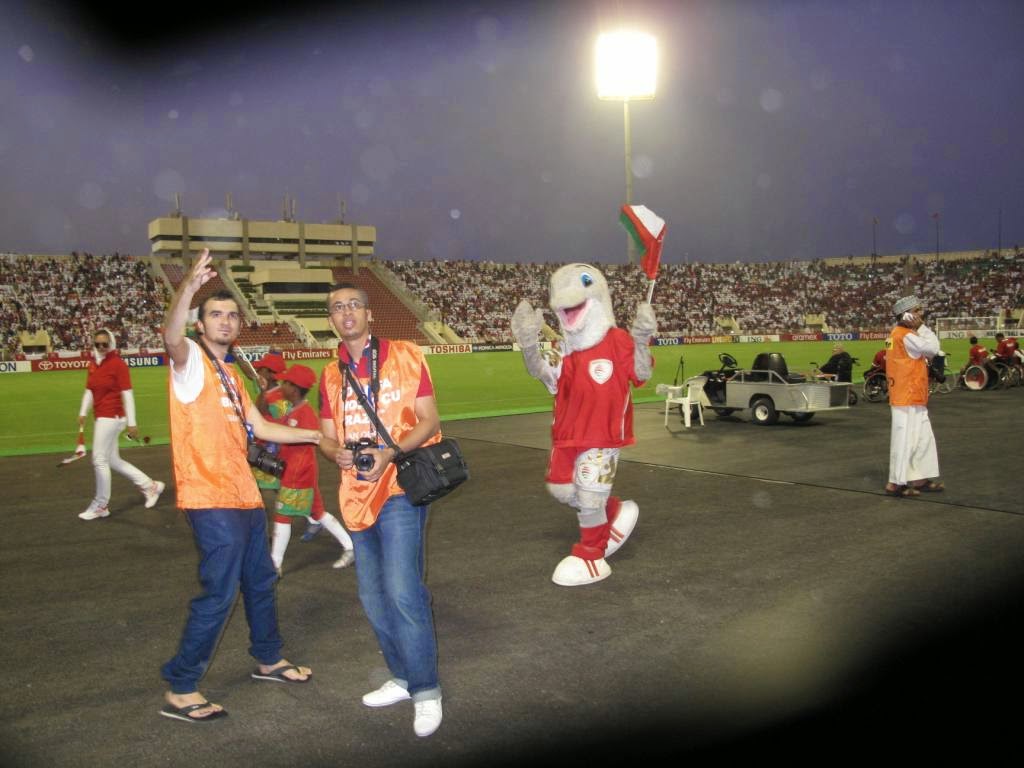
And so it comes to pass that, ten minutes after the kickoff at 17:00 hours, on the 16th of October 2012, I find myself planted squarely on the playing field of a FIFA World Cup qualifier, not twenty feet away from the Omani goalpost, a member of the Press. We are ceremoniously given press vests to put on over our shirts, and warned to return them at the end of the game. Like the players, I feel the weight of 26,500 spectators on my back. I walk up and down the sidelines, the best place to watch this match, with other members of the press, the photographers, the coaches and support staff. 

There is an incessant roaring in my ears, and from my vantage I hear cheers in 5.1 Surround Sound. A goal is missed on the Jordanian side, and, as if immersed in a Dolby universe, I hear the practiced genuflection of a Mexican wave whoosh past me, left to right. The sound a Mexican wave makes is much more impressive than just watching it, I can tell you that. It goes round the stadium two or three times before it dies out.

Putttroo, men!

The match, such as it is, is fraught with injury. Players make their mandatory dives and feints, everyone seems to be inspired by Arjen Robben. The injury cart is regularly trotted up the playing green and prone players are removed from the proceedings for triage and diagnostics. I have decided to become a partisan Oman supporter. Puttroo, men! I shout, several times, but my voice is drowned out in the general hubbub.

the injury cart

Before I know it, it is half time. 
Oman nil, Jordan, nil.
half time

half time

The match resumes, and just when the proceedings threaten to become dreary, at 62 minutes into the game, No 12, Ahmed converts a corner kick. Oman one, Jordan nil. General pandemonium and hot air ensues. The crowds are vocal, but not unruly. At 87 minutes, Darwish of the Omani National Team put in a second one. Congratulations and Celebrations. Much head banging. Someone in the far stand lights fireworks. Smoke billows, an unnerving sight, for a bit. But the beautiful game goes on. At 89 minutes Jordan equalises. Not a peep from the stadium. The silence of the dead, with hovering white shrouds everywhere. The crowd is as partisan as I am.
The moment Darwish of Oman puts the second one in
Oman two, Jordan one.

Soon 90 minutes are over and three minutes of injury time commence. Incredibly, Jordan scores. The referee declares offside. No goal. From every stand a high pitch whistling rises. Screeeeeee! Like a legion of bats has descended into the stadium. In the melee, the last minutes tick by.

Game over. 
Oman two, Jordan one. 
I am happy to report that my newly adopted team, Oman wins. They will go on to play Japan in the next round, and be soundly trounced. Bleddy!

The Omani National Team celebrates on the pitch. The crowds celebrate as they leave the stadium. Roads  fill with cheering supporters. Makeshift musical instruments appear out of nowhere. Some vigorous dancing is punctuated by the ululating tongues. Some of the players themselves join in the dancing with the punters. It is a small country.

While returning to the changing rooms, one of the last players in, Abdul Aziz, I think, gets into serial handshaking mode with the enthusiastic crowd. One thing leads to another, and soon, clutching handfuls reach out to divest him of him team jersey. Off it goes and, in a blink, it is swallowed by the general populace. Poor Aziz has to go and face his team mates, half naked.
 
Aziz dis-vested

And now the hurlyburly’s done, and the battle lost and won. We are able, for few last moments, to walk on the playing field itself.  I cut a lonely figure on the FIFA pitch, take a photo of myself with one hand. All around my feet lie the debris of the match.

After the hurlyburly’s done
Joe and Sanjay

Tuesday, July 1, 2014

Central Time- in conversation with Ranjit Hoskote

Portrait by Nancy Adajania, Utrecht, 2013

Central Time: in conversation with Ranjit Hoskote

In his newest book Central Time (2014) Ranjit Hoskote brings together in its one hundred poems his many, many interests and concerns as a poet, translator and cultural theorist; concerns that persist, as after-images into lines and verses of great beauty. I invited him to talk about his book and its many laminae, sediments and grain, to which he responded with cheerful alacrity. What follows is this e-exchange in which Ranjit, in complete generosity muses, informs and explicates the under-layers that led to Central Time. In some detail, he recreates the 'structural' design of this book, the directions his writing has taken since his first book of poems Zones of Assault (1991), and the influences his own life has had on his writings. In a sense, and I am very grateful for this, our e-conversation culminated in a parallel text that can be read alongside the poems themselves, revealing surprises and giving delight, enriching the experience of reading them.


A bird sits on a branch
of the fury tree:
a bird as big as India.
-‘The Burden of History’

DALVI:
Looking outwards (and inwards) from this bird that is India, I am interested in the ways you project history – is your history performative, taking on the role of curating and archiving, preserving memory, freshening it, or do you use history as a way of contesting the past, providing alternate narratives to the present?

HOSKOTE:
For many people, history becomes crystallized in the form of a collective memory, so naturalized and normalized that it serves them as an absolute guarantee of continuity. They regard it as tradition, as the inheritance of glory and injustice, and, above all, as a talisman of collective identity. In actuality, collective memory is a most malleable substance. It is a system of shifting constructs, contested values and rival narratives that changing elites seek to stabilize through ideological mechanisms from time to time. As a result, history is a not wholly reliable record, in which those elements that are sanctified by a dominant ideology are emphasized, while those it wishes to suppress are eclipsed or buried. And it is these eclipsed or buried elements that often form the most vital strands of history. We must address history critically, if we are to gain a sustaining energy from it.

To be productive, our approach to history must be a symptomatic, archaeological, re-constructive one. To engage with the past is to involve oneself in detective work. We discover the most interesting clues in the shadows and the interstices, which authoritarian histories leave disregarded or have suppressed for their potential to destabilize received wisdom. This is why I do not subscribe to the notion of a single ‘past’. Rather, we are all inheritors of multiple ‘pasts’.

DALVI:
I sense that your poetry does take a stand against history’s possible ‘burdens’. In your embracing its multiple inheritances, as you say, you deny these burdens, you shed its deterministic ballast. Like in your book ‘Confluences’, your poems bring out histories (in the plural), both those that are unseen as well as those seen in new and un-obvious ways.

HOSKOTE:
My poetry draws strongly on these lost, potential or concealed pasts – as elements of selfhood to be retrieved from amnesia; as resources for the production of a new and capacious subjectivity that does not proceed from an imagined, primordial and unified sense of itself, but instead, confidently embraces its heterogeneity, engages with difference, and imagines itself into the future. To address history, we must range through the archive of our inheritances in various states of consciousness: not only the waking consciousness conditioned by the world’s assumptions, but also the states of mind of the dreamer, the quixotic explorer, the pilgrim, the sorcerer’s apprentice, the sleepwalker.

To those who believe that tradition is a static, absolute and unchanging lineage, I would say: Tradition is always a special form of modernity. It is a picture of the past that has been created in and for the present. Let me offer just one example of this, in admittedly schematic and summary form. The foundational 18th-century art historian, Johann Joachim Winckelmann, developed an idealized vision of classical Greece that was intended to celebrate Europe’s genesis in a period of elevated thought and aesthetic expression. In actuality, this was a projection of his own desire for a utopian point of reference to set against the disquietude and ferment of his own time. In imagining classical Greece to be the fountainhead of European civilization, ideologues drawing on Winckelmann’s account have ignored or repressed a variety of cultural and political realities that do not accord with this objective. Classical Greek temples were not pristine white; rather, they were adorned in vivid colours. The Greek alphabet drew heavily on the Phoenician, so-called Semitic, model. And Greek philosophy, far from having come down to modern Europe in an unbroken genealogy, was a gift made to Europe – which was trapped in its Dark Ages – by thinkers from the Islamic world, among them Arabs, Persians, Levantines, North Africans and Andalusians, who had embraced, interpreted, annotated and extended Greek thought. Indeed, as Hobsbawm and Ranger pointed out, tradition is continuously (re-)invented for the purposes of the present.

To me, a far more vibrant model of tradition is that of the gharana. In the spirit of the gharanas of Hindustani classical music, themselves invented as provisional group or lineage identities during the new mobilities and moments of self-assertion of the colonial period, I regard tradition as an experimental continuity, one that proceeds by disrupting itself, improvising and performing itself afresh.

DALVI:
Can you trace a trajectory in your poems from Zones of Assault (1991) to Central Time (2014)? I am interested in the themes and ideas that concern you and the forms you choose to express them.

HOSKOTE:
The question of a trajectory is always important, especially when you are committed to several domains – as of course you know, from your own multiple practices as poet, translator, architect and pedagogue. In Zones of Assault (1991), which brought together poems written in the six years preceding, my concern was to create poems that were sharp, provocative linguistic artefacts; poems that recovered resources from the deep strata of the language, the hard consonantal sound patterns of Anglo-Saxon played across the sumptuous softness of Latinate phrasing. Metal was my ideal. I wanted my poems to come across as weapons, breaking through the crust of expectation.

Between Zones and The Cartographer’s Apprentice (2000) and The Sleepwalker’s Archive (2001), came my Iowa experience. I was visiting fellow and writer in residence at the celebrated International Writing Program at the University of Iowa, Iowa City, in 1995. The roster of IWP alumni reads like a who’s who of world literature, and it is a wonderful tradition to be part of. In our own context, those of Anglophone poetry in India, Dilip Chitre, Adil Jussawalla and Arvind Krishna Mehrotra, among others, are all IWP alumni. I was 26 when I arrived in Iowa City, with two books behind me, Zones of Assault and my translation of Vasant Dahake’s poems, A Terrorist of the Spirit (1992). Living in a community where literary writing was not something to be secured against the world’s demands, but was the everyday activity of practically everyone around you, was a liberating, enriching and enchanted experience. I’ve been on a number of residencies afterwards, and enjoyed them greatly and got a lot of work done there, but Iowa will always remain special. It was my first writing residency; I made friends there, gained enormously from the sense of living and working in a community of writers.

The range of writers who came through, giving talks, lectures or readings, launching books or meeting people in informal colloquies, was amazing: Mark Strand, Jorie Graham, David Lodge, Louise Glück, Mark Doty, Daniel Halpern, to name only a few. Iowa City’s key bookstore, Prairie Lights, was a dazzling platform and meeting place. And I discovered one of my favourite used book stores, Murphy Brookfield, with its erudite and always surprising collection, in Iowa City. And, of course, I assembled, re-drafted and wrote The Sleepwalker’s Archive at 833C Mayflower Hall, on my friend, the diasporic Goan intellectual and Iowa academic Peter Nazareth’s electric typewriter.

Many of the poems in The Cartographer’s Apprentice and The Sleepwalker’s Archive were impelled by questions of refining a voice while improvising among voices, of speaking through masks while also unmasking the speaking subject who segues through a sequence of personae and mirrors. By 2003, when I took several bagsful of drafts, fragments and notes to Munich and settled into the Villa Waldberta on the idyllic shores of the Starnberger See for a three-month residency, these preoccupations had taken definite shape. I reconfigured or wrote all of the new poems in Vanishing Acts: New & Selected Poems, 1985-2005 (2006) at Waldberta. Vanishing Acts also allowed me to deepen my concern with travel, displacement and nomadism, and their relationship with improvised forms of belonging.

In these new poems, I continued to work with ways of being the speaking and experiencing subject in a variety of situations, whether historical predicaments or everyday dilemmas of place and direction. Childhood experiences have formed a pattern within the trajectory through these four books, with the variations of proximity and distance, intimacy and reflective poise, that they offer: being taken to a barber’s for the first time and watching your hair being cut and fall to the floor; reaching out to hold a moth and having it turn into struggling powder in your hands; watching the high, circling flight of birds on thermals. Another pattern has been, of course, my consistent fascination with the inexhaustible power of the visual arts to engage the viewerly imagination. Velasquez, Goya, Magritte, Francis Bacon, Ram Kumar, Mehlli Gobhai, Vivan Sundaram, Raja Deen Dayal, and many other artists have been constant fellow pilgrims on the path.

An intermezzo, at this point-
to this list of books, I would add Pale Ancestors (2008), an artist book on which I collaborated with Atul Dodiya. It took the form of a dialogue between 48 of his watercolours and 48 of my texts. These texts spanned the gamut from poem to prose poem and micro-fiction. A selection of recast, rewired or sometimes substantially reworked pieces from this book has been integrated into ‘The Institute of Silence’, which is the last section of Central Time.

In Jatayu's Forest II, by Atul Dodiya, 2007
Central Time (2014) brings together poems written between 2006 and 2014. In fact, some of the poems in this volume have been in process for as long as 20 years. ‘The Poet in Exile’ is an example. I was helping my parents with some spring cleaning earlier this year, and found, among a mass of papers, a notebook of mine from 1992, in which I found an early avatar of this poem, complete in itself. The poem has travelled with me over two decades, in electronic form, and I have returned to it constantly over this period. Although the file carries the date of the first version, I had not consciously noted the fact that it had been with me for such a long time.

Forests die quietly as the pages catch fire.
The flames play across my chalky walls
and river mist kills my windows.
I wake up wearing a halo of leaves:

my own laureate, my own hangman.
-‘The Poet in Exile’

‘The Poet in Exile’ brings together a cluster of themes that have exercised me greatly. Here, you will find my three key figures, Ovid, Ghalib and Bhartrihari: poetry and power, the poet and the court, centre and periphery, belonging and exile, posterity and extinction, sensuality and renunciation.

As you see, the inner temporality of my writing is not linear, since I range back and forth over drafts, fragments and notes made over three decades – these are my log books, if you will. I also cross over between my various textual practices, or translate material from one form of text to another. For instance, the prose poem, ‘The Last Annal of Alamgir’, as it appears in Vanishing Acts, has gone through several avatars, beginning as a fiction text presented during a workshop with Clark Blaise and Bharati Mukherjee in early 1994 and developed into a prose poem, first published in The Cartographer’s Apprentice (2000), then reworked back into fiction and published in Penguin’s anthology, First Proof #1, in 2005. Eventually, the precipitate of these various acts of tinkering appeared, in a text that shares the qualities of both prose poem and fiction piece, in Vanishing Acts (2006). It was subsequently recrafted for theatrical presentation as a dramatic monologue, directed by Avaan Patel of Stage Two with Tom Alter playing Alamgir (Y B Chavan Centre, Prithvi Theatre and other venues, 2009).

'Forked' by Anju Dodiya, 2006
‘Couple’ is, almost verbatim, a passage from a catalogue essay that I wrote for an exhibition of Anju Dodiya’s paintings at Bose Pacia, New York. That text, in any case, tended deliberately in the direction of literary rather than art-critical tonality, with a ghazal by Ghalib revealing itself line by line in each section of the essay. Some parts of it, such as this passage, were crafted with the cadence of verse. I enjoy the transitions that happen, whether in everyday speech or in literary production, from regular speech through recitative to music.

DALVI:
Perhaps you could talk of your engagement with Ghalib. He makes two appearances in Central Time. You have also written a poem about him ‘Ghalib in the Winter of the Great Revolt’, which is included in Vanishing Acts. You have translated a ghazal from his Diwan in your current book. 

The doors and windows of my shaky house,
says Ghalib, have broken into green tendrils.
Why should I complain,
he draws his shawl closer in the rain,
when spring has visited my house?
- ‘Monsoon Evening, Horniman Circle’

HOSKOTE:
Yes, Ghalib recurs in Central Time, in various guises. As you point out, ‘Monsoon Evening, Horniman Circle’, includes a free translation of a single-couplet ghazal of Ghalib’s:

ug rahaa hai dar-o deevaar se sabzah Ghalib
ham bayaabaan mein hain aur ghar mein bahaar aayi hai

(Green tendrils are sprouting from the doors and walls.
I’m wandering in the wilderness and spring has visited my house.)

The book also includes ‘Night Runner’, which is a translation of the Ghalib ghazal that opens with the couplet:

har qadam doori manzil hai numaayaan mujh se
meri raftar se bhage hai bayaabaan mujh se

Ghalib has long been a very special and important presence for me. I was born in 1969, which marked the centennial of Ghalib’s passing. My mother has always admired Ghalib’s poetry – she studied Shakespeare and Keats formally with Armando Menezes and V N Gokak in the mid-1950s, and read Ghalib by herself – and my father presented her with a number of publications that had appeared during the centennial. From these, she would read to me, as I was growing up.

Growing up, and as I grew more specifically interested in the late Mughal period and the colonial encounter, I found Ghalib a most intriguing and enigmatic figure – poet and courtier, survivor and negotiator, a man nearly executed for his proximity to Bahadur Shah Zafar’s regime during the 1857 Uprising and providentially rescued, a man who then petitioned the British ascendancy and wrote a panegyric celebrating British rule, a poet renowned for his path breaking Urdu poetry, which he personally felt was inferior to his own poems in Persian. For me, Ghalib incarnates the poet in turbulent times, the artist as citizen, confronting the complete range of existential difficulties and defining himself against crises of often epic proportions. A heroic figure, he was fully aware of and attentive to the importance of his contribution, but also capable of self-irony and self-deprecation, and never unaware of the fundamental precariousness of his situation.

DALVI:
You use several forms in your poetry, the Nazm being one, where your lines form distinct couplets. How attuned are you to the musicality of the words as spoken, to rhythms that inhere within them? 

HOSKOTE:
The nazm al-jawahir is a form I am greatly attracted to, the ‘garland of pearls’ that is a legacy of ancient Arabic poetry. It allows for the creation of poetic meaning in multiple ways, with each segment of the poem being complete in itself, while sparking off resonances and assonances with every other segment. It can be read as a sequence, or in parts, and indeed, offers the reader an active role in the production of poetic meaning.

In the context of cadence and musicality, I should perhaps talk about my interest in certain kinds of musical practices, for instance, those of Jan Garbarek and Steve Reich. I am thinking, for instance, of the wind harp and saxophone conversation in Garbarek’s Dis (1976) and the electrifying transitions from wind to cymbals to piano in his I Took Up the Runes (1990). Likewise, I have been endlessly fascinated by the kinetic textures and tempi of Reich’s Music for 18 Musicians (1974-1976), its circling and gathering of sections into wholes and the reverse, the manner in which its pulse structure is based on how long the human breath can carry a tone, whether in voice or clarinet, and how this temporality is brought into a pattern of dynamic adjacency with the insistences of the metallophone, xylophone and marimba, to generate a richly gamelan-like complexity and cascade of music.

In this context, I find extremely interesting, also, Brian Eno’s richly suggestive ideas on ambient music, how everyday acoustic realities come into states of interplay with more formally structured suites of sound, such as music, and his location of ambient music at the ‘cusp between melody and texture’. As ways of structuring time-as-experience and speaking to a plurality of senses and shapes of voice, cadence, melody and utterance, these are compelling models for me.

DALVI:
Is there a scheme, a construct to the organization of the various sections of Central Time? How can a poet write with allusions, as you so profusely do, and still maintain a level of accessibility with the reader?

HOSKOTE:
I had decided, early in the process of preparing this book that it would have a hundred poems. I intended this as an act of homage to the tradition of the centum, or the sataka. Bhartrihari, the great Sanskrit poet with whom we associate the Niti-sataka, the Sringara-sataka and the Vairagya-sataka – and whose work I have been translating for a number of years – was a presence. I was also thinking, in terms of scale, of another favourite collection to which I often return: Kenneth Rexroth’s translation of classical Chinese poetry, One Hundred Poems from the Chinese.

The architecture of Central Time is that of a cycle in five phases or sections. Each phase or section has twenty poems, and articulates the mindspace of a particular character, temperament, or season of the spirit. Of course, my process of preparation relied as much on an intuitive formation of links among poems, as on principles of structural design. As I completed work on the book – and this was triggered off by a re-reading of the philosopher Gaston Bachelard – I thought I could detect the presence, in each section, of a dominant element, or combination of elements, which made compelling sense, although retrospectively.

Section 1, ‘Zoetrope’, seems to unfold in the mind of a man with a magic lantern. He twirls his magic lantern every time he wants a fresh relay of images. Many of them have to do with buildings, bridges, houses, cathedrals, plans, earthworks. Earth, with air, is the prevailing element.

Section 2, ‘The Pilot’s Almanac’, is the record of a pilot struggling to keep his calendar in order even as archetypal patterns impose themselves on history, while forward speed is resisted by the drag of memory. Weather and terror explode with equal force. Ether, with water, is a dominant presence.

Section 3, ‘Gravity Leaps to the Eye’, is conveyed in the voice of narrators who struggle between nomadism and place, momentum and gravity. Questions of location, orientation and selfhood operate here. Sight, location, illusion, mirage, occasions missed and potential, self and proxy, inhabit these poems. Air, with earth, is the ruling element.

Section 4, ‘The Existence Certificate’, is a catalogue of feints, sleights, exits, entries, passages between histories and fictions. It explores the museum of discarded identities and superseded affiliations; revisits childhood, intimate memory, and the landscapes of ruin and retrieval. Its key figures are the stranger, the navigator, the secret agent. Fire predominates here, with strong inflections of air, water, earth and ether.

Section 5, ‘The Institute of Silence’, sets up a log of strange and melancholy journeys, cognitions of direction and re-cognitions of self, mappings of relationships to inherited exemplars like the hunter or the saint, engagements with visceral experiences like sleep, diving, swimming, the fear of diving, the incendiary nature of the contemporary. Water, with ether, predominates.

The book acts as a turning kaleidoscope, in effect, with the elements, voices, narratives, constantly achieving new re-alignments. The trope of the kaleidoscope that is always being pieced together from its fragments, of history as narratives that have to be bricolaged together – always with a surplus, an excess, an infinitesimal or maximal quantum of additional/ contextual energy – holds great significance for me. Hence the epigraph to Central Time, which comes from the writings of the brilliant sociologist Richard Sennett:

“The skilled restorer of porcelain will collect not only the visible chips of a broken pot but also the dust on the table where it rested...”

The title of the book, Central Time, has been with me since 1995. It refers, at one level, of course, to Central Standard Time, the time zone in the Midwest, the measure that defines time in Iowa, where I discovered how one could most forthrightly and productively be a poet leading a literary life among poets. Metaphorically, I associate it with a felicitous situation secured, however momentarily, through and against an experience of continuous mobility, displacement, marginalization.

Increasingly, I tend to think that space and spatiality will always be mediated through conflict and inscribed by multiple claims, so that our occupancy of them will always be contested. By contrast, time and temporality retain the potential for privacy, secrecy, security, as though their very disembodiment and elusiveness allow them to offer us a sanctuary inside which we might be inviolate and unclaimable.

The title also makes oblique reference to the notion of a ‘central poetry’ that Wallace Stevens proposes in his 1948 essay, ‘Effects of Analogy’. Stevens discusses the difference between a deliberately “marginal, subliminal” poetry based on a poet’s belief in “the imagination as a power within him not so much to destroy reality at will as to put it to his own uses” and a “central poetry” anchored in a poet’s conviction that the imagination is “a power within him to have such insights into reality as will make it possible for him to be sufficient as a poet in the very centre of consciousness.” I am attracted to this latter proposition, which is both a challenging provocation and a stimulation to renewed poetic exploration, even as we accept, as Stevens does in his meditation on a bowl of carnations, ‘The Poems of Our Climate’, that
There would still remain the never-resting mind,
So that one would want to escape, come back
To what had been so long composed.
The imperfect is our paradise.


DALVI:
Your encounters with various objects and cultures as a theorist do make their way into your poems that then are expressed with a unique phenomenology, quite your own, that stays on the edge of the world as we know it, but glances at the other side, without tipping over. That is why I love to read your poems, you write about things outside of you, but they aren’t really outside, are they? Like the gargoyle at Notre Dame, you are ‘stapled to the view’, unable to flap your webbed forelimbs and escape your perch.

HOSKOTE:
Very true, I am indeed ‘stapled to the view’. Nothing is outside of us, and we are outside of nothing. We make things our own by reaching out to them with our minds and senses, and we create our own sense of the world through these acts of improvisation with varied itineraries and appropriations. We make the world’s predicaments our own. Here, I would draw strongly on the Yogachara Buddhist teaching of chitta-matra, ‘mind-only’, which is sometimes mistaken for a ‘mentalist’ or solipsist position. The Yogacharins acknowledge explicitly that we know all that we know, and experience whatever we experience, because we receive, process and respond to the world through the mind.

To the Yogacharin, the mind must be clarified of its discontents and delusions, if we are to most clearly and gracefully be present in the world and overcome its conditions and conditioning. We must analyze and empty out the alaya-vijnana, the great storehouse of sensations, thoughts, reflections, reflexes, syndromes and psychic habits that lies beneath our waking consciousness. As a poet, I accept this model of the consciousness but would happily hold on to the alaya-vijnana, to see what patterns emerge from it, and how these may be crafted into expression.


He will cross the bridge of the seasons alone,
laughing, sobbing, constant at his post,
too strong for the pilgrim chain-gangs
that strain and push to get past him:

stone wings folded, last angel, he's stapled to the view.
- Gargoyle, Notre Dame

About the precise choice of word here, ‘stapled’, I’ve changed the verb in this line several times during the last many years, before fastening on it. This word suits me best here because, first, it mudges the entire moment of the poem towards a memory mediated through photographs or archival pages. Secondly, I find a vivid visual analogy mixed with paradox when I compare the gargoyle’s wings and the brace of a stapler, the way these bifid objects cleave together and away, effecting in one case, potentially, connection, and in the other case, potentially, flight. And thirdly and in some ways most persuasively – I am obsessed to a degree with etymology – the Old Norse origins of the word ‘staple’ relate it to ‘stopull’, meaning ‘column’ or ‘pillar’, which sets up a mysterious connection between this verb and the Gothic architectural context of the poem. I am sure that, as an architect and architectural historian, you will warm to this last line of reasoning!


DALVI:
The Sennett quote you invoked earlier that leads off your poems brings to mind the Japanese art of kintsukuroi, of repairing broken porcelain with powdered gold embedding the object with its own history- an affirmation that at once shows both strength and the fragility of existence. How fragile, do you think, is our time in this world, and how central is it to us?

HOSKOTE:
It is amazing and telepathic that you should have thought of kintsugi in the context of the passage from Richard Sennett’s Together: The Rituals, Pleasures and Politics of Cooperation that I have taken as the epigraph to Central Time. I have long been fascinated by the concept of shibui, and by the Heian-period aesthetic of mono no aware, an elegiac awareness of the transience of things coupled with a desire to acknowledge what has lived, breathed, accomplished a measure of expression. I find greatly compelling, also, the related concept of wabi sabi. It gestures towards the illuminating potentiality of the world’s dynamic asymmetries, as for instance through the perceived mutually balancing imbalance between the shine of newness and the lustre of patina, the tender freshness of a shoot and the withered toughness of bark, the smooth rim of one bowl and the chipped rim of its twin. As a cultural and aesthetic ideal, wabi sabi invites us to meditate on the transience of the world, the transitoriness of our own existence, and on the cyclical successions of mood, season and phase of existence through which time progresses, while our lives are shaped within it.

My first introduction to these ideas was visceral, through practice, as a child. My mother studied ikebana in the early 1960s with a visiting Japanese artist couple who spent some years in Bombay. The Akinos had rented a studio residence in Kalanagar from the artist Cumi Dallas; they had come to India in the wake of Akino-san’s mother, the celebrated and even revolutionary Japanese artist Fuku Akino, who was visiting professor at Santiniketan at the time. My mother continued to practice this art, for which the English term ‘flower arrangement’ is sadly reductive, for many years. Watching her at work, and receiving instruction from her in it, was an integral part of my childhood, through the 1970s. Ikebana, like most of Japan’s traditional arts of peace and war, profoundly embodies the principles of shibui and wabi sabi, at the heart of which resides the presence of beauty in decline, decay or decadence, and the experience of regarding and recording evanescence.

Our time in this world is, I think, an invitation to create value and embed it back in the ethos that sustained us, where it might perhaps come in handy for others – as pleasure, as instruction, as institution, as epiphany, as folly. I would home in on another splendidly evocative phrase of Sennett’s. In The Craftsman, he writes of the “embrace of the incomplete”, which is crucial to the work of the artist-artisan, and is profoundly available in a haptic as well as conceptual way to those who work directly with their hands in contact with their materials – pen and paper, clay, wood, stone, or musical instrument – and less available to those poring over blueprints, even less so to those whose work is eased yet paradoxically diminished by a reliance on computer-aided design. It is this full-bodied ‘embrace of the incomplete’, with its surprises, disappointments, hits, misses and discoveries that – I suspect – we are invited to undertake when we approach the world and record that encounter in art.


(interview with Mustansir Dalvi, June 2014)
© Mustansir Dalvi, 2014, all rights reserved.

Sunday, June 29, 2014

Time Out Mumbai - Unforgiving City

This piece was published in an edited version in 
Time Out Mumbai, June 20- July 3, 2014, Volume 10, Issue 22


Unforgiving City

Just how far can you go on forgiving the foibles of our city?

In these pages and elsewhere I have defended Mumbai’s dirt, its density, its congestion, its dearth of open spaces, its overcrowding as natural to the processes of the city. I have extolled the virtues of living together messily in those everyday acts that contribute to its vibrancy and richness. But sometimes you come across a sight that makes you feel that your own leniency makes you an accomplice to something inexcusable.

In the back of a fast moving cab, moving from Metro to Flora Fountain, trundling in the left lane of Mahatma Gandhi Road that is filled with competing four wheelers, I see a decrepit old man laboriously pushing a wheelchair with a frail and visibly ill woman. Life does not seem to have been kind to either of them, and, they are very obviously trying to make their way to Bombay Hospital. The man is negotiating the wheelchair with care, right in the line of oncoming traffic that is not accommodating of his presence in a vehicular lane. He and his charge have no business being there.

I wonder too. But, as I pass them and move ahead it is woefully obvious that the footpath where M G Road turns to meet Mahapalika Marg is simply unfit for anyone to safely push a wheelchair. Walking, even able bodied, is something of a steeplechase. There is encroachment and debris, with little space for pedestrians; trees, hawkers and porta-cabins all grow out of jagged and dangerously irregular paver blocks. There is no length of pavement that is level and true. What else could the old gent do, but to throw caution to the winds, risking not one life but two in the maelstrom of rush hour?

This is too much, even for me. What kind of a city is so unaccommodating that even the infirm and the unwell cannot make their way across it? It is an unfeeling and hostile environment that we have become benumbed to inhabit. I’d like to think that the good city is one we can take for granted. My assumption hardly holds when the pedestrian ways of our city are out of bounds for pedestrians. My gripe is not only about the specially-abled, but for anyone, unfettered by any means of transportation, completely vanilla, on their feet being pushed to the very periphery of presence. 

It is all right, I can argue, that Mumbai really has no open spaces in the European mould, no street-side cafes, no buskers, no flower stalls and souvenir stores, no bespoke urban furniture, no streetlights that geo-position you just by their unique design, no useful signage- our piazzas are our streets. Always have been. We live out our lives measured in walking distances, and latching on to the most meagre of landmarks- shop signs, building corners, even compound walls. As Sahir Ludhiyanvi once wrote: ‘Jitni bhi bildingein thi, sethon ne baant li hai/ Footpath Bambai ke, hai aashiyaan hamaara’. The footpaths belong to us. 

When even this is denied, everyone, panhandler, commuter or flaneur are all exiled from the legitimate city, and are compensated with skywalks built to stop jaywalking, at such heights that trucks carrying idols during the festival season can conveniently drive under. Jaywalking, like jugaad is illegal, but fills the vacuum created by the oversight of the state. The old man and the lady were reduced to doing exactly that by the uncaring nonchalance of those holding municipal responsibility. It occurs to me that, if a mishap should, heaven forbid, happen and either of these two get injured or worse, it is they themselves who would be held accountable and at fault for trying to occupy the vehicular road. 

We are losing those streets that traditionally had very little or slow moving traffic that were once populated by the walking public, doing this and that, other than merely making their way from A to B. Streets, where the pace of life was slower, where one could meet, chat, eat, buy, haggle, curse and move along. Nakhoda Mohalla at one end of Mohammed Ali Road once was a street full of fabric sellers where chiffons and chikan were sold with equal felicity. That was completely ruined with the flyover that swept past one edge. Now Mutton Street, the road that transmogrifies weekly into Chor Bazaar is now on its last legs.

Mumbai is probably the only aspiring world city that does not have a single officially designated pedestrian street. What does this say about its inhabitants and those elected to run it? They seem to have, like Pilate washed their hands and sealed the fate of pedestrians, those pesky critters that move in the manner of the pack donkey. Cars, fortunately for them, are not linearly challenged and predictable in their movements. Just the thought of the pedestrian being considered collateral in the larger fortunes of the city, is distressing, to say the least. 

And as for soft spoken me, I feel just like Howard Beale in Network, who pulls his hair out in great tufts and screams : 'I'm as mad as hell, and I'm not going to take this anymore!' 

Sunday, May 11, 2014

Time Out Mumbai- 2 pieces on Cluster Development


This piece was (in a slightly edited form) published in Time Out Mumbai, Vol. 10, Issue 19, May 2014.


Cluster Bluster

Now that the votes (and the die) for the next government are cast, it does seem that Bombay’s fortunes are nowhere in anyone’s political priorities. In the run up to Election Day, though, there seemed to be one area of emerging consensus. All the candidates (who matter) from the South Mumbai constituency agreed that 'Cluster Development' in the city is the way forward. The only answer.

The biggest problem with our old city, according to them, is its rapidly deteriorating stock of buildings collectively called 'cessed'. These century old piles are filled to the brim with nonchalant tenants paying ‘controlled’ rents and hapless landlords with too few resources for maintenance. As a result these buildings are now decrepit, have common toilets, and are in imminent danger of collapse every monsoon. They are also densely packed together and there is no greenery anywhere.

The panacea for this sorry state is, of course, Cluster Development (aka DC rule 33/9). The argument in its favour is that developing a largish tract of land is less piecemeal, more systematic, and can be 'community driven'. A 40,000 square footprint today can contain several buildings in the inner city. Bringing them down to tabula rasa allows the redevelopment phoenix to soar, up to four times the plot area. These Elysian Fields would provide every stakeholder with a proper (300 sft) unit with toilets inside, lifts, and open spaces around buildings, with trees and lawns. Above all, the rented tag gets converted to ownership, the ultimate wish of every Mumbaikar grihasta. Could anything be better? Two projects at Bhendi Bazaar and Lower Parel are already under construction, so there is precedent too.

Let me be contrarian here. Leave aside the near cliché that such developments only benefit builders and speculators. In making my case against cluster development, I appeal to your urban and civic sensibilities.

Buildings in ‘clusters’ are equally piecemeal, only now the piece is larger. Here, entire neighbourhoods in the dense inner city will potentially be opened out to new vistas of rising skylines, infiltrated by built forms and open spaces that did not previously exist. This is the urban equivalent of pulling out teeth and replacing them with nails instead of dentures.

Our neighbourhoods- Chira and Bhendi Bazaar, Parel and Kalbadevi, Lalbaug and Dongri, all have a scale and uniformity that make up the urban whole. Congestion is the essential urbanity and civic make-up of the inner city. Shop lines open on footpaths, buildings touch buildings familiarly, balconies overlook streets and roofs match up in straight lines, making comprehensible perspectives. And there are people everywhere. Corners are special and built differently, giving identity and helping way-finding.

None of this is sustained in setting back buildings from the street, bounding them in the nutshell of compound walls, CCTV and uniformed security surveillance. Essentially, this large bite is no longer the city that was, only a regurgitated, unfamiliar, aspiration-fulfilling bolus.

Almost all of Bombay's residential neighbourhoods once spoke a ground plus three floors lingo. The city grew through iteration and accretion, just like Bambaiya-speak. Over the years street culture evolved to raising one floor. This happened everywhere, you may live in one such building. Now, imagine a building across your street looming forty floors above you, cutting off sunlight, subjecting you to a wall of heat radiating from air-conditioning units opposite. Such is the price of caprice the older residents of Mutton Street will face in year or two.

Should buildings in bad shape not be repaired? Well, of course they should, but by respecting building lines first. A contemporary, well appointed, state of the art redesign that retains the previous footprint and matches the height and floor-lines of its neighbours on either side is completely possible. Courtesy demands that buildings be re-imagined in their original context, one by one. With broad agreement, every new building may rise by one floor or two, and still retain the harmony of the street. Congestion will remain, but not further densification. Most of Mumbai’s housing requirement can be fulfilled if each residential building is raised one floor. You do the math.

My one disagreement with the cluster model should concern whoever wins the South Mumbai Lok Sabha seat. 33/9 will result in instant gentrification. Either overtly, or through subtle nudge-nudge wink-wink, the older residents will realise they no longer have a place in this new dispensation. Neighbours will be replaced by strangers, humsayas will be lost, local small shops will become untenable, business networks and societal ties, the result of decades of co-existence will dissolve. Ultimately diversity will decrease substantially making the new neighbourhood a confine of homogeneity served in no full measure by 'outsiders'.

This is counter-intuitive, but I do believe that the much derided Rent Control Act helped preserve a social equity amongst the residents of Bombay across half a century. A fixed low rent allowed the very poor to live in the same building with the very rich, and certainly occupy the public realm, the streets outside as equals. With tenancy morphing into ownership this will no longer be the same- as the city you once called Bambai Nagariya gets slowly transformed, the aam aadmi voter in your constituency could well be endangered by the next elections.


The following piece was (in a slightly edited form) commissioned by Time Out Mumbai for their special issue on Bhendi Bazaar, Vol. 9, Issue 12, February 2013.


Splendid Isolation
What Cluster Redevelopment will mean for the city

“Mohalla maa jayaaoon choo!”
Ever since I remember, this is commonly heard in many households. I am going to the Mohalla. The Mohalla is the Bhendi Bazaar. This throbbing heart of Bohra culture in Mumbai is the place to congregate, socialize, conduct small business, pass time, and gorge on pyalis of street side ‘chana-bateta’- a savory of chickpeas and potatoes that could also be ‘packed-up’ for the kids. The Mohalla is for ziyarat, for offering prayers at the Raudat Tahera, the mausoleum where the present Syedena’s father is laid to rest. And of course, if it is Jumma, it must be Chor Bazaar, the Friday-only market on the adjacent Mutton Street, where one can be equal parts flaneur and haggleur.

Urban culture in Mumbai is very real. It is also intangible, and thrives on two assumptions- first, that an urban place in the city can be taken for granted; and second, to paraphrase Robert Frost, when you have to go there, they have to take you in. It is anchored around a very few (and, on occasion, nondescript) physical markers: a left turn here, a shop sign there, a street vendor at the corner. Urban culture is thus, also very fragile. This is true for Bhendi Bazaar, and also for Chira Bazaar, Saat Rasta, Sewri, Parel, or any of the nine or so locations in the city where Cluster Redevelopment is scheduled to happen.

In a city that has replaced planning with speculation and public administration with outsourced anonymity, it is little wonder that the future heart of Mumbai can only be envisioned as a glorious Hausmann-like phoenix, rising out of a tabula rasa. Cluster Redevelopment, based on Clause 33.9 of the Development Control Rules, is the way the state government sees urban renewal in locations populated largely by cessed buildings or historically rented properties. Accepting the premise that the state itself cannot redevelop, the rule allows for private developers to rehabilitate existing users in the same location with some more areas and amenities and offers the developer a substantial pound of flesh for profiteering. While basic humanitarian gestures of temporary re-housing for those existing is built-in, the grand vision is the builder’s entirely, and very naturally based on the attractiveness of the project to potential buyers at full market price.

This vision disregards the intangible, but very real patterns of urban life. Mumbai is Mumbai because the rich and the poor have always lived as humsaya, with homes facing the same street; because the diversity of economic class and religious affiliation has meant nothing, especially in the densest neighbourhoods; because although there are ghettos, especially in the inner city, there are no walled exclusions; because the desire to come together to create an urban place is the result of social accretion over years, very real, even if you can’t put a finger on it. Mumbai is Mumbai not only because of urban homogeneity, but because of social diversity. To presume this the other way round, like cluster redevelopment projects seem to do, is to deny and choke the very spirit of the city.

Look at the New Bhendi Bazaar, this is what we see: a private future built on sixteen acres of south Bombay, imagined by the wealthiest of a Mumbai sub-community in its own image. We see pristine, ‘homes of rest and quiet’, secluded from the rest of the dirty city, your city, by walls or buildings that function as walls. Access into these redesigned acres will now be through gateways that never existed before. We see skyscrapers rising sixty stories abutting the same narrow street on which older four storey structures still exist. We see several buildings demolished to make way for a large park with unobstructed frontage around the Raudat Tahera.

Where did the Mohalla go? Can the same social fabric that held together for a century remain in this upmarket utopia? Can small businesses thrive without their former durable networks? Will Chor Bazaar retain any identity, when one edge of Mutton Street transforms into a barricade?

Cluster redevelopments as private real-estate speculations only take away from the city, both physically and spiritually disentangled from the larger reality of metropolitan Mumbai. While they load fresh urban burdens onto its infrastructure, they deign to exist in splendid isolation, in a rarefied haven of Eloi, while Morlocks outside toil in its grime.

Who speaks for Mumbai in these new projects? We accept the rights of the individual as supreme in our capitalist present. No one denies that better housing, amenities and facilities should be paramount for all. But should we, at the same time, not define responsibilities the same individual has towards the city at large? No quid pro quo?

Woh intezaar tha jiska yeh woh s(h)eher to nahin.


Tuesday, March 25, 2014

Time Out Mumbai- Travel Lite


This piece was published in an edited version in 
Time Out Mumbai, March 14-27 2014, Volume 10, Issue 15

Travel Lite
Those in academic circles probably know this already, but Mumbai has been the international flavor of for quite a few years now. This is especially true for students of architecture and urban design. Each time the monsoon bids Mumbai farewell and her sodden soul slowly dries, cohorts from universities, unknown and ivy-league, travel to her shores for field visits, just like flamingos at Sewri.

After parking themselves in one of the many establishments on or off Colaba Causeway, high-seating Volvo buses are procured and from such rarefied and elevated environments the city is absorbed. Driving down from the Gateway of India (referred to by some as India Gate) to the boondocks of Navi Mumbai, depending on the theme of the semester, the colonial SoBo, the dense inner-city areas of Kalbadevi, Bhuleshwar, the ‘panjra-pol’, the Dhobhi Ghat, the City Improvement Trust precincts of Dadar-Matunga, the former mill and current mall lands, the eastern docklands, the fast-disappearing mangroves and salt pans and ‘slums’ of every stripe are mandatorily observed. Local trains (in non-rush hours) are given custom, the monorail admired, and various skywalks crossed. Getting serious, development plans are procured, Google Maps pored over, terrabytes of jpegs clicked, local colleges of architecture visited and a few brains picked- all this in about three days or so. Oh, of course, Dharavi-darshan happens and 'Kumbharwada' becomes part of international vocabulary. It joins words like 'jugaad', which have already been learnt in advance.

There is quite an abyss between the literature available and the city's reality. In the spirit of academia, much previous reading is prescribed. Suketu Mehta, David Gregory Roberts, Katherine Boo, Dwivedi and Mehrotra, among others form the canon. ‘Slumdog Millionaire’ becomes the visual point of reference. This is pretty obvious when you encounter un-nuanced positions about slums or the role of real estate; cluster housing is fait accompli- a shining pointer to end all woes, after all it is community driven, no? Speculative theories coalesce into New Urbanism projects, learnings from weekend immersions and catch-as-catch-can ethnography informs the iterations of computer extrusions, where high rise developments (the only answer) are clothed with a garb of Bollywood culture.

What does our city offer that attracts so many to it? To be charitable, Mumbai does provide the foreign observer with several contradictions, to paraphrase Whitman, being large and containing multitudes. It is some surprise that trains run on time, but garbage remains uncollected. One family lives in a 2 billion dollar, 20 storied skyscraper residence, while more than half of the city lives in self-built postage stamp housing. The rule of law is indexical of our democracy, but common law applies everywhere. Everyone here walks and talks English, but as a phunny Indian language. However, despite these polarities, true to our common ethos, what you cannot see is vital to understanding and appreciation, but intangibles are often subsumed in the morass of visual documentation. This can lead to some ‘face-palm’ results. Some American students of architecture found the sights and smells of one corner of one street in the city so overwhelming that it became a metonymy for the city as a whole, and resulted in the design of skyscrapers made out of ‘kachra’. 

Nothing interests student practitioners of architecture and urban design and their mentor institutes more than change. The objective is always to make a city ‘more livable’. This is predicated on the understanding of a city as it is as ‘less livable’. Sociology rather than technology is currently the driving force behind change, and alternatives derived to conceptualize ‘better cities’ are the results of surveys and sampling, even if the sample set is a few persons doing muttergashti at street corners, or a paanwallah, say, or a local SIM shop. There is an urgent need to put it all down on paper and soon conceptual charts, three dimensional street views, stitched photo-collages and before/after layouts are all put together and displayed. 

By now, there is entire machinery in place here in the city to receive these visitors and cater to their needs, spaces for work and presentations, large panels for pinning up their work and seminar spaces for discussion, even for the conduct of international conferences. The usual suspects of invited city experts are rounded up from time to time to take on these fights of urban regeneration fantasies, and to give anecdotal and insightful comments and ‘crits’ about the nature of change in Mumbai, which are eagerly lapped up by these wide eyed, travel-lite acolytes. I should know, on occasion I have been one of them.


Thursday, February 27, 2014

struggles with imagined gods

struggles with imagined gods
by 
Hemant Divate
translated from the Marathi by
Mustansir Dalvi

Published by Poetrywala
An imprint of Paperwall Media & Publishing Pvt. Ltd.
2014
ISBN 978-93-82749-07-3
Price: Rs.200
Available at Kitab Khana, Mumbai and on amazon.in

'struggles with imagined gods' in the press and media:
(click on titles)

Kanika Sharma discusses 'struggles' and Hemant Divate in Mid-day
A Different Kind of Poet

A short review in 
The Caravan: a journal of politics and culture
'What happened to the language' and other poems.

Sampurna Chattarji reviews'struggles' in Woodsmoke
Free Agent in a Land of Devastation

Eunice de Souza discusses 'struggles' in Mumbai Mirror
Some Literary Puzzles


Mustansir Dalvi
On translating Hemant Divate's Poetry
in Poetry at Sangam

‘Hemant Divate writes of his world, of his everyday embedded-ment in it. A prisoner of his own reality, he is aware of his incarceration,’ notes poet-translator Mustansir Dalvi in a specially commissioned translator’s note; we carry extracts from Divate’s recent book Struggles with Imagined Gods. Divate is publisher of the often audacious imprint Poetrywala; his struggle against sentimental poetics and the shallowness of the post-globalized world is keen. Languages wear duplicities, delicacies and skins of time that reflect their philosophical strengths, street tenor and chaotic co-opted multilingual urgencies. Hemant Divate takes this between his teeth, ‘Poets have stopped/ writing in their own language/ and have, instead, begun/ grinding it down into finer and finer grain.// … languages change completely/ every twelve years./ Which means, after thirty-six years/ no language can remain our own.’

Dalvi’s translations are almost combative to contain the patois employed by this gritty poet. We sense his intelligence scanning possibilities before homing in. He writes, ‘[Divate] writes as he speaks, as is the wont of the Marathi manoos of Mumbai. The translations then, to stay authentic have to remain within the realm of the English speaking citizen of Mumbai, equally multilingual – one part Marathi, one part Bambaiyya and two parts everything else… Strange choices have to be made to make Divate’s Marathi poems into English poems.’

This is tough, high voltage stuff."
-Priya Sarukkai Chabria
Poetry at Sangam

advance praise for 'struggles with imagined gods':

“Divate has an appetite for the contemporary, devouring both its poisons and its nourishments with gargantuan ease. A rich feast, but not for weak stomachs.”
-Adil Jussawalla

"Like the surrealists he admires, Hemant Divate favors the trick mirror and the unsettling image, his work reminds us that modernism came to Marathi literature before it came to Indian writing in English"
-Jeet Thayil

“Hemant Divate existentialist ‘struggles with imagined gods’ depicts today’s Indian consumerist society as a meaningless/absurd world, filled with disoriented individuals. With colourful contrasts and his ironic, hallucinated and hectic writing-style, he swamps the reader, forcing self-examination. For this Marathi Sisyphus, poem titles are lower case letters; flattened like society is flattened before the illness of religions. Nostalgia is a refuge, but not a cure. ‘Struggles with imagined gods’ is another of Divate’s necessary contributions to contemporary Indian poetry.”
-Zingonia Zingone


the fresh, juicy meat of a poem

A moment from life is stuck
between the teeth
of a poem.
It lingers in the interstices,
like scraps of meat
leftover, after chewing
on a chicken lollypop,
no different
from the space between two words
filled with the fresh, juicy meat of a poem.


what happened to language?

What happened to the language
of the boy sucking on a sugarcane stick?
What happened to his language, this vagabond,
rolling an old tyre all over his village?
What happened to the everyday tongue
of this little boy, playing thabu and marbles?

What happened to the language of the child
who loved surparambya, gilli–danda, lagori,
tops, mummy–daddy, doctor–doctor?

What happened to this free bird
who blew his whistle lustily during the jatra?
This brawling boy, who played appa–rappi
and cricket with a ball of rags? What happened?

The same boy, who spoke with his own friends later,
self-conscious of his obviously ghati tongue.
What happened to his language?
Kaay zhaala?


tell me when my number is called

So I was pushed
through some kind of machine.
A software was loaded into me, automatically.
How much space is left in my brain?
The reading says zero.

The technician said:
there’s no space in your brain for humanity,
all mind-space is completely full,
the brain has decayed through disuse,
whatever drive you open
is stuffed with brands.
Brand names, logos, and advertisements,
all nestle snugly into each other.
Naturally, you have lost
all awareness about life
In order to load some humanity back into you
shock treatment is necessary.

In this netherworld, I stand last in line
waiting for my number.
My number is the one after Yours.
Tell me when my number is called.


More poems from Struggles with imagined gods (published in Poetry at Sangam):
Mail Address 
Flowers have Turned Brutish 
Anything can Make your Blood Pressure Rise 
Dreams while Shopping 

Contents
    life begins
1. the fresh, juicy meat of a poem
2. Praha: I’ll be back
3. three poems for Pedru Uncle
4. mail address
5. a man may die, but...
6. who typed the password to restart?
7. life begins when you enter this room...
8. Rewind- 2

    what happened?
9. what happened to language?
10. flowers have turned brutish
11. funny mood
12. fuck me, if you can
13. brands surround them
14. New Age 1 2 3
15. dreams while shopping
16. here’s a long, winding, uneasy wall
17. anything can make your blood pressure rise
18. despite this, very timidly, he lives a good life
19. what is to be done about the axe embedded in the mind?
20. my struggle with an imagined god
21. tell me when my number is called
22. in Warsaw’s blue cemetery

The poems in this collection were first published in ‘Thambtach yet naahi’ (Abhidanantar, 2006) and ‘Hya room madhye aale ki life suru hote’ (Poetrywala, 2012).


HEMANT DIVATE
Hemant Divate is a poet, translator, editor and publisher of avant-garde poetry. His collections in Marathi, Chautishiparyantchya Kavita and Thambtach Yet Nahi are considered path-breaking. The renowned poet Dilip Chitre has translated Chautishiparyantchya Kavita into English, titled Virus Alert. His second translation -A Depressingly Monotonous Landscape -was also well received by the critics and readers. His poems are also translated into Spanish, French, German, Irish, Urdu, Gujarati, Bengali, Hindi, Odia, Tamil, Telugu, Kannada and Malayalam.

Hemant is the winner of the Bharatiya Bhasha Parishad Award (Kolkata, India) and the Maharashtra Foundation Award (USA). He is the first Indian poet to be honoured by the Costa Rican government, and his work is translated into Spanish and published as Alarma de Virus. This collection is also published in Irish, titled Foláireamh Víris.

Hemant’s publishing house, Paperwall Media & Publishing Pvt. Ltd, has published more than 50 poetry collections of extraordinary quality in Marathi and English. As founder and editor of the Marathi little magazine Abhidhanantar, Hemant provided a rare platform for fresh talent and great poetry to enrich the post-nineties Marathi literary scene.

Hemant lives and works in Mumbai.


MUSTANSIR DALVI
Mustansir Dalvi was born in Bombay. He teaches architecture in Mumbai.

His poem 'Choosing Trains' was awarded First Prize in the Indian national daily Asian Age's Poetry Contest in 2001.

His poems are included in the anthologies These My Words: The Penguin Book of Indian Poetry (Eunice de Souza and Melanie Silgardo, editors), Mind Mutations (Sirrus Poe, editor), The Bigbridge Online Anthology of Contemporary Indian Poetry (Menka Shivdasani, editor), The Dance of the Peacock: An Anthology of English Poetry from India (Vivekanand Jha, editor) and in the forth coming Anthology of Poetry for Young People (Jane Bhandari and Anju Makhija, editors) from the Sahitya Akademi, Delhi.

Mustansir Dalvi's 2012 English translation of Muhammad Iqbal’s influential Shikwa and Jawaab-e-Shikwa from the Urdu as ‘Taking Issue and Allah’s Answer’ (Penguin Classics) has been described as ‘insolent and heretical’, while making Iqbal’s verse accessible to the modern reader.

'Brouhahas of Cocks' is his first book of poems in English, published by Poetrywala in 2013.