Sunday, May 26, 2013

Don't Stand So Close To Me

Image Copyright Mustansir Dalvi, 2013
It's springtime in Bombay, should you care to notice.

The time when, in the midst of unbearable heat, flowers bloom all over our port city, trees are lush, the foliage at its thickest, and riotous color explodes all over. One tree in the Sir JJ School of Art Campus is currently misbehaving wonderfully, blossoming in all the wrong places and, in near surreal narratives of decoys and smells creating the most ridiculous fruit, perfectly spherical globes that would crack your nut open if it fell on you squarely from its traditional height of eighty feet. Hence the title.

Image Copyright Mustansir Dalvi, 2013
Although regarded as a tree with medicinal qualities since  the times of the Ayurveda, there are not too many surviving examples of the Cannonball Tree (Couroupita Guianensis) in Bombay. There is one in the University campus at Fort, one in the Victoria Gardens (Jijamata Udyan) and yet another in the IIT Campus in Powai, and then there is this one- growing sturdily and quietly behind the canteen in the Sir JJ School of Art Campus. This is a good time to visit the campus, incidentally, gulmohur and bougainvillea are arrayed like Hindi fillum heroinis on the Cannes red carpet.

Image Copyright Mustansir Dalvi, 2013
Unlike other trees, the Cannonball tree oozes flowers directly from its trunk, hanging out showers of globular buds just like crazed amaltas from gnarly stems. The buds break open into spectacular six petaled flowers, with its anemone like stamens, which instantly get busy attracting pollinators from all around them.

Image Copyright Mustansir Dalvi, 2013
I did a bit of reading and discovered that these fairly large (cabbage sized)  flowers proffer no nectar, but attract bees and bats because of their vibrant display and unusual hood shaped arrangements of stamens (compared to nagas, hence the local names Naagchapha or Kailashpati) and an enticing aroma. The outer more attractive purplish and yellow stamens are sterile decoys and the inner less imposing ones are the real thing. Bees or bats fly into or between them and get coated with pollen. Thus does the selfish gene pass on.

Our campus is particularly suited to this arrangement as we have our share of  bats that occupy two trees. These flying foxes have been around since before the site became the School of Art. Their fore-mummies and daddies very likely oversaw young Rudyard making a mess in his aayah's lap, wailing for Uncle Terry. Today, sadly, they are slowly diminishing in number, thanks to the unfavorable environment that metropolitan life creates but they persist nevertheless and we are happy about this.This cannonball tree is but one example of their perennial usefulness.

Image Copyright Mustansir Dalvi, 2013
The flowers turn into fruit, in the same bunched formations as the buds, slowly browning in the summer heat, and honing their spherical shapes until they are too heavy to sustain and fall with an almighty explosion on the ground, cracking open like dried coconuts and throwing their seeds all around. Although I have not experienced this, the fruit apparently give out the most godawful smell, which, de gustibus non est disputandum, attract some animals who eat their pulp and move away with the seeds to drop them serendipitously in other places for another tree to begin its eighty foot journey into space.

Image Copyright Mustansir Dalvi, 2013
These fruit are the eponymous cannonballs, and you can see how perfectly shaped they are. You might want to take a step (or two) back. 

Unless, of course you have passed your genes on already.

Image Copyright Mustansir Dalvi, 2013


Wednesday, May 15, 2013

The Semiotics of Indian Citizenship


This is a long-form essay first published in 'the Indian Quarterly', Vol.1, Issue 2, January-March 2013, with the title 'When Rules Acquire Flesh'. 

Illustration by MSMDNYC, courtesy Indian Quarterly

The Semiotics of Indian Citizenship
an essay by
Mustansir Dalvi

1.
In Mumbai, here are a few things you can do with relative impunity: travel ticket-less; wheedle your way out of a parking ticket; get a substantial discount on a piece of real estate by paying rokda; erect a pavilion in the middle of a busy road during festival time; squat on government land or burn an effigy, a book or a bus, should you be collectively outraged. In Mumbai, you can also land in jail for kissing a cheek.

These quotidian acts make for a substantial part of the city’s citizenship. You can see them for what they are, illegal. But that will neither lead to an understanding of why they take place, nor help imagine useful remedial or preventive defenses against them. 

Think instead, of practiced citizenship (legal and otherwise) as a language, an articulation of communication between the city’s inhabitants, and a development of conversations that, taken to a head leads to a discourse that runs parallel to the one created by the state through its legislation  Language is a speech-act, where meaning is possible only in a context. Language is, in a very real sense, a game you play, and games can only be coherently played when all the players know (and follow) the rules. Citizenship is a street-act, played out in an urban context that gives rise to both a discourse and a semiotic. 

Language, as it is used is defined and in turn defines its user. This bonded binary was first described by the Swiss linguist Ferdinand de Saussure in 1916. For Saussure, language presents itself to the user as a series of rules, such as grammar, that form an essential sign-system that all its users know and accept. Saussure calls this system ‘langue’. However, it is practiced by each individual user as a series of everyday choices, where the spoken or written word is articulated, or made visible, either perfectly within the system of grammar, or deviated from (which works, as long as meaning is conveyed). Saussure calls this praxis ‘parole’. With such practice and deviation, language is constantly evolving and is at any given moment the sum of the parts that are langue and parole.

Meaning and coherence is the result of this pas de deux, where rules are tentative, but followed and the spoken words are the rules made flesh, equally tentative, emerging in a visible spectrum from ‘propah’, to colloquial, to slang, to nonsense, to entirely internal dialogues, which still retain a semblance of sense across speakers.

It is no great stretch of imagination to see that our street-acts also follow a kind of langue and parole. What each citizen does individually coalesces into collective custom over a period of time that like an Impressionist painting, metonymically expresses the wisdom of the whole. How we act is governed by how everybody acts. And yet, our actions change based on immediate stimuli, peer pressure, or, on occasion our own motivations. So, in Mumbai here is another thing I can do with relative impunity: cross a street when the light is red, if the traffic is relatively frugal. I do so, of course, because everyone else is doing it too.

2.
The idea that laws can be bent, abused or broken is a matter of transaction on Mumbai’s streets. Looked at from an objective distance one can, somewhat vaguely, discern the rules that define the transactions.  These rules are like langue, ‘multiform and heterogeneous’ to quote Saussure. The parole/acts, however, are diverse, random and arbitrary, but spontaneity is often followed by mimesis, leading to a kind of normalization of behavior that we recognize as ‘common law’. I have to do so, because everyone else is doing it too.

If pulled up by a traffic policeman for a possible breach, what should I do? This quotidian stimulus calls for my response. This response is particularly acute when there are two ways to do something: one within and one outside the law. Do I show him my driving license with, or without a fifty rupee note tucked inside it? If we accept as a given that no one consciously breaks the law unless there is the possibility of a reward, then we accept that specific incentives are in place for making a choice. Whether I actually do this or not is parole. An act, as Roland Barthes says, of selection and actualization. The confidence to do it depends on the discourse, the extended street-acts that recur. I know it has been done before. 

This known discourse is based on possibility, tolerance and acceptability and is practiced, mostly by imitation. It is nearly impossible to find the first offender for any breach of law. Through iteration then, to impunity. I put the currency note in my driving license; it gets looked at and is returned, sans note. I drive away. There is a tipping point beyond which such behavior becomes convention, and is integrated into the language of the street-act. At the pointy end of parole, any attempt to attribute ethical values or moral judgement is beside the point. What remains is the transaction conveyed, without words, acted out as a meme.

3.
In 1976, Richard Dawkins, in his seminal book ‘The Selfish Gene’ proposed the concept of the meme (an extrapolation of the ‘gene’) as an idea that is transmitted through a culture through words, speech, or actions, anything that can be imitated. These idea/memes take a life of their own in a society and persist through mimesis. Just like genetic evolution, these self-replicate to become ‘sticky’, like catch-phrases, or a tune that you cannot get out of your head. 

For good or ill, they remain as events in the life of a culture. The meme cannot be controlled or wished away; it can only be modified through mutation, or lost through disuse. A meme may be replaced by another meme, over a period of time. If certain normalized memes in our society breach the laws that our own society makes, then cracking down on individual offenders is most unlikely to stop that meme/act from taking place in the future. For this very reason, attributing causality to certain acts serves no purpose beyond merely showing that these acts do, in fact, take place.

Of course we know memes today as those quirky elements in the social networking universe that seem to keep capturing the eyeballs and multiplying in numbers and variations. With text, images and videos, meme-generators and phone applications, some objects, like cute kittens or laughing babies, on the internet, go ‘viral’. It is interesting how the language around memes uses phrases associated with disease.  Viruses spread. Memes are transmitted. Copycat behavior or even a general kind of imitation keeps the memes active and the infection in the population thrives. 

Aaron Lynch describes the spread and persistence of memes as a ‘Thought Contagion’. In his book ‘Thought Contagion: how belief spreads through society’, he describes the various ways that memes spread in a favorable environment: Some ideas remain as their consumers are loath to let them go. The user preserves the meme in the presence of other memes. Some memes are motivational, in that people adopt them out of a need for self-interest. Some memes are cognitive; they fall in smoothly with accepted belief patterns of their consumers in a society and thrive in their easy acceptability. On the other hand, some memes thrive by being adversarial, by being aggressive against other memes. Crossing railway tracks, for example, can be seen as cognitive behavior, preserved through repeated practice. Parole as seen in the practice of citizenry often takes one or the other of these meme paths, more out of convenience and custom rather than such options being well thought out.

In all these cases mimesis, usage and transmission make the memes flourish in a society favorable to their adoption. Taken together they coagulate into a rough and ready discourse, a system that is largely followed simply because it is largely followed. This coagulation or langue then is institutionalized socially, as (in Barthian terms) a collective contract that should be accepted in its entirety if one wishes to communicate. At this level, a single individual cannot bring change into the system.

4.
Unlike language, the semiotics of citizenship differs in one important aspect. Langue manifests itself in two forms, both separately institutionalized but one at a systemic level and one at the level of praxis. The langue described thus far is the second, formed by common-law agreement and repetitive usage. It is largely arbitrary and unmotivated, quite beyond the pale of cause and effect. The first langue is what society legislates as law, written down, for practice, defended and adjudicated over. The law applies to all, irrespective of individual desire, belief, value and motivation. There are written consequences for breaking the law, applicable theoretically to all who do so.

This law, an alternative manifestation of langue, is framed, codified and signed off in the legislatures of a country. While they seek to represent the values of its citizens as a whole, laws tend not to be reactionary, but equitable, even handed. As such, many deliberations go into its final framing, issues are examined from all sides, several times over, usage is simulated and worst-case scenarios analyzed. Framing the law is an intellectual and critical activity, serving its citizens well by deliberately looking beyond common sense. Law is frequently counter-intuitive, and thus prone to conflict with the other langue, the one of common-law agreement. 

Consider this: in the enrollment form for the Universal Identity Card (the Aadhar Card) issued by the Government of India to all its citizens, there are three boxes to be ticked under the category of gender: Male, Female and Transgender (in Hindi- ‘Anya’ or Other). This clear legitimation at the level of the State of the possibility of gender affiliation extending beyond the obvious binary is completely at variance with the way people with alternative gender choices are treated (or even recognized) in Indian society today. In an ideal culture, parole should coalesce into langue codified in law, but that is seldom the case. To use a Darwinian analogy, while the langue of the street develops through a process of evolution, trial and error, a survival of the most repeated meme; the langue presupposed by legislation is often a mutation, an intellectual exercise whose consequences appear at first glance to be far removed from the day to day.

So often at the level of the street-act, ‘the law is an ass’. Why can’t I cross the street when the light is red and there are no cars in sight? Why can’t I cross tracks when no train is present? Why can’t I pay for something in cash for a discount; I don’t keep the bill anyway? Why can’t I collectively express my religious fervor on a busy street during a festival day? Parole sees law as obdurate, as inconsiderate as a speed breaker is to a driver with one foot on the accelerator, who will (because he can) bypass this bump by taking his car over the pavement instead. Everyone does it, no? No one was harmed. So, parole subverts one langue with another, one that it makes collectively, and soon breaking the law does not seem such a big deal after all.

5.
In our country, there has been a growing distance between the codification of law and its actual implementation. In this vacuum, parole flourishes, and the law is bent, abused or broken in its use (as has been mentioned before, at a transactional level) rather than followed, as a civic partaking from a common troth. As the gulf widens, parallel discourses squat in their place. While the law is seldom actualized except in the most heinous of circumstances; at a quotidian level it is ‘used’ as a locally applied tincture, a semiotic, an exploration for possible gain, for the moment. There is an otherness while considering the ethical positions that brought the law into being. ‘The law may be so, but over here, this is what everybody does.’

The manner in which the law is followed, in part or in the breach, becomes normative, and soon takes a life of its own. Memes that emerge from motivational or cognitive imperatives become material. Common sense becomes operative in the common-law langue of the street: not rigid, not causal, loosely based on agreed upon values and beliefs, mediated by consequences of investment and return. This langue is powered by a shopkeeper’s logic that varies from day to day, depending on a perception of gain or loss, fueled by notions of acceptability and elasticity. Nothing personal, only bijness. In the end, all that remains is possibility.

6.
In the miasma of implementation, lies the shadow of occupation. 
Out of the 18 million or so citizens of Mumbai, more than half live in homes they have built for themselves, glossing over the city’s building bye laws and development control rules. From simple tarpaulin tents, often occupying land that belonged to the government, many of its inhabitants have, through slow accretion, now built ‘pucca’ homes in RCC with all the fittings of modern life, while still existing in a status of dubious legality. Some have lived in the same place for nearly half a century. This physical occupation, illegal though it is from the point of view of the state, is an example of the tolerance exhibited by the state itself in the form of deferred implementation of laws that prohibit such occupation. 

Illegality is allowed to happen for a variety of reasons that over time cease to matter. What only does is that the squatters are there, fait accompli. Parole has subsumed into langue, and every second person in the city you could shake hands with arguably lives in one or the other of these neighborhoods. More and more migrants, who come to the city plug into this system, learn to play the game of slum-dwelling. Soon, by becoming normative this results in a palimpsest of urban living that, although unrecognized by the authorities, cannot be wished away by mere legislation. Every major initiative by the state to eradicate slums in the city has flopped, in large part because they have got the discourse wrong. Calling the slums ‘difficult areas’, using a language that pontificates, harping on the dwellers of having a lack of hygiene, living in congestion or ‘stealing electricity’ simply treats them as unwanted without actually having a plan for them. Waving the red flag of illegality has simply ceased to have effect. In the meanwhile, these parts of the city live and flourish, following a langue of their own, evolved the hard way, over time.

Here, tolerance is a game played by all the stakeholders. Local officials allow the neighborhoods to continue, while they implement tentative rules that are acceptable to both. The occupiers are allowed to live, but under the constant threat of demolition, a threat that is seldom carried out, and both know it. Services and infrastructure make their way into these neighborhoods slowly, and very soon they take their place as alternative middle-class housing, with the structures they live in, while still illegal now command real estate values equivalent to the ‘legal’ parts of the city.

7.
In the miasma of implementation, lies the shadow of transaction. 
Laws are made; they are just not applied that way. The consequences of behavior in the breach are a series of negotiations over a rough ground of transactions that are smoothened through mutual agreement. The langue of the common people displays a level of acceptance that is much more elastic and variable than the law, that rigid old school master with a cane and a set of arcane pronouncements. Some things are frowned upon, completely unacceptable: thou shalt not kill, no doubt, nor rape, nor cause bodily harm. Thou shalt not burgle a home. Thou shalt certainly not be in breach of promise, but for all else there is cash. 

The parallel economy is widely acknowledged as one that substantially greases the wheels of the country’s economy. This economy runs outside the law, which insists that all transactions must be acknowledged to the state and taxes paid over services and value given. But what the state will not know, it will not miss, and nudge-nudge, wink-wink, things can be managed. The langue that is derived from the discourse of acceptability has, in our country, developed systems that are as rigid as the laws of the state. It is extremely unlikely, for example, that you could buy a piece of real-estate in Mumbai entirely through ‘cheque payment’. Hard, unaccountable currency is a large part of these transactions. The law is completely subverted by the norm. Now in practice for so many years this has become custom, accepted by all. To deny this is to encounter looks of astonishment, to be pitied as naive, as an amateur in a world whose rules you obviously have no idea of, Membership in a city based on a langue derived from praxis, exacts a price for your participation in it. We don’t need no steenking rule-book. Play this game, there is no other.

Even at the level of the state, where someone is authorized to permit an activity or a transaction, there exist a series of stages where interpersonal negotiations (settled in cash) make for quick or customized permissions. Such acts have now become convention, and monies have to be paid for permits even if everything is above board and nothing special is asked for. Such practices, loftily labelled corruption, are now so entrenched; even to describe them seems infantile. As mentioned before, an act practiced over and over, by a greater and greater number of people becomes essentially amoral, even though it is agreed to have broken the law. 

Where transactions acceptable between two entities outside of the gaze of the law are now conventionalized and follow their own specific langue acts, it is virtually impossible to eradicate such behavior by merely describing it in morally dubious terms. The corruption meme works strictly within preservational and cognitive ambits, having far too many participants and far too little useful outrage to actually transform it into anything else. Legislations against corrupt practices fail if they refuse to look at the practice as transactional and merely focus on booking the receiver of graft and denying the role or culpability of the giver. 

8.
In the miasma of implementation, lies the shadow of outrage. 
Where implementation of most laws are largely unmonitored, some laws can be fore-grounded, based on the perceived values of the wielder. A police inspector, scouring the watering holes of Mumbai to eradicate illicit activities, and arresting all the women in a restaurant or pub for perceived prostitution, is taking a high moral ground no different from a mob burning a bus in self-righteous moral outrage. A beat cop, booking a couple for a relatively benign display of affection in  a public space is implementing a law to suit his purpose and thus abuses it as a matter of personal choice. This is an act of parole as a reflection of a common-law langue, rooted in a vague moral conservatism, born out a milieu where the alienation of the other is a necessary aspect of the validation of the self. The law becomes subservient to the individual, and is interpreted arbitrarily to serve the individual’s purpose.

Let us take this possibility to its natural limit: imagine then, legislation made purely on the basis of the street-act. If langue is formed out of the collective discourse of a million acts of parole, then parole is the way langue is practiced. If common-law rules become the law, they will inevitably reflect a reactionary and conservative mindset, limited by peer pressure, not wanting to step across a line. The acceptability of the opinions of the lowest common denominator will rearrange the limits for the majority to remain within. In a sense this is the langue of the mob made law. 

In a public realm that is becoming rapidly de-intellectualized, this can only lead to a limiting of diversity, of free expression, of an acceptance of personal values, beliefs and choices of action. In this ‘with-us-or-against-us’ environment, petty slights will be enacted on the street in the form of expressions of outrage. Even today, even with our laws in place there is a hypersensitivity about treating the violent, public expression of outrage (especially religious) for what they are, as acts of criminality and vandalism. Imagine then, a common-law legislated to legitimize such behavior. 

In the recent past Mumbai has seen enough examples of such collective ‘rage’. This anger was essentially fueled by an astute use of adversarial memes that placed one set of people in a discourse of victim-hood  essentially in opposition to the rest. This manifested itself into public violence that disrupted the city and cost lives.  When the state acts to prevent such outbreaks in the future, an over compensation is inevitable, and an excessive zeal to keep the peace will result in the proscription of all free expression in the form of the arts, books, media, dress, and even individual presence in public spaces.

9.
If the discourse of state does not actively engage its citizens, the citizens will create their own through practice and experience. One discourse will rapidly be replaced by another discourse if the former recedes from public imagination. Such a langue will have no reasons for being other than that they exist at any given moment. Largely un-premeditated, it will flourish in its use and iteration, and only vaguely reflect the collective opinion of its practitioners. It will, however, have a hold on its adherents, who will follow the langue in their acts of parole simply because that is the way things are done. After all the reasons have been subsumed in the actions, the actions themselves will remain, carried out mechanically. For those who are charged with making good laws for their citizens, this situation will allow no accommodation. They are, after all, playing a different game. 

Unless engagement is actively sought and cultivated, laws, however well intentioned are doomed to sterility. Sensitivity to the semiotics of citizenship is the necessary first step in the development of a functioning, critical and inclusive nation state.


Thank you, Madhu Jain and Jonathan Foreman.

Friday, May 10, 2013

Dil ko khush rakhne ko, Ghalib, yeh khayaal achcha hai (translated by Mustansir Dalvi)

a Ghazal by 
Ghalib

Husn-e-maah garche ba-hangaam-e-kamaal achchaa hai
Us-se mera maah-e-kursheed jamaal achcha hai

Bosa dete nahin aur dil pe hai har lehzaa nigaah
Jee mein kehte hain ki muft haath aaye to maal achcha hai

Aur bazaar se le aaye agar toot gayaa
Saagar-e-Jam se mera jaam-e-sifaal achcha hai

Betalab dein to mazaa usme sivaa milta hai
Woh gadaa jis mein na ho khu-e-sawaal achcha hai

Unke dekhe se jo aati hai munh par raunaq
Woh samajhte hain ki beemaar ka haal achcha hai

Dekhiye paate hain ushshaaq buton se kya faiz
Ek Barheman ne kahaa hai yeh saal achcha hai

Hamsukhan teshe ne Farhad ko Shireen se kiya
Jis tarah kaa bhi kisi mein ho kamaal achcha hai

Qatraa dariyaa mein jo mil jaayen to dariyaa ho jaaye
Kaam achcha hai jo jiska ma’aal achcha hai

Khizr Sultaan ko rakhkhe khaaliq-e-akbar sar sabz
Shah ke baag mein yeh tazaa nihaal achcha hai

Hum ko maaloom hai jannat ki haqeeqat, lekin
Dil ko khush rakhne ko Ghaalib yeh khayaal achcha hai


This thought’s not bad. Not bad at all.
translated by
Mustansir Dalvi

It’s all very fine, from time to time,
to bask in the beauty of a blossoming moon,
but my beloved’s face, like day for night
is brilliance no less, and dazzles eternally.

You won’t kiss me, but always keep
my heart captive in your cold eyes,
and then surmise: if it’s free after all,
that’s not bad. Not bad at all.

Should it perchance shatter, you could
buy one from the bazaar another day.
Better than Jamshed’s bejewelled goblet,
is it not? This, my ignoble cup of clay.

Nothing gives greater pleasure
than to receive without having to ask.
Even a panhandler's presence is preferable
if silently, he goes about his task.

Each time I get a glimpse of her
a slow radiance rises on my face.
She sees me glowing thus, and thinks:
why, this invalid's all better again!

Let’s see what gains lovers accrue
prostrating before such wanton icons.
Well, here’s a Brahmin who has decreed:
this year'll be a good one.

It took a workman’s shovel to bring
Shirin and Farhad to speak of love.
Do not look down upon this.
Every humble skill has its worth.

Each drop that falls into the sea
is subsumed to make the sea itself.
Every endeavour is praiseworthy
if it succeeds in its conclusion.

O Great Creator, let Sultan Khizr
flourish and thrive. This fresh sapling
in the garden of the emperor
may bring good fortune to us all.

I know the truth about paradise, but
you will agree Ghalib, if this fable
provides cold comfort, then
the thought’s not bad. Not bad at all.


Translation and Transliteration © Mustansir Dalvi, 2013, All rights reserved.

Sunday, May 5, 2013

Ten Hindi Movies Only I have Seen

Ten Hindi Movies Only I have Seen

Since I should not be left behind in the list-making that everyone is indulging in to celebrate 100 years of Indian Cinema, here is my list of 10 Hindi movies that only I have seen (or so I believe). Who else would want to see them- some of the most weird, most peripheral and some of the most dire (what-the-fuck-were-they-thinking variety of) Hindi movies ever made and released?
Says something about me, I suppose.

1
Aman (1967)
Dir. Mohan Kumar, with Rajendra Kumar, Saira Banu, Balraj Sahani, and 
Bertrand Russell (as himself, died 1970, no connection)


The movie begins with a dedication to Jawaharlal Nehru (framed photo with rose), and this title slide appears anon:
“Lord Bertrand Russell, 
courtesy Bertrand Russell Peace Foundation 
in Emkay Productions’ 
‘Aman’”.


Here is a brief plot summary from Wikipedia: 
Dr. Gautamdas (Rajinder Kumar) attains his qualifications in London, England, and with the blessings of Lord Bertrand Russell (himself) decides to re-locate to Japan, which has been devastated by the explosion of atom bombs on two of its cities - Hiroshima and Nagasaki.

I saw this on Bombay Doordarshan, and it was notable for two guest appearances:
1. Laaard Bertrand Russell, whom ‘Jubilee Kumar’ Rajindr Kmar meets and gushes: "Iyyum Haanered! Iyyum incraeged!"
2. Two half naked acrobats doing the most incredible splits (not at the same time as the above)


2
Birbal My Brother (1973) 
Dir. Raja Thakur, with Sachin, Lilian, William Soloman and Poonam Vaidya
I saw this one on Bombay Doordarshan, too.
This was an ‘English’ movie about a tour guide in Agra ferrying an English mem around. The movie would slip into Hindi at will, and return with locals speaking to locals in English. I remember that Sachin ends up being killed by dakus, and one incredibly risqué scene (to my childhood eyes) involving a lady in a string choli and ghagra and a packet of itching powder.

In an additional bit of trivia, Bhimsen  Joshi sang a juglabandi  of Raag Malkauns in this film along with Pandit Jasraj.


3
Jeevan Sangram (1974)
Dir. Rajbans Khanna, with Shashi Kapoor, Padma Khanna, Jalal Agha, Iftekhar, Radha Saluja and Om Shivpuri
Screenplay and dialogues by Gulzar and Qamar Jalalbaadi

For a longish time, almost nothing was available about this movie on the web, but this was probably the one of the best action movies made in India before ‘Sholay’ (1975) rewrote the textbooks. 

The story involves the radicalization of one of the disembarked passengers of the famous 'Komagata Maru' steamship in 1914 (Shashi Kapoor), and his exploits as a revolutionary. Some amazing stunt work, as I recall, especially the taking down of a train carrying armament (reminiscent of ‘Lawrence of Arabia’, later also attempted rather poorly in ‘Rang De Basanti’) and a climatic Butch Cassidy and the Sundance Kid type shoot out.

I would like to see this once again, and now I have my chance.
Here is Jeevan Sangram on You Tube.


(From Wikipedia)
The Komagata Maru incident involved a Japanese steamship, the Komagata Maru, that sailed from Punjab, India to Hong Kong,Shanghai, China; Yokohama, Japan; and then to Vancouver, British Columbia, Canada, in 1914, carrying 376 passengers from Punjab, India. Of them 20 were admitted to Canada, but 340 Sikhs, 24 Muslims, and 12 Hindus, all British subjects were not allowed to land in Canada, and the ship was forced to return to India.The Komagata Maru arrived in Calcutta and was stopped by a British gunboat, and the passengers were placed under guard. The government of the British Raj saw the men on the Komagata Maru not only as self-confessed lawbreakers, but also as dangerous political agitators. When the ship docked at Budge Budge, the police went to arrest Baba Gurdit Singh and the 20 or so other men that they saw as leaders. He resisted arrest, a friend of his assaulted a policeman and a general riot ensued. Shots were fired and 19 of the passengers were killed. Some escaped, but the remainder were arrested and imprisoned or sent to their villages and kept under village arrest for the duration of the First World War.This incident became known as the Budge Budge Riot. 


4
Chala Murari Hero Ban ne (1977)
Dir. Asrani, with Asrani, Bindya Goswami and Simi Garewal
and special appearances by 
Dharmendra, Hema Malini, Premnath, Amitabh Bachchan, A.K. Hangal, Keshto Mukherjee, Jagdeep, Ashok Kumar, Paintal, David, Sunil Dutt and Kishore Kumar
Asrani directed this movie about a village bumpkin rising in the Bombay film industry to become a major star. Around this same time another similar film was being bandied about on Vividh Bharati called ‘Naya Bakra’ (Baaaaa!) but I am not sure that ever saw the light of day.

Lots of Asrani’s friends made cameos in this film. This was a total ‘B’ movie that I saw in Bombay’s (now) only surviving ‘B’ theater Edward, where the balcony had the cheaper seats, wooden benches that you had to run to catch.

Why did I see this? Probably this was the age when we saw anything with Amitabh Bachchan in it, however fleeting his presence, a trait we would soon learn to regret.


5
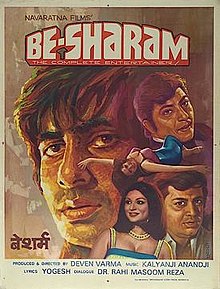
Be-Sharam (1978)
Dir. Deven Verma, with Amitabh Bachchan, Sharmila Tagore, Amjad Khan, A. K. Hangal, Iftekhar, Nirupa Roy and Deven Verma
Every comedian in Hindi films has probably directed one movie, lost everything and retired with tail-between-legs. Here is another one. One of the direst. Even as we watched this, we were appalled at the kind of things Bachchan was in. Typically, a movie without a story, probably put together as the shooting went on. Not helped at all by Deven Varma in triple role- of a comedic sidekick and his mummy and his daddy; and a scene with Sharmila Tagore in black-face.


6
Devata (1978)
Dir. S. Ramanathan, Sanjeev Kumar, Shabana Azmi, Danny Denzongpa and Sarika
Music by Rahul Dev Burman

Alas, I remember this well.

A kind of channeling of ‘Les Misérables’ set in a Katlick community, where in the first half a 40-year-old Sanjeev Kumar (as a 21-year-old Jean Valjean) in a half-chaddi spends time romancing Shabana Azmi, with the over-the-top song: ‘Chand chura ke laya hoon, chal baithe Churrrch ke peeche’.

The second half is all about Danny Denzongpa (as Javert) trying to expose the identity of Sanjeev Kumar, now returned from the dead with a French beard and a three-piece suit.
And this final dialogue: 
Mere andar ke jaanwar ko mat jagaao Inspecktuuuuurr!" 


7
Jurmana (1979)
Dir. Hrishikesh Mukherjee with Amitabh Bachchan, Raakhee and Vinod Mehra
Terrible, this movie, whose central regressive conceit is a bet between Vinod Mehra and Amitabh Bachchan to get Rakhee inside Amitabh's bedroom. What was Mukherjee thinking?

This movie opens with a completely gratuitous fight sequence in a pub whose only reason seems to be to get the Bachchan fan to buy a ticket.  Incidentally, the shooting of this very scene would make a reappearance in HM’s epical ‘Golmaal’ made the same year, where Amol Palekar is taken by Deven Varma to meet Mr. Bachchan.


8
Morchha (1980)
Dir. Raveekant Nagaich, with Ravi Behl, Aruna Irani, Suresh Oberoi, Jagdeep, Shakti Kapoor,
Music by Bappi Lahiri, Lyrics by Ramesh Pant and Faruk Kaisar

Silly enough story of a prepubescent snotfaced kid who turns to karate after his family members are raped/murdered (by rote). Had one song in which Jagdeep rhymes karate with ‘parathe’. I went to see this perhaps taken in by the director’s previous film ‘Suraksha’, the camp James Bondish caper with Mithun Chakravorty as Gunmaster G9, but this was a disappointment.

Except for one thing:
The awesome tribute song by Bappi Lahiri ‘Let’s Dance for the great guy Bruce Lee’ (click on link), sung by Bappi and Annete Pinto, full of ‘Hoo! Hah!’ kung fu-style, and bubbling electro sounds like an upset stomach.


9
Spandan (1982)
Dir. Biplab Roy Chowdhury, written by Biplab Roy Chowdhury (story) and Vijay Tendulkar (screenplay), with Amol Palekar, Utpal Dutt, Anita Kanwar

This was a relentlessly morbid ‘art’ film that book-ended the phase of 1970s indie films and the rise of the VHS cassette, which is how I came to see this film. Nothing of this shows a trace on the webs, not even an image.

Spandan (pulse) is about a good for nothing type who resorts to smuggling aborted foetuses to medical colleges. Towards the end he tries to make his pregnant wife believe that she has a tumor instead of a baby, to harvest this foetus too.

I have done many things in the cause of art, as you can see.


10
Star (1982)
Produced by Biddu, Dir. Vinod Pande, with Kumar Gaurav, Rati Agnihotri, Raj Kiran
Music by Biddu, songs sung by Nazia Hassan and Zoeb Hassan


This, of course was, for Nazia Hassan (and Biddu, seen in cameo below), the only other paradigm apart from A R Rahman more than a decade later to seriously challenge the entrenched Hindi film music stronghold. ‘A Star is Born’ garden-variety film, which should have run on its music alone, but after the high of ‘Aap Jaisa Koi’ and the album length ‘Disco Deewaane’, Biddu could not sustain an entire movie of platitudes and songs that went ‘Ooie Ooie’ and ‘Boom Boom’ (which is the only thing from this movie that has survived, thanks to the remix).


This tanked so badly that it would be 26 years before a similar attempt was made with ‘Rock On!!’

Saturday, April 27, 2013

Time Out Mumbai- Hindi Picchers


This piece appeared in a slightly edited version in my 'After Words' column in Time Out Mumbai,  Volume 9 Issue 18, April 26-May 9 2013.

Hindi Picchers

Indian Cinema is a 100 years old. I have been around for approximately half that time. I can measure my life out in matinee shows (do they even call it that anymore?). My back-story begins, so I am told, with my sleeping through most of ‘Shikar’ (1968). My mum would wake me whenever the tiger made an appearance and I would make loud growling sounds, irritating all the other Dharmendra fans. I was four.

In the same year, I was given a choice of seeing either ‘Brahmachari’ (chakke pe chakka) or ‘Raja aur Runk’. I chose the latter as I already knew Mark Twain’s ‘The Prince and the Pauper’, read out to me from Classics Illustrated comics. I still haven’t seen ‘Brahmachari’, except for the song where Mumtaz in a cut-off saffron sari shakes a jelly belly.

In the late 60s, movies came to us through advertising rather than actual movie going. As a schoolboy, my eyes were stabbed by the flash of psychedelic hand-painted billboards of ‘Hare Krishna Hare Ram’ (1971) and ‘Bobby’ (1973). One poster I can never forget is of ‘Bhoot Bangala’ (1965) with its skeletons doing the twist and Tanuja screaming on the Radio Cinema; a rerun, in a rundown theatre. Radio would make its way to dusty death in 1974, to be replaced by the pyro-happy Manish Market, home of ‘do number ka maal’.

I readily believed in ghosts for several years after, an obsession fuelled weekly by very cinematic radio plays called ‘Adbhut Kahaniyaan’ on Vividh Bharati. Radio is where we got our primary movie education. New movies would be presented in 15 minute ‘radio-programs’. The phrase ‘kitne aadmi the?’ was on everyone’s lips much before ‘Sholay’ opened on 15th August 1975, thanks mainly to the radio, our very own social media. Television was something we knew of only by reading American Gold Key Comics.

Television (1972) brought with it the back catalogue of films (from the 40s to the most recent) which we assiduously imbibed every Sunday evening at a convenient neighbour’s house, and learnt songs by heart every Thursday with ‘Chhayageet’ and antakshari. Hindi films (and advertising) also educated us in Urdu. Even as a child I knew some impressive words- ‘Aalingan’, ‘Ulfat’, ‘Jwar Bhata’, ‘Salaakhen’, ‘Saawan Bhadon’.

It is lesser known, but world cinema was regularly telecast on Bombay Doordarshan in the 1970’s. I vividly remember every ‘bloody’ scene from Chabrol’s ‘Le Boucher’ (1970) telecast in B/W when I was 8 or 9. Even after television, radio-programs for films would survive well into the 1980s, when the Asian Games, colour TV and Delhi Doordarshan killed all civilised programming that once came out of Bombay’s Worli studios. The memes of popular cinema continued as songs, thanks to Radio Ceylon and toothpaste. Ameen Sayani would host the weekly ‘Binaca Geet Mala’ right until 1988.

Seeing movies was something we took for granted in our fledgling years. All movies ran at the same time- 3.30, 6.30 and 9.30 pm, while children’s films had matinee shows at 10.30am. I saw 3 movies a day several times, especially in college, hopping from theatre to theatre all located near Bombay VT.

Even the prices were mostly the same: cheap seats were the Lower and Upper Stalls, the Balcony was costlier and the Dress Circle the costliest. A carryover from the days of drama, many of Bombay’s cinemas were converted playhouses, which meant that sometimes you had to hope that you wouldn’t get a seat with a column in front of you.

Movies were like comfort food. They would begin with advertisements, the Indian News Review, a Films Division Documentary, the trailers (forthcoming attractions) and a cartoon, all before the main (feature) film started. We missed none of these pleasures.

Hindi picchers were to die for. I waited 2 days straight in line for a ticket of ‘Amar Akbar Anthony’ (1977) and went back home disappointed after reading ‘House-full’ in every seating slot just above the booking window. I had to content myself with radio-programs for several weeks before I finally witnessed the awesomeness of Manmohan Desai’s magnum opus (but I knew all the dialogues before that). Do movies ever go ‘House-full’ anymore?

Seeing a movie ‘First Day First Show’ was a matter of peer pressure. We could not believe how one bunch of kids in school always managed to do that. They would gleefully commit the unforgivable sin of telling you the story and ruin everything. We hated them.

The only movie I managed to see in all its First Day First Show glory was Attenborough’s ‘Gandhi’ (1982) at the Regal. We got lucky, buying tickets from the ‘panch ka pachhees-wallahs’ at no extra cost because on an unusual police presence. Of course, this hardly a story we could tell the next day to those smug so-and-so’s and return the favour.


Sunday, April 7, 2013

Collapsing buildings: who’s to blame? (September, 1997)


This short opinion piece was published in the Sunday Times of India, September 21, 1997
(in Black and White)

Collapsing buildings: who’s to blame?
Exorbitant prices lead to unscrupulous and unsupervised modifications to interiors, putting intolerable stress on the structure

Living in a city with the world’s costliest real estate, the ordinary Bambaiwalla has increasingly found his slice of floor-space pie getting smaller and smaller. And yet, there has been a copious increase in the availability of consumer appliances, all within reach of his slowly bulging pocket. These many articles have to fit into the tight spaces of his home or work-place. When all options of using the floor are exhausted, the occupant has no recourse but to use the volume of inhabitable space, the meager nine-and-a-half feet evenly spread over the total area of the flat or office. Increased affluence leads to the acquisition of wealthy status symbols: the lofts and mezzanines, the personal safes, a number of steel cupboards, false ceilings with concealed lighting (which also conceal the structural systems and services) and split air-conditioners.

In the fixing of many of these systems, there is a tampering with the RCC frames that form the structural components of the building. Altering or chipping away at the reinforcement (also pulling down the columns as in the Navare building collapse in March 1996, or punching holes in beams to conduct air-conditioning ducts or plumbing) with impunity seriously weakens the structure.

Commercial structures like the Poonam Chambers are designed for specific live loads, which means the combined weight of the furniture, fixtures and human occupants expected, given the nature of use. Live loads caused by accumulated paper (file records, books, publications) are the heaviest, as is the load of water (tanks, cooling towers). Mezzanines and lofts are created inevitably for storage rather than in-habitation  and this is where most of the paperwork or the extra Sintex tank goes. Small goods dealers or manufacturers stock their limited cubicles blindly, causing intolerable stresses on the structures.

The terraces of man buildings are virtual junkyards. Air-conditioning systems include water cooling towers are built on older terraces not designed for these technologies. These may, over a time cause stresses in the structural frame with incessant vibrations. Buildings get taken for granted these days and are added, subtracted, multiplied and divided far beyond the modest expectations of the modest design.

Concrete being a rigid material is unlikely to show excessive physical deformation that could act as a harbinger of imminent failure, at least to the untrained eye. The occupant of a distressed building may not be able to differentiate between cracking plaster and crumbling concrete. Faithful to the very end the RCC frame tolerates all atrocities meted out on it, and then fails, suddenly and spectacularly. There are innumerable structures all over the city that are waiting for the proverbial straw that will break the camel’s back.

Collapses like the Poonam Chambers are symptomatic to be paradigm. The collapse of Mumbai’s Akashdeep building in August 1983 in which several lives were lost had similar reasons for its failure cited by the Tembe Committee. Investigations revealed unauthorized mezzanines and their over-loading with heavy parts and packages by the dealer tenants on the lower floors. The recent tragedy has shown that nothing has been learnt from bitter experiences and what the future portends is also disturbing.

There has been a recent move by the BMC to regularize all lofts and mezzanines built illegally all over the city. And in Navi Mumbai, an illegally enclosed balcony can be regularized by paying a small fine/fee even before it is built. This is typical of developmental authorities getting over a problem they cannot solve by escapism rather than by applying their mind. This attitude of ‘indulging’ wrongdoers by a farcical ‘payment’ for their sins has consequences that are only obvious.

Perhaps the most pathetic testimony in the Poonam Chambers tragedy came from the security guard who ignored falling debris because he thought that happened all the time. A high level of acceptance of the lowest standards of maintenance, and an almost total desensitization to the environment that surrounds us could blind us to impending tragedy. This should also be a lesson for the future.


Friday, March 29, 2013

Time Out- Weighty Tomes


This piece appeared in a slightly edited version in the March 29-April 11 2013 (Vol.9 Issue 16)  issue of Time Out Mumbai in my After Words column.

Weighty Tomes

Bibliophiles in Mumbai are currently having their Bull-in-a-Chinashop moment. Sundarabai Hall, that cavern on Marine Lines, home to the book exhibition since yonks, is hosting one where books are being sold by the kilo. Yes, that’s right. No typo.

After several friends made me sufficiently jealous with tales of treasures they had trawled, and the pittance they had paid, I could not stay away.

Normally, a visit to a book exhibition is a slightly ‘posh’ activity, where aficionados move in slow-motion along the stacks, eye-ball the merchandise, stop occasionally to flip a page or two, glance at the back cover, look at the price and more than usually move on. The deliberations are like that of an English high tea, all ritual and gesture. It is not so much about buying books, but about basking in their presence. Here, in contrast, the scene was like a rag-pickers paradise painted by Goya. The many, many visitors scurried from table to table, weighed down by baskets filled with books, giving everyone else the evil eye.

This was a paradigm shift, for when book are sold by weight, any concern about the content becomes secondary to the probability of ownership. The stacks were nominally separated by books for children, fiction, non-fiction, encyclopaedias and suchlike, but had no finer divisions. Those who asked the management for another copy of a particular book were given wan smiles in recompense. What you see is what you get. Also, inherently embedded: garbage in, garbage out.

Not immune to the thought of paying a hundred rupees per kilo, I tucked in myself, and was soon amazed and appalled by my own desires over-riding sense. In such a situation, the only book that you would potentially not buy was one you already have. But dear reader, I bested myself, by buying one or two of the books that already line my shelves at home. Pavlov would have loved to jump out of his grave and take behavioural sampling,  for like a dog that salivates conditioned by the sound of a bell, I filled my basket within no time.

The smart ones in the crowd had worked out that they could get a bigger bang for their buck by choosing paperbacks over hardcovers (again, the more fool me, who bought seven kilos of only hardbacks). On the other hand, this was the moment to go after those weighty tomes that would have been untenable in any other exhibition (cum-sale) of books.

So, at the end of an hour and a half in the company of more books than I could reasonably count, and of more people I took an instant dislike to because of the contents of their baskets (that I coveted), I emerged into the mid-morning haze of a Mumbai summer, lighter of purse but proud daddy to a newborn, overweight pack of books (no plastic bags).

Now that I was out, and had unburdened my load on the seat beside me in a taxi ferrying me homewards, I rubbed life back into my hands and contemplated the books I now owned. But did I really need them? Life-lessons were learned. Should you wish to follow my path, these you should know:

When buying books by weight, you do not bring either the age of the book or its current condition into consideration. It is simply- do you want the book or not?

Either you pick it up or someone else will. As the grand sage Yoda says: do, or do not.

Many of the books are familiar. But there is no point ruing the fact that you had seen this book on the road at Flora Fountain for ten rupees thirty years ago, but you did not buy it then, either.

You can judge a book by its cover. If it is attractive and shiny, pick it up. What is inside can to be seen to when you get home.

Yes, your home is already filled with books. Yes, your shelves have long since been outgrown and stacks are piled your spouse’s side of your bed, but so what? One kilo for one hundred rupees, bleddy!

Please do not get into petty issues like- will you read the book when you buy it? No true bibliophile buys books only to read, come on!

It’s all right if you do not pick up 'The Da Vinci Code’. They published far too many of those than were needed, anyway.

Do not think of the behind the scenes business model of this kind of sale. What the organizers make out of this is none of your business. Just think: is your basket full, and do you want another?

I am home now, and it is more than a week since my purchases. My book stack still is unopened. What’s the hurry? I kind of like it, just the way it is.


Thursday, February 14, 2013

Time Out- Loo Brow


This piece was published in Time Out Mumbai's After Words (Vol 9, Issue 13; February 15-28 2013) in a slightly edited version.

Loo brow
No loo is too loo-brow for me to give it custom.

Being blessed with far too much weight and far too weak a bladder, I follow the only injunction I hold to be the one truth- when you have to go you have to go. I therefore have no qualms about the smell, the wetness, the ability of the flush to work, or the sight of previous detritus. Can’t afford them. All this and more can be bypassed if I am able to pass some myself.

I have, more or less mastered the art of standing tippy-toe on dryer patches of a public toilet, managing with a bag in one or both hands, and not being excessively prissy if the loo does not have a door latch. Bodily privacy does not amount to much when it comes to bodily priority and evacuation is imminent.

When it comes to going for the ‘big one’, I go down on my knees (bad choice of words here) and thank providence for a decade of apprenticeship that I had, of living in a chawl with common toilets. Over the years, I mastered the art of doing my thing with a single, approx. three-fourths of a litre, ‘tim-pat’ (tin-pot) of water. This included washing to satisfaction and saving some for flushing after (in deference to the next-in-line). This rigour has stood me in good stead when I needed, no, when I had to go behind a rock outcrop near the Khardungla Pass (17,582 ft.) with a bottle of Bisleri, or to similarly not embarrass myself, and others, numerous times when on the road.

I am not complaining, but I have also had access on occasion to upmarket loos too. I remember being utterly impressed by the newly minted ones in the Inox at Nariman Point when that multiplex opened its doors. It was all glitter and glam, just like going to the movies, but only for valid ticket holders. I have visited the ultra swank bogs at the Royal Opera House in Muscat, complete with gilt signage of a man in Omani national dress and its squatting-type WC’s that shone like burnish’d gold. Damn it all, we all grew up to treat the ground floor loo (to the left) at the Taj Mahal Palace Hotel near the Gateway as the public toilet of choice in our growing up years, didn’t we?. That one of course is no longer of use when the urge is too strong; the time you spend getting frisked and patted down could lead to a disaster having national consequences.

How a body is able to manage in Mumbai’s streets is another thing altogether. Loo-lore of the location and proximity of public conveniences is vitally important to my well being when I go about my daily work. This is of no help at all in places I do not normally frequent, where such knowledge is unavailable. Mumbai has no signage in her grand outdoors that indicates where a toilet is located. Even if you wished to throw all civic sense and propriety to the wind, in our densely occupied streets there are few alleys or shielding walls offering the possibility of unseen micturation. The undersides of flyovers, those puke-inducing pools of putridity have also been appropriated now for pay and park purposes.

Thank you for reading thus far. You must know that I am of the male persuasion, and that these are profound urban inconveniences that I find myself subject to. Now imagine being a woman with similar needs on Mumbai’s unhelpful streets.

Mumbai needs many more accessible toilets for both men and women than it needs urban transport, redevelopment or any other form of aspirational pipe-dreams. It needs them as first priority, placed visibly, and with it the signage and directions for immediate and easy access. It needs them at frequent enough intervals so that long lines do not form outside them. It needs them with doors that latch and with hooks for bags.

I would like to see the day that the Chief Minister proudly proclaims (on TV, on Twitter and in print) that Mumbai has more loos than Shanghai. It is no excuse that loos are not built because maintaining them is difficult. You might not like to hear this, but Mumbai needs public toilets first, their hygiene and cleanliness can follow.

Sunday, February 10, 2013

No country for young women (and men in love)


My piece in the Times of India Crest Edition, 6th February 2013

TABOO TALES
No country for young women (and men in love)

Every overt public display of affection I see on Mumbai's streets adds a minute to my life. Every instance of the holding of hands, the intertwining of fingers, a big, warm hug, a weary head resting on a shoulder, a quick peck on the cheek or an unexpected caress warms the cockles of my heart. These displays are quick and momentary but bring delight like the chance spotting of a bright red flower blossoming in a grey, dystopian landscape. Love comes, as the Rolling Stones sing, at the speed of light. These brief flashes energize and comfort me that all is well with the world.

Now consider our universal reaction to a canine couple doing that which they are prone to, willfully disregarding the sensitive space that is our public realm. Crowds gather with the singular aim of interrupting coitus. We can't abide sex in any situation even if it is an animal doing it. Slippers are slung, brickbats fly, even chilli powder is procured, all with an aim to separate those parts conjoint in communion. Vast cheers go up at the successful delinking as each hapless animal scurries away. No individual participates in such behaviour. It is always a mob.


There seems to be an almost atavistic need to separate the sexes in our city. Recently a friend told me of a visit to a temple with his wife. After the ritual darshan they emerged from the sanctum into the sunlight and sat for a moment on the parapet outside. They were immediately accosted by the temple administrators and asked to leave. My friend argued but to no avail, they left with a bad taste in the mouth. We seem to have a problem even with a public display of sitting-down.


When the spark of affection is ignited in a public space, it is almost certain that this is because the female has asserted or at least consented to show or receive love. Agency has been exercised. Patriarchical mores have been resisted. The public space has been made more equitable. And that, of course, cannot be tolerated.


There is little to separate the looney-fringe nutters who violently break up couples quietly sitting in restaurants and pubs and the recent 'Ched-chad Virodhi Pathak', a posse of 15 plainclothesmen of the Thane police who were mandated to round up couples and even single women in the outdoors in order to, presumably, prevent them from being accosted by 'Romeos and molesters'. They were authorised to fine couples, or to book them under section 110 of the Bombay Police Act for 'causing public nuisance' just for being present, and worst of all, to give these 'suspicious elements' long moralising lectures about their loose and wayward behaviour not in keeping with Indian culture. 


With blithe nonchalance, the senior inspectors aim to bring down crime by ensuring that 'no one should be found in corners and isolated places unnecessarily even in the day time'.

Both the lumpen louts and the up-keepers of the law approach their targets like those rabidly intent on separating copulating dogs. Both assert a moral righteousness that allows them to violently accost men and women seen together in the city, for the preservation of Indian culture and Indian values. 

Even the Commissioner of Police in Mumbai remarked at a meeting on women's safety that he favoured moral education to sex education. He believed (really!) that women in countries where sex education is taught are more prone to instances of sexual assault.


No doubt, the Police Commissioner is well versed in a subject called 'Moral Science' that we were all taught at school. This oxymoronic subject was a weekly series of sleep-inducing homilies about how we should behave. Here we learnt how we should all conform for our own good, that each one of us had our roles to play, that we were defined by our upbringing, and our rectitude consisted in adhering to these very circumstances. Boys should be good boys. Girls should be good girls. Typically, the science of this morality is particularly focused on keeping women in their place, which is off the streets.


In our indoctrinated and patriarchic milieu, there is little space for a woman to exercise agency. Even the ordinance recently signed by the President making tougher the penalties against sexual assault do not explicitly give complete autonomy to an Indian woman over her own body. There are always occasions, and exceptions where a woman is dependent on others. Little surprise then, that a police force, from the very top down to the beat cop immersed in such values can only keep the peace by clearing the streets. 


Of women.


We don't need no moral education. Instead, there is an urgent need for creating a contemporary cultural awareness in all those in executive power, and at every level of governance, imparting in them a reformed world view not rooted in labels and stereotypes. They need to learn how to champion diversity, protect the autonomy of the individual and loudly deride those who would keep us in our place. 


So here is my humble proposal: Each morning, before being let loose on the citizens at large, the following lines should be repeated in place of the morning prayer, along with a cup of chai (and with increasing levels of sincerity): 


'A woman may be seen in the open without reason. 

It is alright if she is alone, or with someone of either sex. 
It is my job to ensure that she continues to do whatever it is she wants to do. 
Anyone sitting (or existing) in the open is not a public nuisance. 
If I see anyone displaying affection I must remember that I too am the product of such acts. ' 

And in every police station, I propose there should be a large poster with the very recent image of the Leader of the Opposition warmly embracing the President of our largest Opposition Party, with the bold caption:

 'KEEP CALM AND CARRY ON'.