Sunday, May 5, 2013

Ten Hindi Movies Only I have Seen

Ten Hindi Movies Only I have Seen

Since I should not be left behind in the list-making that everyone is indulging in to celebrate 100 years of Indian Cinema, here is my list of 10 Hindi movies that only I have seen (or so I believe). Who else would want to see them- some of the most weird, most peripheral and some of the most dire (what-the-fuck-were-they-thinking variety of) Hindi movies ever made and released?
Says something about me, I suppose.

1
Aman (1967)
Dir. Mohan Kumar, with Rajendra Kumar, Saira Banu, Balraj Sahani, and 
Bertrand Russell (as himself, died 1970, no connection)


The movie begins with a dedication to Jawaharlal Nehru (framed photo with rose), and this title slide appears anon:
“Lord Bertrand Russell, 
courtesy Bertrand Russell Peace Foundation 
in Emkay Productions’ 
‘Aman’”.


Here is a brief plot summary from Wikipedia: 
Dr. Gautamdas (Rajinder Kumar) attains his qualifications in London, England, and with the blessings of Lord Bertrand Russell (himself) decides to re-locate to Japan, which has been devastated by the explosion of atom bombs on two of its cities - Hiroshima and Nagasaki.

I saw this on Bombay Doordarshan, and it was notable for two guest appearances:
1. Laaard Bertrand Russell, whom ‘Jubilee Kumar’ Rajindr Kmar meets and gushes: "Iyyum Haanered! Iyyum incraeged!"
2. Two half naked acrobats doing the most incredible splits (not at the same time as the above)


2
Birbal My Brother (1973) 
Dir. Raja Thakur, with Sachin, Lilian, William Soloman and Poonam Vaidya
I saw this one on Bombay Doordarshan, too.
This was an ‘English’ movie about a tour guide in Agra ferrying an English mem around. The movie would slip into Hindi at will, and return with locals speaking to locals in English. I remember that Sachin ends up being killed by dakus, and one incredibly risqué scene (to my childhood eyes) involving a lady in a string choli and ghagra and a packet of itching powder.

In an additional bit of trivia, Bhimsen  Joshi sang a juglabandi  of Raag Malkauns in this film along with Pandit Jasraj.


3
Jeevan Sangram (1974)
Dir. Rajbans Khanna, with Shashi Kapoor, Padma Khanna, Jalal Agha, Iftekhar, Radha Saluja and Om Shivpuri
Screenplay and dialogues by Gulzar and Qamar Jalalbaadi

For a longish time, almost nothing was available about this movie on the web, but this was probably the one of the best action movies made in India before ‘Sholay’ (1975) rewrote the textbooks. 

The story involves the radicalization of one of the disembarked passengers of the famous 'Komagata Maru' steamship in 1914 (Shashi Kapoor), and his exploits as a revolutionary. Some amazing stunt work, as I recall, especially the taking down of a train carrying armament (reminiscent of ‘Lawrence of Arabia’, later also attempted rather poorly in ‘Rang De Basanti’) and a climatic Butch Cassidy and the Sundance Kid type shoot out.

I would like to see this once again, and now I have my chance.
Here is Jeevan Sangram on You Tube.


(From Wikipedia)
The Komagata Maru incident involved a Japanese steamship, the Komagata Maru, that sailed from Punjab, India to Hong Kong,Shanghai, China; Yokohama, Japan; and then to Vancouver, British Columbia, Canada, in 1914, carrying 376 passengers from Punjab, India. Of them 20 were admitted to Canada, but 340 Sikhs, 24 Muslims, and 12 Hindus, all British subjects were not allowed to land in Canada, and the ship was forced to return to India.The Komagata Maru arrived in Calcutta and was stopped by a British gunboat, and the passengers were placed under guard. The government of the British Raj saw the men on the Komagata Maru not only as self-confessed lawbreakers, but also as dangerous political agitators. When the ship docked at Budge Budge, the police went to arrest Baba Gurdit Singh and the 20 or so other men that they saw as leaders. He resisted arrest, a friend of his assaulted a policeman and a general riot ensued. Shots were fired and 19 of the passengers were killed. Some escaped, but the remainder were arrested and imprisoned or sent to their villages and kept under village arrest for the duration of the First World War.This incident became known as the Budge Budge Riot. 


4
Chala Murari Hero Ban ne (1977)
Dir. Asrani, with Asrani, Bindya Goswami and Simi Garewal
and special appearances by 
Dharmendra, Hema Malini, Premnath, Amitabh Bachchan, A.K. Hangal, Keshto Mukherjee, Jagdeep, Ashok Kumar, Paintal, David, Sunil Dutt and Kishore Kumar
Asrani directed this movie about a village bumpkin rising in the Bombay film industry to become a major star. Around this same time another similar film was being bandied about on Vividh Bharati called ‘Naya Bakra’ (Baaaaa!) but I am not sure that ever saw the light of day.

Lots of Asrani’s friends made cameos in this film. This was a total ‘B’ movie that I saw in Bombay’s (now) only surviving ‘B’ theater Edward, where the balcony had the cheaper seats, wooden benches that you had to run to catch.

Why did I see this? Probably this was the age when we saw anything with Amitabh Bachchan in it, however fleeting his presence, a trait we would soon learn to regret.


5
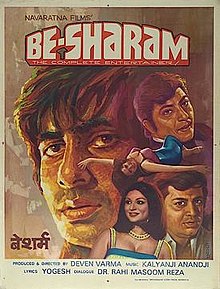
Be-Sharam (1978)
Dir. Deven Verma, with Amitabh Bachchan, Sharmila Tagore, Amjad Khan, A. K. Hangal, Iftekhar, Nirupa Roy and Deven Verma
Every comedian in Hindi films has probably directed one movie, lost everything and retired with tail-between-legs. Here is another one. One of the direst. Even as we watched this, we were appalled at the kind of things Bachchan was in. Typically, a movie without a story, probably put together as the shooting went on. Not helped at all by Deven Varma in triple role- of a comedic sidekick and his mummy and his daddy; and a scene with Sharmila Tagore in black-face.


6
Devata (1978)
Dir. S. Ramanathan, Sanjeev Kumar, Shabana Azmi, Danny Denzongpa and Sarika
Music by Rahul Dev Burman

Alas, I remember this well.

A kind of channeling of ‘Les Misérables’ set in a Katlick community, where in the first half a 40-year-old Sanjeev Kumar (as a 21-year-old Jean Valjean) in a half-chaddi spends time romancing Shabana Azmi, with the over-the-top song: ‘Chand chura ke laya hoon, chal baithe Churrrch ke peeche’.

The second half is all about Danny Denzongpa (as Javert) trying to expose the identity of Sanjeev Kumar, now returned from the dead with a French beard and a three-piece suit.
And this final dialogue: 
Mere andar ke jaanwar ko mat jagaao Inspecktuuuuurr!" 


7
Jurmana (1979)
Dir. Hrishikesh Mukherjee with Amitabh Bachchan, Raakhee and Vinod Mehra
Terrible, this movie, whose central regressive conceit is a bet between Vinod Mehra and Amitabh Bachchan to get Rakhee inside Amitabh's bedroom. What was Mukherjee thinking?

This movie opens with a completely gratuitous fight sequence in a pub whose only reason seems to be to get the Bachchan fan to buy a ticket.  Incidentally, the shooting of this very scene would make a reappearance in HM’s epical ‘Golmaal’ made the same year, where Amol Palekar is taken by Deven Varma to meet Mr. Bachchan.


8
Morchha (1980)
Dir. Raveekant Nagaich, with Ravi Behl, Aruna Irani, Suresh Oberoi, Jagdeep, Shakti Kapoor,
Music by Bappi Lahiri, Lyrics by Ramesh Pant and Faruk Kaisar

Silly enough story of a prepubescent snotfaced kid who turns to karate after his family members are raped/murdered (by rote). Had one song in which Jagdeep rhymes karate with ‘parathe’. I went to see this perhaps taken in by the director’s previous film ‘Suraksha’, the camp James Bondish caper with Mithun Chakravorty as Gunmaster G9, but this was a disappointment.

Except for one thing:
The awesome tribute song by Bappi Lahiri ‘Let’s Dance for the great guy Bruce Lee’ (click on link), sung by Bappi and Annete Pinto, full of ‘Hoo! Hah!’ kung fu-style, and bubbling electro sounds like an upset stomach.


9
Spandan (1982)
Dir. Biplab Roy Chowdhury, written by Biplab Roy Chowdhury (story) and Vijay Tendulkar (screenplay), with Amol Palekar, Utpal Dutt, Anita Kanwar

This was a relentlessly morbid ‘art’ film that book-ended the phase of 1970s indie films and the rise of the VHS cassette, which is how I came to see this film. Nothing of this shows a trace on the webs, not even an image.

Spandan (pulse) is about a good for nothing type who resorts to smuggling aborted foetuses to medical colleges. Towards the end he tries to make his pregnant wife believe that she has a tumor instead of a baby, to harvest this foetus too.

I have done many things in the cause of art, as you can see.


10
Star (1982)
Produced by Biddu, Dir. Vinod Pande, with Kumar Gaurav, Rati Agnihotri, Raj Kiran
Music by Biddu, songs sung by Nazia Hassan and Zoeb Hassan



This, of course was, for Nazia Hassan (and Biddu, seen in cameo below), the only other paradigm apart from A R Rahman more than a decade later to seriously challenge the entrenched Hindi film music stronghold. ‘A Star is Born’ garden-variety film, which should have run on its music alone, but after the high of ‘Aap Jaisa Koi’ and the album length ‘Disco Deewaane’, Biddu could not sustain an entire movie of platitudes and songs that went ‘Ooie Ooie’ and ‘Boom Boom’ (which is the only thing from this movie that has survived, thanks to the remix).


This tanked so badly that it would be 26 years before a similar attempt was made with ‘Rock On!!’

Saturday, April 27, 2013

Time Out Mumbai- Hindi Picchers


This piece appeared in a slightly edited version in my 'After Words' column in Time Out Mumbai,  Volume 9 Issue 18, April 26-May 9 2013.

Hindi Picchers

Indian Cinema is a 100 years old. I have been around for approximately half that time. I can measure my life out in matinee shows (do they even call it that anymore?). My back-story begins, so I am told, with my sleeping through most of ‘Shikar’ (1968). My mum would wake me whenever the tiger made an appearance and I would make loud growling sounds, irritating all the other Dharmendra fans. I was four.

In the same year, I was given a choice of seeing either ‘Brahmachari’ (chakke pe chakka) or ‘Raja aur Runk’. I chose the latter as I already knew Mark Twain’s ‘The Prince and the Pauper’, read out to me from Classics Illustrated comics. I still haven’t seen ‘Brahmachari’, except for the song where Mumtaz in a cut-off saffron sari shakes a jelly belly.

In the late 60s, movies came to us through advertising rather than actual movie going. As a schoolboy, my eyes were stabbed by the flash of psychedelic hand-painted billboards of ‘Hare Krishna Hare Ram’ (1971) and ‘Bobby’ (1973). One poster I can never forget is of ‘Bhoot Bangala’ (1965) with its skeletons doing the twist and Tanuja screaming on the Radio Cinema; a rerun, in a rundown theatre. Radio would make its way to dusty death in 1974, to be replaced by the pyro-happy Manish Market, home of ‘do number ka maal’.

I readily believed in ghosts for several years after, an obsession fuelled weekly by very cinematic radio plays called ‘Adbhut Kahaniyaan’ on Vividh Bharati. Radio is where we got our primary movie education. New movies would be presented in 15 minute ‘radio-programs’. The phrase ‘kitne aadmi the?’ was on everyone’s lips much before ‘Sholay’ opened on 15th August 1975, thanks mainly to the radio, our very own social media. Television was something we knew of only by reading American Gold Key Comics.

Television (1972) brought with it the back catalogue of films (from the 40s to the most recent) which we assiduously imbibed every Sunday evening at a convenient neighbour’s house, and learnt songs by heart every Thursday with ‘Chhayageet’ and antakshari. Hindi films (and advertising) also educated us in Urdu. Even as a child I knew some impressive words- ‘Aalingan’, ‘Ulfat’, ‘Jwar Bhata’, ‘Salaakhen’, ‘Saawan Bhadon’.

It is lesser known, but world cinema was regularly telecast on Bombay Doordarshan in the 1970’s. I vividly remember every ‘bloody’ scene from Chabrol’s ‘Le Boucher’ (1970) telecast in B/W when I was 8 or 9. Even after television, radio-programs for films would survive well into the 1980s, when the Asian Games, colour TV and Delhi Doordarshan killed all civilised programming that once came out of Bombay’s Worli studios. The memes of popular cinema continued as songs, thanks to Radio Ceylon and toothpaste. Ameen Sayani would host the weekly ‘Binaca Geet Mala’ right until 1988.

Seeing movies was something we took for granted in our fledgling years. All movies ran at the same time- 3.30, 6.30 and 9.30 pm, while children’s films had matinee shows at 10.30am. I saw 3 movies a day several times, especially in college, hopping from theatre to theatre all located near Bombay VT.

Even the prices were mostly the same: cheap seats were the Lower and Upper Stalls, the Balcony was costlier and the Dress Circle the costliest. A carryover from the days of drama, many of Bombay’s cinemas were converted playhouses, which meant that sometimes you had to hope that you wouldn’t get a seat with a column in front of you.

Movies were like comfort food. They would begin with advertisements, the Indian News Review, a Films Division Documentary, the trailers (forthcoming attractions) and a cartoon, all before the main (feature) film started. We missed none of these pleasures.

Hindi picchers were to die for. I waited 2 days straight in line for a ticket of ‘Amar Akbar Anthony’ (1977) and went back home disappointed after reading ‘House-full’ in every seating slot just above the booking window. I had to content myself with radio-programs for several weeks before I finally witnessed the awesomeness of Manmohan Desai’s magnum opus (but I knew all the dialogues before that). Do movies ever go ‘House-full’ anymore?

Seeing a movie ‘First Day First Show’ was a matter of peer pressure. We could not believe how one bunch of kids in school always managed to do that. They would gleefully commit the unforgivable sin of telling you the story and ruin everything. We hated them.

The only movie I managed to see in all its First Day First Show glory was Attenborough’s ‘Gandhi’ (1982) at the Regal. We got lucky, buying tickets from the ‘panch ka pachhees-wallahs’ at no extra cost because on an unusual police presence. Of course, this hardly a story we could tell the next day to those smug so-and-so’s and return the favour.


Sunday, April 7, 2013

Collapsing buildings: who’s to blame? (September, 1997)


This short opinion piece was published in the Sunday Times of India, September 21, 1997
(in Black and White)

Collapsing buildings: who’s to blame?
Exorbitant prices lead to unscrupulous and unsupervised modifications to interiors, putting intolerable stress on the structure

Living in a city with the world’s costliest real estate, the ordinary Bambaiwalla has increasingly found his slice of floor-space pie getting smaller and smaller. And yet, there has been a copious increase in the availability of consumer appliances, all within reach of his slowly bulging pocket. These many articles have to fit into the tight spaces of his home or work-place. When all options of using the floor are exhausted, the occupant has no recourse but to use the volume of inhabitable space, the meager nine-and-a-half feet evenly spread over the total area of the flat or office. Increased affluence leads to the acquisition of wealthy status symbols: the lofts and mezzanines, the personal safes, a number of steel cupboards, false ceilings with concealed lighting (which also conceal the structural systems and services) and split air-conditioners.

In the fixing of many of these systems, there is a tampering with the RCC frames that form the structural components of the building. Altering or chipping away at the reinforcement (also pulling down the columns as in the Navare building collapse in March 1996, or punching holes in beams to conduct air-conditioning ducts or plumbing) with impunity seriously weakens the structure.

Commercial structures like the Poonam Chambers are designed for specific live loads, which means the combined weight of the furniture, fixtures and human occupants expected, given the nature of use. Live loads caused by accumulated paper (file records, books, publications) are the heaviest, as is the load of water (tanks, cooling towers). Mezzanines and lofts are created inevitably for storage rather than in-habitation  and this is where most of the paperwork or the extra Sintex tank goes. Small goods dealers or manufacturers stock their limited cubicles blindly, causing intolerable stresses on the structures.

The terraces of man buildings are virtual junkyards. Air-conditioning systems include water cooling towers are built on older terraces not designed for these technologies. These may, over a time cause stresses in the structural frame with incessant vibrations. Buildings get taken for granted these days and are added, subtracted, multiplied and divided far beyond the modest expectations of the modest design.

Concrete being a rigid material is unlikely to show excessive physical deformation that could act as a harbinger of imminent failure, at least to the untrained eye. The occupant of a distressed building may not be able to differentiate between cracking plaster and crumbling concrete. Faithful to the very end the RCC frame tolerates all atrocities meted out on it, and then fails, suddenly and spectacularly. There are innumerable structures all over the city that are waiting for the proverbial straw that will break the camel’s back.

Collapses like the Poonam Chambers are symptomatic to be paradigm. The collapse of Mumbai’s Akashdeep building in August 1983 in which several lives were lost had similar reasons for its failure cited by the Tembe Committee. Investigations revealed unauthorized mezzanines and their over-loading with heavy parts and packages by the dealer tenants on the lower floors. The recent tragedy has shown that nothing has been learnt from bitter experiences and what the future portends is also disturbing.

There has been a recent move by the BMC to regularize all lofts and mezzanines built illegally all over the city. And in Navi Mumbai, an illegally enclosed balcony can be regularized by paying a small fine/fee even before it is built. This is typical of developmental authorities getting over a problem they cannot solve by escapism rather than by applying their mind. This attitude of ‘indulging’ wrongdoers by a farcical ‘payment’ for their sins has consequences that are only obvious.

Perhaps the most pathetic testimony in the Poonam Chambers tragedy came from the security guard who ignored falling debris because he thought that happened all the time. A high level of acceptance of the lowest standards of maintenance, and an almost total desensitization to the environment that surrounds us could blind us to impending tragedy. This should also be a lesson for the future.


Friday, March 29, 2013

Time Out- Weighty Tomes


This piece appeared in a slightly edited version in the March 29-April 11 2013 (Vol.9 Issue 16)  issue of Time Out Mumbai in my After Words column.

Weighty Tomes

Bibliophiles in Mumbai are currently having their Bull-in-a-Chinashop moment. Sundarabai Hall, that cavern on Marine Lines, home to the book exhibition since yonks, is hosting one where books are being sold by the kilo. Yes, that’s right. No typo.

After several friends made me sufficiently jealous with tales of treasures they had trawled, and the pittance they had paid, I could not stay away.

Normally, a visit to a book exhibition is a slightly ‘posh’ activity, where aficionados move in slow-motion along the stacks, eye-ball the merchandise, stop occasionally to flip a page or two, glance at the back cover, look at the price and more than usually move on. The deliberations are like that of an English high tea, all ritual and gesture. It is not so much about buying books, but about basking in their presence. Here, in contrast, the scene was like a rag-pickers paradise painted by Goya. The many, many visitors scurried from table to table, weighed down by baskets filled with books, giving everyone else the evil eye.

This was a paradigm shift, for when book are sold by weight, any concern about the content becomes secondary to the probability of ownership. The stacks were nominally separated by books for children, fiction, non-fiction, encyclopaedias and suchlike, but had no finer divisions. Those who asked the management for another copy of a particular book were given wan smiles in recompense. What you see is what you get. Also, inherently embedded: garbage in, garbage out.

Not immune to the thought of paying a hundred rupees per kilo, I tucked in myself, and was soon amazed and appalled by my own desires over-riding sense. In such a situation, the only book that you would potentially not buy was one you already have. But dear reader, I bested myself, by buying one or two of the books that already line my shelves at home. Pavlov would have loved to jump out of his grave and take behavioural sampling,  for like a dog that salivates conditioned by the sound of a bell, I filled my basket within no time.

The smart ones in the crowd had worked out that they could get a bigger bang for their buck by choosing paperbacks over hardcovers (again, the more fool me, who bought seven kilos of only hardbacks). On the other hand, this was the moment to go after those weighty tomes that would have been untenable in any other exhibition (cum-sale) of books.

So, at the end of an hour and a half in the company of more books than I could reasonably count, and of more people I took an instant dislike to because of the contents of their baskets (that I coveted), I emerged into the mid-morning haze of a Mumbai summer, lighter of purse but proud daddy to a newborn, overweight pack of books (no plastic bags).

Now that I was out, and had unburdened my load on the seat beside me in a taxi ferrying me homewards, I rubbed life back into my hands and contemplated the books I now owned. But did I really need them? Life-lessons were learned. Should you wish to follow my path, these you should know:

When buying books by weight, you do not bring either the age of the book or its current condition into consideration. It is simply- do you want the book or not?

Either you pick it up or someone else will. As the grand sage Yoda says: do, or do not.

Many of the books are familiar. But there is no point ruing the fact that you had seen this book on the road at Flora Fountain for ten rupees thirty years ago, but you did not buy it then, either.

You can judge a book by its cover. If it is attractive and shiny, pick it up. What is inside can to be seen to when you get home.

Yes, your home is already filled with books. Yes, your shelves have long since been outgrown and stacks are piled your spouse’s side of your bed, but so what? One kilo for one hundred rupees, bleddy!

Please do not get into petty issues like- will you read the book when you buy it? No true bibliophile buys books only to read, come on!

It’s all right if you do not pick up 'The Da Vinci Code’. They published far too many of those than were needed, anyway.

Do not think of the behind the scenes business model of this kind of sale. What the organizers make out of this is none of your business. Just think: is your basket full, and do you want another?

I am home now, and it is more than a week since my purchases. My book stack still is unopened. What’s the hurry? I kind of like it, just the way it is.


Thursday, February 14, 2013

Time Out- Loo Brow


This piece was published in Time Out Mumbai's After Words (Vol 9, Issue 13; February 15-28 2013) in a slightly edited version.

Loo brow
No loo is too loo-brow for me to give it custom.

Being blessed with far too much weight and far too weak a bladder, I follow the only injunction I hold to be the one truth- when you have to go you have to go. I therefore have no qualms about the smell, the wetness, the ability of the flush to work, or the sight of previous detritus. Can’t afford them. All this and more can be bypassed if I am able to pass some myself.

I have, more or less mastered the art of standing tippy-toe on dryer patches of a public toilet, managing with a bag in one or both hands, and not being excessively prissy if the loo does not have a door latch. Bodily privacy does not amount to much when it comes to bodily priority and evacuation is imminent.

When it comes to going for the ‘big one’, I go down on my knees (bad choice of words here) and thank providence for a decade of apprenticeship that I had, of living in a chawl with common toilets. Over the years, I mastered the art of doing my thing with a single, approx. three-fourths of a litre, ‘tim-pat’ (tin-pot) of water. This included washing to satisfaction and saving some for flushing after (in deference to the next-in-line). This rigour has stood me in good stead when I needed, no, when I had to go behind a rock outcrop near the Khardungla Pass (17,582 ft.) with a bottle of Bisleri, or to similarly not embarrass myself, and others, numerous times when on the road.

I am not complaining, but I have also had access on occasion to upmarket loos too. I remember being utterly impressed by the newly minted ones in the Inox at Nariman Point when that multiplex opened its doors. It was all glitter and glam, just like going to the movies, but only for valid ticket holders. I have visited the ultra swank bogs at the Royal Opera House in Muscat, complete with gilt signage of a man in Omani national dress and its squatting-type WC’s that shone like burnish’d gold. Damn it all, we all grew up to treat the ground floor loo (to the left) at the Taj Mahal Palace Hotel near the Gateway as the public toilet of choice in our growing up years, didn’t we?. That one of course is no longer of use when the urge is too strong; the time you spend getting frisked and patted down could lead to a disaster having national consequences.

How a body is able to manage in Mumbai’s streets is another thing altogether. Loo-lore of the location and proximity of public conveniences is vitally important to my well being when I go about my daily work. This is of no help at all in places I do not normally frequent, where such knowledge is unavailable. Mumbai has no signage in her grand outdoors that indicates where a toilet is located. Even if you wished to throw all civic sense and propriety to the wind, in our densely occupied streets there are few alleys or shielding walls offering the possibility of unseen micturation. The undersides of flyovers, those puke-inducing pools of putridity have also been appropriated now for pay and park purposes.

Thank you for reading thus far. You must know that I am of the male persuasion, and that these are profound urban inconveniences that I find myself subject to. Now imagine being a woman with similar needs on Mumbai’s unhelpful streets.

Mumbai needs many more accessible toilets for both men and women than it needs urban transport, redevelopment or any other form of aspirational pipe-dreams. It needs them as first priority, placed visibly, and with it the signage and directions for immediate and easy access. It needs them at frequent enough intervals so that long lines do not form outside them. It needs them with doors that latch and with hooks for bags.

I would like to see the day that the Chief Minister proudly proclaims (on TV, on Twitter and in print) that Mumbai has more loos than Shanghai. It is no excuse that loos are not built because maintaining them is difficult. You might not like to hear this, but Mumbai needs public toilets first, their hygiene and cleanliness can follow.

Sunday, February 10, 2013

No country for young women (and men in love)


My piece in the Times of India Crest Edition, 6th February 2013

TABOO TALES
No country for young women (and men in love)

Every overt public display of affection I see on Mumbai's streets adds a minute to my life. Every instance of the holding of hands, the intertwining of fingers, a big, warm hug, a weary head resting on a shoulder, a quick peck on the cheek or an unexpected caress warms the cockles of my heart. These displays are quick and momentary but bring delight like the chance spotting of a bright red flower blossoming in a grey, dystopian landscape. Love comes, as the Rolling Stones sing, at the speed of light. These brief flashes energize and comfort me that all is well with the world.

Now consider our universal reaction to a canine couple doing that which they are prone to, willfully disregarding the sensitive space that is our public realm. Crowds gather with the singular aim of interrupting coitus. We can't abide sex in any situation even if it is an animal doing it. Slippers are slung, brickbats fly, even chilli powder is procured, all with an aim to separate those parts conjoint in communion. Vast cheers go up at the successful delinking as each hapless animal scurries away. No individual participates in such behaviour. It is always a mob.


There seems to be an almost atavistic need to separate the sexes in our city. Recently a friend told me of a visit to a temple with his wife. After the ritual darshan they emerged from the sanctum into the sunlight and sat for a moment on the parapet outside. They were immediately accosted by the temple administrators and asked to leave. My friend argued but to no avail, they left with a bad taste in the mouth. We seem to have a problem even with a public display of sitting-down.


When the spark of affection is ignited in a public space, it is almost certain that this is because the female has asserted or at least consented to show or receive love. Agency has been exercised. Patriarchical mores have been resisted. The public space has been made more equitable. And that, of course, cannot be tolerated.


There is little to separate the looney-fringe nutters who violently break up couples quietly sitting in restaurants and pubs and the recent 'Ched-chad Virodhi Pathak', a posse of 15 plainclothesmen of the Thane police who were mandated to round up couples and even single women in the outdoors in order to, presumably, prevent them from being accosted by 'Romeos and molesters'. They were authorised to fine couples, or to book them under section 110 of the Bombay Police Act for 'causing public nuisance' just for being present, and worst of all, to give these 'suspicious elements' long moralising lectures about their loose and wayward behaviour not in keeping with Indian culture. 


With blithe nonchalance, the senior inspectors aim to bring down crime by ensuring that 'no one should be found in corners and isolated places unnecessarily even in the day time'.

Both the lumpen louts and the up-keepers of the law approach their targets like those rabidly intent on separating copulating dogs. Both assert a moral righteousness that allows them to violently accost men and women seen together in the city, for the preservation of Indian culture and Indian values. 

Even the Commissioner of Police in Mumbai remarked at a meeting on women's safety that he favoured moral education to sex education. He believed (really!) that women in countries where sex education is taught are more prone to instances of sexual assault.


No doubt, the Police Commissioner is well versed in a subject called 'Moral Science' that we were all taught at school. This oxymoronic subject was a weekly series of sleep-inducing homilies about how we should behave. Here we learnt how we should all conform for our own good, that each one of us had our roles to play, that we were defined by our upbringing, and our rectitude consisted in adhering to these very circumstances. Boys should be good boys. Girls should be good girls. Typically, the science of this morality is particularly focused on keeping women in their place, which is off the streets.


In our indoctrinated and patriarchic milieu, there is little space for a woman to exercise agency. Even the ordinance recently signed by the President making tougher the penalties against sexual assault do not explicitly give complete autonomy to an Indian woman over her own body. There are always occasions, and exceptions where a woman is dependent on others. Little surprise then, that a police force, from the very top down to the beat cop immersed in such values can only keep the peace by clearing the streets. 


Of women.


We don't need no moral education. Instead, there is an urgent need for creating a contemporary cultural awareness in all those in executive power, and at every level of governance, imparting in them a reformed world view not rooted in labels and stereotypes. They need to learn how to champion diversity, protect the autonomy of the individual and loudly deride those who would keep us in our place. 


So here is my humble proposal: Each morning, before being let loose on the citizens at large, the following lines should be repeated in place of the morning prayer, along with a cup of chai (and with increasing levels of sincerity): 


'A woman may be seen in the open without reason. 

It is alright if she is alone, or with someone of either sex. 
It is my job to ensure that she continues to do whatever it is she wants to do. 
Anyone sitting (or existing) in the open is not a public nuisance. 
If I see anyone displaying affection I must remember that I too am the product of such acts. ' 

And in every police station, I propose there should be a large poster with the very recent image of the Leader of the Opposition warmly embracing the President of our largest Opposition Party, with the bold caption:

 'KEEP CALM AND CARRY ON'. 

Mumbai Two Decades After: Landscapes of Exclusion, Mindscapes of Denial


Mumbra, as seen from Google Earth

My essay in Vol - XLVIII No. 07, February 16, 2013 of the Economic and Political Weekly on the demographic and attitudinal changes Twenty Years after the Bombay Riots.

Mumbai Two Decades After:
Landscapes of Exclusion, Mindscapes of Denial
(in: Economic and Political Weekly, Vol - XLVIII No. 07, February 16, 2013) 

Twenty years after the communal riots of 1992 and the serial bomb blasts of 1993, Mumbai finds itself demographically changed. Muslim families are being forced to move to distant suburbs. The "outside" becomes peripheral to the lives of the men and women inside the new enclaves, especially the young males brought up in the restrictive practices of the ghetto, who use it for unrestrained risk-taking.


.
In December 2012, several families staying in a relatively poor neighbourhood of Nalasopara, one of Mumbai’s western suburbs, got a rude shock when they saw that the electricity bills listed their address as “Chhota Pakistan”. While a section of the media expressed outrage, the usage of this term is not unusual (except for its appearance on an official document generated by an agency of the state). Despite the fact that this neighbourhood did not have any significant communal history, the appellation, odious as it was, generalised the presence of a significant group of Muslims living close to each other. The name then can be comprehended as a common, rather than a proper noun.

When it comes to Muslims the city works with labels. Exclusionary descriptions like “Chhota Pakistan”, “Chhota Bangladesh” or “Laden Nagar” have sunk deep into the consciousness of Mumbai’s citizens to the point that these can be used to direct autorickshaw drivers when you want to go there. It is likely therefore that the Maharashtra State Electricity Board (MSEB) used this term unselfconsciously and therein lies the insidiousness. After the blood-shedding of 1992, which turned gorier in 1993, Mumbai has seen shifts in its demography. However more than the physical ghettoisation of Muslims into certain areas of the city, it is in the mental maps created as a result of this that the city has been reorganised. There are areas where “they” live. There are places where “we” do not go.

It is 20 years since the riots that rocked Bombay in the wake of the Babri Masjid demolition in Ayodhya. Mumbai has hardly experienced reconciliation since. The punishment for its perpetrators has been handed out only fitfully along a perpetually winding road. Children born in 1992-93 have now reached adulthood. For many of them, there has been very little interaction with people outside their own community. Both Hindus and Muslims have been brought up on separate memories (and mythologies) of the riots in some cases known by the places affected like the “Radhabai Chawl”, “Suleiman Usman Bakery”, “Hari Masjid”, and on separate senses of the self and of the other.

It is also 20 years since the old regimes of state control gave way to the laissez-faire of liberalisation. While it allowed for mobility towards relative affluence and unbridled consumerism, it also legitimised the exclusion of those it left behind. The enterprise afforded by the new paradigm combined with the increased mobility of transactions made possible by the information technology explosion has taken up much of the mind-space, especially in the last 10 years, occluding the fact that the events of 1992-93 left behind unfinished business. The city moved on, taking those who moved on with it, and those who did not simply sank to the bottom. Now after 20 years it is the flotsam of superficial normality that gives us the space to look back.

Separate Spaces and Practices

A majority of the riot victims were Muslim (900) but many more Muslims were hurt, traumatised, dis-housed and eventually stigmatised. Any effort to appreciate the changed city has to be made from their perspective. The riots were followed at first by a long silence, stretching into many months. This was briefly punctuated by the serial blasts of March 1993, which left 250 dead. Before the city could get back to normalcy, shifts in the location of Muslims had begun to substantially alter its demography. Places like Mumbra (near Thane), Jogeshwari east, Powai and Kurla began to see the influx of Muslims relocating from central Mumbai (from areas like Tulsiwadi, Asalpha and Ghatkopar) and seeking refuge in areas with co-religionists. The refuges turned into enclaves as more and more Muslims settled there permanently and then turned into ghettoes. Many areas became Muslim-dominated only because the Hindus moved out of there. Examples of this are areas like Naupada and Behrampada.

These newer, substantially Muslim, neighbourhoods contrasted with those that were earlier seen as Muslim areas in Mumbai. The city has traditionally been a “mosaic of subcultures”, to use a term by the urbanist Chistopher Alexander (C Alexander, S Ishikawa and M Silverstein (1979), A Pattern Language: Towns, Buildings, Construction, New York: Oxford University Press) to describe a place where people “choose to live in, and still experience many ways of life different from their own”. Places in the city could always be described in religious or linguistic terms (Bohra, Marathi, Jain, Roman Catholic), but the edges to these areas were always amorphous. In a neighbourhood like Masjid Bunder for example, cross streets differentiated communities. Most Muslim localities were like this, several of which are located at the eastern port end of Mumbai.

After 1993, these older localities continued as before without significant shifts, and slowly these commercially dominant areas returned to some semblance of business as usual, but things had substantially changed in the attitudes of the rest of the city towards them. The old collegiality and willingness to do business with whoever was as willing had vanished, and bitterness for the other was pervasive. Neighbourhoods now developed hardened edges, with overt displays of community and religious identity in the public realm that over time became entirely separate in their spaces and their practices.

This bitterness is the direct outcome of a sense of victimhood among Muslims. It is fuelled by a discourse amongst them that only Muslims died during the riots and that the perpetrators were not only free but flourishing with many of them rising to political office. This alienation plays out in two ways. First, in the form of fatalism that reconciles them to a belief that justice will never be done, so one should move on with one’s life in whatever manner possible, that religion is the only solace and that “Allah will take care of all things”. Meena Menon, in her survey of the lives of those affected by the riots (Riots and After in Mumbai: Chronicles of Truth and Reconciliation, Sage Publications, 2011) writes that the alienation from the majority community has led to many Muslims “huddling together in the ghettos (with a) reluctance to talk or meet on this issue and a feeling of lethargy and hopelessness”. The second form of alienation borne out in many subsequent interactions with the state (mainly the police) leads to the view that the world outside their ghettos (whether physical or of the mind) is somehow no longer theirs. There is a tremendous loss of confidence in society (according to Menon), in the judiciary, the police and even in the media.

The vacuum created by the exclusion of communities has, according to urban researcher Sarover Zaidi, been filled over the years by a modern form of Islamisation wrought by several ultra conservative Sunni and Shia academies and phirqas with strong forms of organisation and mobilisation and who have steadily gained support on the ground. They have played on the sense of despondency in the Muslim communities, especially in the newer settlements on the periphery of the city by bringing in a sense of purpose and activity, but one ensconced squarely within the rubric of their specific communities. The erstwhile spirit of cosmopolitanism has been further challenged by their infiltration into Sufi cultures that had always existed in Mumbai, resulting in Hindus retreating from these places and making space for Wahhabist tendencies, fixing identities and sapping its syncretic strength. The Muslim enclaves have thus been reinvented economically and socially (bound by a kind of conservative homogeneity), where order and transaction are common law. Quotodian operations are internalised, creating a kind of self-sufficiency thus increasing isolation from the world outside. The very exclusion that these communities are subject to has been made into the subject itself. The world outside is a different place.

The Badlands

In this restrictive world view, the spaces outside the ghettos are the badlands. Not only places where individuals will be shunned for who they are, but where legal recourse, when needed, may be denied. The flipside of this is that the badlands transform into a myth-world where the common-law discipline of the ghetto no longer exists, and one may freely roam its streets ignoring (or flouting) both the laws and the civilities of quotidian metropolitan life. This is seen especially among younger Muslims, who having been brought up conditioned to this mindset, and straining under the restrictive practices of the ghettos, use the city outside for unrestrained risk-taking. It is a common sight to see young children (all male) travelling on the roofs of commuter trains or performing peer encouraged stunts outside its doors, riding two-wheelers recklessly, breaking traffic laws, ruling the night, as it were, with drag-racing along the Marine Drive. This behaviour is indexical of a larger world view, and as these youth grow into adults and take their place as producing members, the city that they inhabit becomes more and more peripheral to their existence.

For Muslim women, the restrictions are manifested in two ways both inside the ghettos and outside in the wider world. Within the community, women are conditioned and coerced to conform to whatever prevalent tehzeeb is accepted as common law, and this is seen mostly in sartorial prescriptions and limited or mediated mobility. The necessity to partake in the membership of the community and its rituals become mandatory. Outside too, Muslim women are instantly foregrounded because of their distinctive hijab, the burkha or rida (as in the case of the Bohras) and thus singled out. Stereotypes kick in instantly and make these women subject, at the same time, to exclusion and to self-consciousness.

No Place for the Other

Four significant events in Mumbai have left their mark (and scars) on its denizens, each contributing to an evolving language of “otherness”. Mumbai has never been free from communal rioting. Even within living memory, the riots of 1969, 1981 and 1984 stoked the flames between Muslims and Hindus, never allowing them to see each other with empathy. The 1992-93 riots alienated the two communities more than before and consolidated separate positions within Mumbai. The riots were followed by the serial blasts of March 1993, and as it became clear that they were the handiwork of the Mumbai mafia led by Dawood Ibrahim, the generalisation of Muslims not only as “the underworld” but as “terrorists” came into common usage. The impression of the “terrorist living next door to us” became further entrenched with the seven bombs that went off in suburban trains in Mumbai in July 2006, killing 200 citizens. The “26/11” attacks of 2008 that led to the death of 164 Indians and foreigners conflated the image of terrorists and Pakistanis into a common cautionary rhetoric that coloured all dealings with Muslims in the city.

The city outside has reinvented itself too. While not ghettoised to the extent of the Muslim localities, identities are redefined and represented in overt and covert assertions of religiosity or cultural convention. In 2008, a family in a housing society in Andheri was denied water and electricity by the other (predominantly Jain) members because they were Muslim. This situation continued for two years before it became public knowledge. Housing societies in Mumbai routinely prevent inclusion into their membership on the basis of religion, language and dietary habits. Such discrimination was legitimised in 2005 by the Supreme Court allowing housing societies to sell or lease apartments to those of a single religion, citing the freedom of association under Article 19(1)(c). Today this is manifest in an across-the-board rejection of Muslim families seeking homes in mixed neighbourhoods. Whether for ownership or for lease, housing to Muslims is routinely denied by mutual consent. House agents are instructed to accept offers from anyone except “Mahommedans”. Muslims have to fall back on homes within the enclaves, further hardening the demographic edges between communities in the city.

Despite the large-scale building activity that is currently underway throughout Mumbai, the only projects advertised by real estate developers “friendly” to Muslims are on the fringes of the city in places like Badlapur, Nalasopara and Mumbra. The one exception to this in the heart of Mumbai is the Bhendi Bazaar redevelopment project, currently underway, that is propelled by the affluent community leaders of the Bohras. More than 200 buildings in the dense inner city are being developed to rehouse around 20,000 residents over a period of time. This project too hardly represents the city, and is conceived mainly as a haven for the Bohra community. It is a given that Muslims seeking housing in Mumbai will only find it within Muslim areas.

Consolidated and Carved

The earlier ethos of secular coexistence is no longer sacrosanct even though no riots have occurred in Mumbai on the scale of those in 1992-93. This is despite the provocation of repeated serial bomb blasts in the city some targeting specific non-Muslim communities. Even the 60 hours of violence perpetrated during the Mumbai attacks of “26/11” have not resulted in retaliation against Muslims in Mumbai. Ever since 1993, several engagements between Muslims and Hindus have been mooted and practised (by non-governmental organisations (NGOs) and even the Mumbai police), but these have at best contained violence, not effected reconciliation.

The ruptures are too deep for darning and have not been helped by the perceived absence of justice and an ongoing sense of repression and surveillance. Journalist Naresh Fernandes who covered the riots of Mumbai said in a recent meet to remember those events that “by not dealing with these injustices, we have begun to deal with other injustices”. There has been a normalisation of attitudes, a legitimisation of differences and spaces in the city have been carved, created and consolidated for “us” and “them” to operate in well-defined separation. Meanwhile outside the stereotypes predominate unhindered.

While returning from this meeting which recalled those bloody months I caught a taxi from Churchgate to Bori Bunder. Another taxi cut into our path and my driver remarked sharply “Bhendi Bazaar ki paidaaish lagti hai!” (Has to be the spawn of Bhendi Bazaar!). I looked up startled, meeting his eyes in the rear view mirror. And noticed the vermillion daub between his eyebrows.


The essay is also posted on the link here.

Saturday, February 9, 2013

brouhahas of cocks by Mustansir Dalvi


Paperback: 106 pages
Publisher: Poetrywala
 1st edition (2013)
ISBN-10: 9382749012
ISBN-13: 978-9382749011


Now available on Amazon and Flipkart 
Also at Kitab Khana, Flora Fountain, Mumbai and Yodakin, Delhi.


merry morning locals
yellowbrown slugs grind
steel teeth. clucketycluck sparks.
brouhahas of cocks.


'fresh, wise, luminous.'
— Ranjit Hoskote

'These poems are compact, carefully crafted, affectionate inter-continental sagas, far superior to the saggy-baggy international sagas written by some of our novelists, and acclaimed by our clueless media. They confirm my belief that our poets are by and large far superior to our novelists, though it is the novelists who get all the attention, and, of course, the hefty advances.'
— Eunice De Souza

‘When reading Mustansir Dalvi’s poetry you must do several things: You must pay attention, for in his poems one word follows another in a slow accretion of meaning, while soundscapes and timezones change swiftly. must be prepared to duel, as he does, with all manner of concepts,emotions, situations, complexities, absurdities, personages, mythologies, geographies and fantasies. You must laugh out loud at the wit, the humour, sometimes even the bawdiness that takes you off-guard, unsettles and delights. And you must not flinch, as the poet doesn’t, from encountering the everyday violences of roadkills and sexual assaults, the terrors of madness, brutality, carnage and conflagration.’
—Sampurna Chattarji

‘In a series of precise images, a montage of people and historic moments, roadkill and mangoes, Mustansir Dalvi brings us his version of the city. But this is no jerrybuilt dystopia of despair; instead it is the vision of someone who will not look away, who will look at and then look beneath at the architectonics of the human endeavour to be human. This is poetry of commitment and compassion and one comes away all the richer for having read it.’
—Jerry Pinto


INTERVIEW

'Meet Navi Mumbai's Bard', an interview with Reza Noorani in the Times of India.


REVIEWS

A review of 'Brouhahas of cocks' by Eunice De Souza in Mumbai Mirror.

A review of 'brouhahas of cocks' by Lindsay Pereira in Mid-day.

'Free Verse', a short review by Vilasini Roy in Time Out Delhi.


Contents
Click on links for selected poems.

I 
Geography 
the last dinosaur roams Matheran
Goodbye, Gondwanaland
Rama’s bridge: 26.12.2004, dawn

II 
Urbs Secunda 
6.15, Takka
the horse is a centaur
pushing fruit
Friday mosque in New Bombay
effigy maker
never came down after all
edge
bird, upside down
hardback awakening
Happy Diwali
apple
Terna Circle

III 
brouhahas of cocks 
merry morning locals
choosing trains
Peabody
the Ladies Only
lines for an infant who fell off a train

IV 
Kokanpatti
forest fires over Khopoli
South Africa’s first Kokani wicket-keeper
Elijah’s feast
caterwaul
Elvis Presley Blvd
sunset at Bardem

V Vembanad 
Backwater Bongo
faith on the Vembanad
Leech 101
Danaë
kingfisher at Nileshwaram

VI 
Mar Thom 
Mar Thom crosses the oceans
anywhere but Hind
King Gudnaphar’s tirade
Didymos
Teo’ma
Sweet Bird of Mylapore

VII 
Denizens
Haven
da boys of Yankee Stadium
hunchback of the World Trade Centre
Khan Murjan
a real, live Parsee
the perfumer’s woman
a saint prays for rain


BIO
Mustansir Dalvi was born in Bombay.
He teaches architecture in Mumbai.

His poem 'Peabody' was awarded 1st Place in the December 2002 Inter Board Poetry Competition (IBPC). 'Choosing Trains' was awarded First Prize in the Indian national daily Asian Age's Poetry Contest in 2001.

He has been Associate Editor at the online poetry workshop Desert Moon Review and the editor of their bi-annual e-zine The Crescent Moon Journal.

Mustansir Dalvi's poems are published in the e-zines Bakery of the Poets, Can We Have Our Ball Back, The Crescent Moon Journal, MiPo Best of Head Quarters 2003, MiPo Digital magazine, Octavo: Poetry Quarterly of the Alsop Review, Pierian Springs, PK Poetry List- Anthology, Poetic Inspirations, Poets Against the War, Slow Trains, Snakeskin, Worm, and the Writer's Hood.

His poems have appeared in print in The Brown Critique, Poetry India: voices of silence, Poiesis: A Journal of the Poetry Circle Bombay, Poetry India: emerging voices, Time Out Mumbai and International Gallerie.

His poems are included in the anthologies:
These My Words: The Penguin Book of Indian Poetry (Eunice de Souza and Melanie Silgardo, editors),
Mind Mutations (Sirrus Poe, editor),
The Bigbridge Online Anthology of Contemporary Indian Poetry (Menka Shivdasani, editor),
The Dance of the Peacock: An Anthology of English Poetry from India (Vivekanand Jha, editor)
and
To Catch a Poem: An Anthology of Poetry for Young People (Jane Bhandari and Anju Makhija, editors), Sahitya Akademi, Delhi.

His translations of poetry from Urdu and Marathi have been published in Poetry at Sangam, The Caravan magazine and The Dhauli Review.

Mustansir Dalvi's 2012 English translation of Muhammad Iqbal’s influential Shikwa and Jawaab-e-Shikwa from the Urdu as ‘Taking Issue and Allah’s Answer’ (Penguin Classics) has been described as ‘insolent and heretical’ and makes Iqbal’s verse accessible to the modern reader.

''Brouhahas of Cocks' is his first book of poems in English published by Poetrywala in 2013.

His most recent book is 'struggles with imagined gods'- selected translations of the poems of Hemant Divate from the Marathi, published by Poetrywala in 2014.


Cover painting:
Detail from 'The Incredulity of Saint Thomas'
by Caravaggio (c. 1601–1602),
Sans souci, Potsdam, Germany


Sunday, January 13, 2013

Time Out Mumbai- Long Cut


This piece was published in Time Out Mumbai's Back of the Book (Vol 9, Issue 10; January 4-17 2013) in a slightly edited version.


Long Cut

I pull up the Kharghar Skywalk on Google Earth. It was recently thrown open to public, after the inevitable delay for want of a suitable politician.

Touted as the longest skywalk in India, I measure with a divider (you know what that is) placed gingerly on my laptop. I mark off Kharghar Station; long enough for a 12 bogie train, and compare this with the skywalk. It is six times longer than the station, running a length of 5340 feet. Five times longer than the Eiffel Tower laid on its side and just about 500 feet shorter than the Golden Gate Bridge, here is a missed opportunity that I can only attribute to a certain laziness in doing a Google search.

Elevated walkways are not new to Mumbai. The foot-over bridge (paad-chaari pul) is the humble progenitor, and has been around since local trains gained custom. The new skywalks are most efficient when plugged into these venerable bridges, allowing commuters to cross above fast moving traffic that inevitably obstructs the fronts of stations. Both foot-overs and skywalks are meant to be perpendicular crossings over train tracks or over busy vehicular roads. 

Consider this absurdity: at Kharghar, first one climbs down to a subway under the tracks, then one climbs up out of it, after which one trudges up 20 feet or so to the cable-stayed bridge that fords the fast flowing NH4. Then, this steel worm drags on and on for a kilometre and a half flanking the highway into Kharghar triumphantly upending at Utsav Chowk. What purpose does a long and winding skywalk serve parallel to a highway? Could there not have been a decent footpath instead, lined with shade giving trees and occasional park benches? Of course, but then it would not have cost Rs.36 crores. What’s the fun then?

Skywalks in Mumbai set the trend for running along existing footpaths. Much of the Bandra skywalk and the one at Cotton Green do this. So does the skywalk at Sion, disconnected from the station just a short distance away. The Ville Parle Skywalk runs for 1500 feet over the very road that accesses the station. There is duplication and redundancy to these costly urban interventions. Left to themselves, pedestrians choose the geodesic- the shortest line between any two points, accounting for local obstructions. These over time become common-law crossings. Urban planners call these ‘desire lines’.  Mumbaikars have a less highfaluting name - ‘short-cut’. We also use its opposite, one that nobody opts for, if avoidable- ‘long-cut’. That is what most of skywalks are, and that is why they fail. No one chooses a long-cut.

The long-cut is acutely felt in the climb up to these skywalks. Most decks are at a height of 18 feet, to account for container-trucks and double-decker buses. The MMRDA also acquiesced to the demand of Ganesh Mandals to raise the deck-heights along the processional paths by another three feet, making a climb of twenty feet or more. This means forty to fifty steps with two or three mid-landings before one reaches the deck. With neither elevators nor escalators, no wonder your grand-mum will prefer the risk of vehicular demise, and take the short-cut below.

The skywalk, emerges from some rather specious thinking about pedestrian benefit is an example of the vast and not so visible reclamation that has currently beset our city. Unlike before, when land was reclaimed from the sea, land is now reclaimed from land itself. All over the world, cities are being reclaimed for pedestrians- highways are reconsidered, subways are filled up, even train lines, as in New York’s High Line are redesigned as public spaces. In Mumbai, the powers that be come up with this: if you can’t clear a path, build one over it. Smart, no? 

What is even smarter is the fringe benefit- spaces for rent. Not for accommodation, but for hoardings. Right from the first skywalk at Bandra, this was obvious. Today, benefits accrued from leasing out billboard real-estate come close to offsetting the costs of the skywalks themselves. Look at Kharghar again, with its 5340 feet running length. Now, multiply by two. What do you get? Chaandi.


Friday, December 7, 2012

Time Out Mumbai- Good manners

This piece was published in Time Out Mumbai's After words (Vol 9, Issue 8; December 7-20, 2012) in a slightly edited version.

Good Manners

Can architecture have good manners? Architects and urbanists have debated this for more than a century, ever since the idea of new towns was conceived. In Mumbai too, there is evidence of urban etiquette, but to see it you need to focus a bit. We have come to accept the notion that Mumbai is an unplanned, an accretive city. Not entirely. For a century, several precincts and neighbourhoods within it have been deliberately planned, to create better conditions for living. Look at some parts of apna shahar on Google Earth. You’ll see what I mean. After the dark years of plague in the 1890s, the city fathers set up the City Improvement Trust, and created several new neighbourhoods to the north, in contrast to the congested and compact ‘native city’. These precincts had wide roads and well spread out plots. They accounted for the rise of vehicular traffic while emphasising the need for green lungs. Five Gardens at Matunga is probably its best surviving example.

The impetus for this piece came from a discussion with a friend researching the social mores of the inner city. Why are some buildings curved, she asked? The answer, my friend, is because they are well mannered. Curved buildings are evidence that there is a town planning authority at work. When plots were laid out, the corners of streets always turned a quarter-circle, never a right angle to accommodate a turning radius for cars. Buildings on such plots swept along the two roads with a curved front. Enforced initially by building regulations for frontages, this resulted in built harmonies along streets. Walking along some of these streets is a delight even today. Good manners are something you expect, and anticipate. There is a special charm to a curved building that matches your urban perception, a comforting notion that things are as they should be.

A corner building also gets the privilege of being iconic - it can be seen from three sides unlike the next one in line which has to be content with one. They locate places in your memory. You describe them while giving directions. These buildings can surprise and delight when encountered for the first time. Take Hornby View on Gunbow Street, with its shorter semicircular end sharply bisecting the street. Its rousing Art Deco features emphasise the corner, while the inviting doorway leads straight into Ideal Restaurant, home of Dhan Dar Patiyo. We have many such urban delights- Empress Court on the Oval has streamlined curves, one of G B Mhatre’s best, while at the end of the road Eros, with its curved, turreted, marquee-end provides a most satisfying full stop.

Sometimes the buildings bow in reverse, in concave arcs like D. R. Chowdhary’s Yogakshema at Nariman Point, sweeping inwards to encompass the garden in front. So do the Venetian Gothic buildings flanking Hornimann Circle with their pioneering covered arcades. But, if I was pressed to choose one above the rest it would surely be the Jehangir Art Gallery, whose arced front, shell canopy and entrance steps on the street makes it the best mannered building in Mumbai.

Curved buildings also have a functional advantage when it comes to security. ‘The buildings on a street equipped to handle strangers and to insure the safety of both residents and strangers must be oriented to the street’ says urbanist Jane Jacobs. She prescribes ‘eyes upon the street’ belonging to those who live there. Typically, a curved building with windows on three sides allows for better surveillance, keeping the immediate surroundings safe. There is no blind side.

Ironically, Mumbai’s curved geometries are evidence of its past, not its present. Its built etiquette withered with time, and died an unlamented death in the seventies with the introduction of FSI. Rectangular buildings were designed on corner plots and cylindrical ones on rectangular ones- an expression of architects’ originality. Today, when the worldly ambition is to squeeze out the last inch of FSI or lay on as much extra TDR as can be mustered, good manners in architecture are not the first (or the last) thing that comes to mind.