Friday, August 19, 2011

The Architect's Alphabet by Rudyard Kipling

The Dean's bungalow at the School of Art Campus in Bombay, in which Rudyard Kipling was not born.

The Architect's Alphabet 
by 
Rudyard Kipling

A was an Architect: B were his Brains
C was the Chaos he wrought when he used 'em
D was the Dissolute course of his Drains
E was the End of the people who used 'em
F were the Fools who allowed him to build
G were his Gehennas of brickbats and lime
H were his houses, bacteria filled
I am the poet who left them in time
J were his Joists- but they broke with the rats on 'em
K were his Kements (I adhere to this spelling)
L were his Leadings- you couldn't swing cats on 'em
M was the Mildew that clove to each dwelling
N was his Notion of saving expense
O were the Odds it would cost like all Tophet
P (please insert for the sake of the sense)
Q were his Quantities, P was his Profit
R were his Roofs which were waterlogged rafts
S for they Sagged (S is also his Sinks)
T the Tornadoes he told us were draughts
U were his Usual Unspecified Stinks
V was the Vengeance I vowed on the head of him
W was Wrong and Waiting and Waste
X is King Xerexes (God knows I have need of him!,
Y and a Yataghan wielded with taste)
Z are Zymotic diseases, a host of 'em
Ambo's my architect, I have got most of 'em.

A poem written by Rudyard Kipling in the 1890s in the margin of a notebook belonging to architect Sir Herbert Baker. 'Ambo' is Ambrose Poynter, an architect, cousin and friend of Kipling. Obviously, Kipling was less than satisfied with his work.

This unpublished poem was discovered in 1968 by the anthologist Kenneth Baker.

I acknowledge the wonderful book 'The Art of Looking Sideways'by Alan Fletcher (Phaidon Press) as the source.

Tuesday, August 9, 2011

Why don't we do it in the road?


1.
Why don't we do it in the road?
Why don't we do it in the road ?
No one will be watching us 
Whaa-aay don't we do it in the road!
(Lennon/McCartney)


2.
"I think of the postmodern attitude as that of a man who loves a very cultivated woman and knows that he cannot say to her ‘I love you madly’, because he knows that she knows (and that she knows he knows) that these words have already been written by Barbara Cartland. Still, there is a solution. He can say ‘As Barbara Cartland would put it, I love you madly’. At this point, having avoided false innocence, having said clearly that it is no longer possible to speak innocently, he will nevertheless have said what he wanted to say to the woman: that he loves her in an age of lost innocence. If the woman goes along with this, she will have received a declaration of love all the same.

"Neither of the two speakers will feel innocent, both will have accepted the challenge of the past, of the already said, which cannot be eliminated; both will consciously and with pleasure play the game of irony… But both will have succeeded, once again, in speaking of love.”
(Umberto Eco, Postscript to the Name of the Rose)


3.
6.30pm at Bombay VT Station. Platform 1. The Harbour line.
It is the cusp before full-blown rush hour. A young couple, uncharacteristically entwined, walk the length of the platform towards where the first class compartments would arrive. The boy, almost all in black, encircles the girls waist with one arm. The girl is slim and short, a petiteness further enhanced by a really tight pair of jeans and a top that fits only too well, has, over one shoulder a biggish ladies bag with several dangly bits. She wears fashionable heels, giving her an inch or two. With her free arm she clinches the boy back, tightly. It is unusual to see such a public display of affection, especially in a railway station in the evening.

The boy can only see her eyes.
The girl’s face and hair are obscured, wrapped completely, a dark dupatta forming a very makeshift naqaab. Both are engrossed; they bill and coo to each other as they wait for the train. Soon, the Vashi train trundles in, quite on time. The girl raises her head and gives the boy a peck on his cheek, right through the dupatta. The boy disentangles himself and gets into the general compartment. The girl walks a few steps down to the Ladies First Class.

Even before she finds a place to sit, with one smooth motion, she whips away the dupatta from her face, her hair falls to her shoulders, and once again she becomes Everywoman.


Thursday, August 4, 2011

Bombay, or what’s left of it


This was an occasional piece written for the Mumbai Reader 10 (2010, UDRI, compiled by Pankaj Joshi and Isaac Matthew) published last year. Given the speed and unpredictability of change in Bombay's urban space currently, I am posting it on this blog to see whether it still holds good.

Bombay, or what’s left of it

It all depends on the way you look at it. Our city is too diverse and too variegated for one single future. It is the sum of its parts and each part, in turn, is the sum of its parts, and so on, ad infinitum. Nowhere is this expressed better than in Mumbai’s inner city- Bombay.

Limits
What are the limits to the inner city? Everything south of the mill lands? Everything south of the Mithi? Neighbourhoods and precincts in our city are undefined, subtle, constructed out of mutual agreements rather than constructed of discreet boundaries. For definition instead, we have generic Wards. ‘C’ and ‘D’ Wards in Mumbai are the archetype of the Inner City, of the Bombay of public memory, identified not by colours on a map, but by paths, places and domains, resonating with neighbourhood names –Kalbadevi, Bhuleshwar, Tardeo, and landmarks- Panjrapol, Gaiwadi, the Cotton Exchange. The urban character, its fabric, its people and its apparent chaos and filth all make it what it is. With the current penchant of making-over all that is old in the city, one wonders what of this will sustain, even a decade from now. For far too long decisions about change are made by foregrounding visual blight as a tool of damnation- garbage, decrepitude, rundown areas, leaking house-gullies, open wiring; all these and more are reason enough for wholesale change. Eyes, of course, are the easiest to fool.

Preserve
Current models of redevelopment assume the helplessness of the residents of the Inner City to better themselves; that these hapless denizens require the benevolence of their ‘betters’-developers and legislators alike. It is assumed that tenants and landlords coexist in an extended no man’s land, thanks to the vagaries of the Bombay Rents, Hotel, and Lodging House Rates Control Act, 1947. Interestingly, it is the Rent Act itself that, over the last sixty years has helped preserve and sustain the egalitarian character of the Inner City. Owners, landlords, tenants, sub-tenants, leave and licensees, common-law occupants, parasites, saprophytes, the homeless and their relatives, friends and pets all make the broad spectrum of life that fill these streets and enrich our city. The enforced clampdown of rents and sales for decades prevented sudden gentrification of these valuable areas, preventing the polychromy of shared existence to be faded down to the monotone ‘Owner’.

Over the rest of Mumbai, as its peripheries ballooned northwards and general affluence rose steadily since the early eighties, the idea of owning a piece of the property pie eclipsed the idea of rented property in the minds of its inhabitants as the only ‘safe’ model for living. Today, home and material estate have got mixed up in a bind, severely strained by the limited space of a city bounded on three sides by water. This has led to a siege mindset, where the real survivors are Owners, and people who need to rent ‘transients’. Little wonder then, that speculators have had an open field over the last thirty years.

Commodity
Today, when even the possibilities of northward expansion seem to be exhausted, the city is turning on itself, trying to survive by devouring its own children. Every area in the city, salt pan or mangrove, green field or brown, lived in or decrepit, outer or inner is fair game. In the hyperdense inner city of the C and D wards, land is the key commodity for speculation, of forcing a value on paper, of commodifying a human need for profit. This paper value multiplies without restraint simply by assigning a perceived agency to it, either by speculation or even legislation. The recent modifications to the Town Planning Act, the eponymous clauses 33/7and 33/9 legislate the densification the already dense.

These Santa Clauses for the speculators posit redevelopment of inner city areas as if they are tabula rasa. The recent proposal for the area we now know as Bhendi Bazaar is a case in point where several hundred structures are proposed to be consumed into thirty or forty high rises. The inevitable result of this would mean the erstwhile tenants would be under severe pressure to move away, those who can afford the many zeros per square foot would move in leading to wholesale  and instant gentrification and demographic change. Modifications in the existing fabric, creating filth-free gated communities, with gated mindsets will lead to a substantial reduction of communal wealth that is the street, the plaza, the playground. What politically correct, un-cosmopolitan, pristine and monolith will replace the grungy surprises, the get-your-hands-dirty delights of the much loved and much visited Chor Bazaar?

Property/ Value
Physical land in our inner city is acutely finite, so how can it be sub-divided, ad infinitum? Historically, landed property defined feudalism. Owning land or real estate generated income for the owner without the owner having to do the actual work of the estate. Landed property was a key element of the feudal pecking order, and freed the owner for other tasks such as living the high life.

In the early years after America shucked off the British yoke, its economy was largely agrarian. Land ownership led to social divide, exploitation and slave ownership. Thomas Paine, in Agrarian Justice (1795) defined two kinds of property- one, Natural property, ‘which comes from the creator, such as earth, air, water’ and the other ‘artificial or acquired property, the invention of men.’ Paine felt that equality in the latter was impossible; but equality in the former was necessary. ‘Every individual in the world is born therein with legitimate claims on a certain kind of property or its equivalent. …the condition of persons born after civilization should not be worse than that of those born before. The earth in its natural, uncultivated state was, and ever would have continued to be, the common property of the human race.’ Thomas Paine stressed that individual property should be manifest only in the value of improvement, and not in the actual ownership of land. ‘Every proprietor, therefore, of cultivated land, owes to the community a ground rent (I know no better term to express the idea) for the land which he holds.’ In 1850, Frédéric Bastiat, in his book Economic Harmonies, defined property not as a physical object, but rather as a relationship between people with respect to an object. What one owned was not the object in itself but the value of the object. As such, Bastiat believed that the increasing proportion of communal wealth to private property would result in grater and agreeable egalitarianism.

These lessons from the past are still relevant and can be put to effect in seeking solutions to redevelop of the inner city of Bombay. Some of these prescriptions may appear counter intuitive, but thinking outside the box is the only option available in recent times. Immanuel Kant’s Categorical Imperative (from the Groundwork of the Metaphysic of Morals) must therefore be invoked: ‘Act in such a way that you treat humanity, whether in your own person or in the person of any other, always at the same time as an end and never merely as a means to an end.’ To paraphrase Kant crudely- ‘Do unto others as you would have everybody do unto everybody’. Using his sage advice, here are a few, perhaps counter-intuitive ways of seeing a possible future for Community living in the Inner City.

Define the Limits of the inner city        
Our city has to overcome the ‘one size fits all’ approach of the Development Control Rules. Colaba and Virar cannot be developed by the same standards. It is the wholesale application of the DC rules that wreaks the maximum damage on the well defined fabric of many of the older areas in the city. Controls need to be stated, most certainly, but from neighbourhood to neighbourhood, making local conditions a priority rather than monetising every thing into units of FSI. Define neighbourhoods, even streets, as units for development. The inner city is a sum of parts, a mosaic of subcultures, and palimpsest of historical accretion. To achieve this, an institutional setup needs to be envisaged where residents and administrators combine into a unified, democratically run association of inner city management.

Create a model for Participation, not Ownership
Every permanent resident should be considered a part-owner or shareholder in a neighbourhood. Individual ownership, tenancy and occupation should be limited to ‘built property’, not the land on which the property is built. The inner city is old, and worn down. A massive restructuring of infrastructure is necessary. In order to achieve this, developers will need to be called in to technically and financially assist reconstruction. Each developer should therefore be compensated by a right to avail an equivalent area of Transfer of Development Rights (TDR) outside the inner city for proposals of buildings with unit areas not less than 1000 sft. This would imply that the developer can build and profit from housing for middle and upper middle income holders, adding to housing supply, while not further congesting the inner city.

Free the Ground Plane for Public Use
The Ground Plane shall be excluded from individual holdings completely and be administered and developed by an association of inner city management. Amenities for the benefit of local users shall be created, and accessed by pedestrian movement alone. Vehicular accesses could edge neighbourhoods and enter them only at specific points, and as cul-de-sacs. The areas under buildings can be used as they are used now-for social interaction, community activity, rituals, even production with mutual understanding between neighbours. Vertical living, currently being much touted as the only solution to the congested city, can therefore be re-examined critically. Residential and office spaces can then be taken off the ground, increasing individual safety and privacy.

Preserve Urban Memory- the fabric of the inner city
We live in a city of history, of onion layers of memory. These layers allow us to take the city for granted. That is as it should be, for knowledge leads to ‘ownership’ that ensures a sense of well being in the city. Any rebuilding must preserve erstwhile (names and) footprints, and the street character layout, complementing the essentially pedestrian nature of inner city streets. Any sensitive reconstruction must display an appreciation of heritage and its effective conservation; most importantly preserve egalitarian nature of the inner city. There is a city beyond that the eyes can see. It is intangible and it is vast. It is as Whitman describes himself, full of contradictions: ‘I am large, I contain multitudes’.

World over, inner cities age and ripen with the respect and care of its inhabitants. Our inner cities are older than most, yet most alike in form and character. They define Bombay, or what’s left of it. Let us leave some parts of the city free from the jackboot stomp of the speculator and accept that its residents are capable of determining its place in the new order. Unrealistic individual aspiration leads to a clamour for perceived rights, without accounting for responsibilities that come with it. If each one does not return to the city rather than merely take, we all stand diminished. We are, in a sense our own worst enemy. 

Sunday, July 24, 2011

The right of women to do as they damn well please


My review of ‘Why Loiter? Women & Risk on Mumbai Streets’,  by Shilpa Phadke, Sameera Khan and Shilpa Ranade, Penguin Books, 2011.  The review is published in the latest issue of Indian Architect & Builder.


(excerpt)
'Why Loiter?’ is about the ultimate freedom a woman demands in an urban space: the freedom to do exactly what a man is allowed to do. Mumbai, the progressive city, denies this just by being what it is.  Perhaps the most important liberty a megalopolis should offer is the choice to do nothing. To loiter. To have fun. To be a flaneur, to go walkabout, to regard the city and its life as it happens, with no purpose in mind at all. The problem is, if you are not some kind of useful cog, you are a deviant, and a surveillance obsessed society will not accept this. It is difficult enough for men in Mumbai to loiter without being seen as vagabonds.

Tuesday, March 1, 2011

Port City Multiculturality


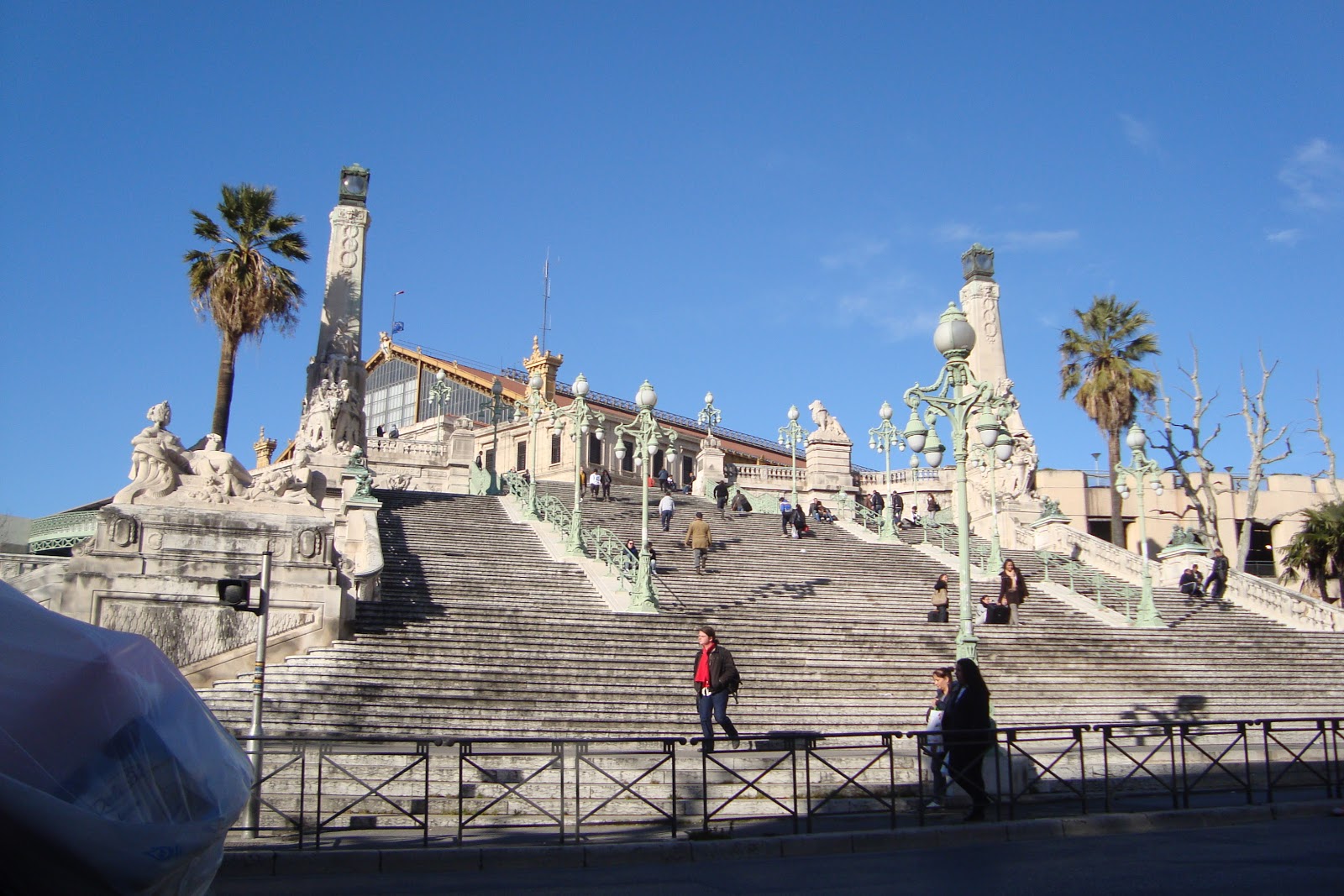
At the Marseille St. Charles TGV, I turn to my fellow traveler, he, with the wife, three smart phones and two blond children. I smile goodbye. “Waalekum Salaam” he responds.

Francois, mine host, greets me warmly, and, as he leads me down the grand steps outside the station, tells me that this city is France’s most multicultural. We walk down the Longue des Capuchins and the flavors of multiculturalism assail our senses. Hotels and street side stalls present cuisines from the fragrant Orient. Lebanese, Moroccan, Turkish and Arab fares grab our attention. Sweets steeped in sugar syrup, sweets made of burnt milk, sweetmeats not unlike barfis bulge lusciously from corrugated paper canapés. As we turn right into the main thoroughfare La Canebiere making our way towards the quay, the Vieux Port, hotels and street front menus written in chalk on blackboard all show the day’s fare, all halaal. Right on the Quai de la Fraternite, on the Neuve is the Jaipur, an Indian Restaurant. Khalil, mine host, is a Pakistani from Peshawar, and offers you naans you could go to war for.

You could look at anyone on the street and know neither ethnicity nor nationality. France has legislated prohibition on displaying religious affiliation on clothing or person. Everyone dresses similarly, exquisitely. But buildings and artifacts, sights, smells the music and speaking in tongues betray the confluence of cultures that only happen in a robust port city.

Saturday, December 11, 2010

What is an architect worth?

What is the value of a professional architect?

This question came up, when, in a recent round of placements for Architectural Interns, one of India's largest and most prolific architectural firms offered interns from my college Rupees Five Hundred per month (Rs.500/-) as salary for placing them. You read that right. Both times.

Apart from being deviant, perverse and downright ridiculous, it is unfortunately not so far from the norm as far as architectural interns in Bombay or the rest of the country are concerned. In architecture colleges, the coursework is for a five-year duration. The final semester of this long course is a term of professional internship where a student joins a firm to understand the nitty-grittys of professional practice and also be an active part of the team of architects that execute projects. They are never intended to be observers or by-standers. Students who join as interns are made to work without any fixed work conditions, and depending from office to office, have to work 12 hours a day or more, and even during weekends. They are (mostly) not reimbursed travel expenses for commuting to work and, as some say, 'hamare office mein chai ka paisa bhi dena padta hai.'

Despite this, many interns join architects offering them an internship salary of anywhere between Rs. 2,500/- to Rs.7,500/-. Few firms offer Rs.10,000/- or above. The highest I have heard is Rs.18,000/- which a student of mine got by joining a firm in Delhi. I have often wondered why, no matter what the pittance offered to them, do students get reconciled, even happy to a salary that amounts to an insulting amount of bheekh (largesse)? The reasons interns give us are:
1. It is a good architectural design firm.
2. I always wanted to work with so-and-so architect.
3. I am getting to learn so many things.
4. I will do my internship here, and then change when the mandatory time period is over.
5. I will get a good recommendation letter from the firm when I apply for post-graduate studies.
6. I am not the lowest paid (in comparison to my peers) so it’s OK.

Why do architects not have even a twinge of conscience when paying sums like these? Architectural firms come in all sizes. There are many one-person proprietary firms with few projects and resources, and then there are some monster firms with staff strengths of over 200 employees and office branches in several cities. Paying such low salaries is not necessarily restricted to size, as is evident by my initial example. Mostly it is a culture of conditioning. And added to that the arrogance of self-aggrandizement. The reasons firms give for their salary structure is:
1. Students don’t learn anything in college. We have to spend time teaching them.
2. They don’t stay with us for a longer duration; they run away the first opportunity they get.
3. We are a small firm; we can’t afford to pay them more.
4. They will never get a better experience than in our firm.
5. They won’t sign a bond to stay in our firm for (x) years.
6. Everybody is doing the same thing.
7. We don't really want interns.

It is by plunging to the lowest common denominator that both employers and interns perpetuate this culture of exploitation. In my irritation and frustration (we have, for several years, tried to get our students placed in offices that pay what the interns minimally deserve, but have not succeeded), I propose that, instead of wasting their half-decade long learning, skills, experience and talent to people who do not value them, they should instead join the unskilled workforce and get jobs either breaking stones or sweeping floors.

Here is the definition of an unskilled employee: An unskilled employee is one who does operations that involve the performance of simple duties, which require the experience of little of no independent judgment or previous experience although familiarity with the occupational environment is necessary. His work may thus require in addition to physical exertion familiarity with variety of articles or goods.

Just as a comparison: an architectural intern is one who does operations that involve the making of architectural drawings and models (the drawings made on computers using specialized software), making site visits, doing site supervision and measurements, meeting clients and other professional consultants, visiting local municipal agencies for procuring certificates of commencement for projects, etc., helping in the creation and checking of tenders and bills of quantities, writing correspondence, sending/receiving drawings and other documents, and doing pretty much everything required by the employee; which requires five years of professional learnings, but whose independent judgment is of little or no value, with no previous office experience, although familiarity with the occupational environment is necessary. The work may require, in addition to physical exertion, familiarity with variety of articles or goods.

Nevertheless, for the purposes of argument let us consider the architectural intern unskilled.

Unskilled workers come under the purview of the Minimum Wages Act, 1948, which is a legislative protection for workers to receive a minimum wage, and a fundamental premise of decent work. With effect from November 2009, the National Floor Level of Minimum Wage is Rs.100/- per day. Minimum wages are fixed for work up to 9 hours a day and 48 hours per week.

For employment in Maharashtra, the Labor Department, Government of Maharashtra makes the following provisions for unskilled stone crushers/breakers: their basic wage varies from Rs.169.23 to Rs.192.31 per day. The total minimum wage for stone crushing/breaking varies from Rs.227.63 to Rs. 250.71 per day. That works out to Rs.5,918.38 at the very minimum for a 26 day working month (a 6-day week).

Unskilled sweepers and scavengers have a similar basic wage and their total minimum wage varies from Rs.194.87 to Rs. 217.95 per day. This works out to Rs. 5,066.62 at the very minimum per month.

To the best of my knowledge, almost one out of every four architectural firms I know of pays their architectural interns less than this. Even using the national floor level of minimum wage, an intern's salary should amount to Rs. 2600/ per month. Certainly not Five Hundred.

A generation of architects has already been warped by this despicable mindset. Architects as employees have no long term loyalty to firms; keep jumping jobs for a pittance in salary raise, develop a mercenary mindset and go abroad the first chance they get. Employers keep taking interns with three month commitments; manage without senior architects, run their show like road contractors offering daily wages to all comers, all this while publishing their work in the glossy magazines.

Sure, this is not in violation of any Child Labor Laws, but them it isn’t much removed from that either.

Just in case you find this hard to swallow, you can read this rather dismal chain of posts from a discussion on ArchNet.

All Wage Data from http://www.paycheck.in/

Sunday, November 28, 2010

My First Serial Killer

I saw Claude Chabrol's Le Boucher (The Butcher, 1970), I'm not sure, but probably around 1974. I was nine.

I watched this film in blurry black and white on Bombay Doordarshan. This was a time of fledgling programming by Bombay's only television channel, leading to its golden age in the mid-seventies. Foreign films were a weekly staple, as I remember, under the program head of 'Montage'. For me though, looking back now, Chabrol's film was one of many firsts: it was my first introduction to world cinema, it was my first sub-titled film (something I unquestioningly accepted as normal) and it was my first serial killer movie.

Of course, what stood out for me was the last bit. As kids we were all brought up on a bloody diet of killing, murder, bloodshed, what have you... you know the wholesomeness of growing up, none of the namby-pamby stuff.

One scene in the movie stood out, clearly imprinting in my memory. I have recalled it many times since, I must have been pleasantly traumatized by it. A schoolteacher takes a bunch of children out on a picnic to a cave site in the hills. They sit by a stone ledge and open their sandwiches. One little girl open her buttered sandwich and exclaims 'Its raining!' The teacher says 'It's not raining.' The girl cries out 'But its red!' and looks up. A bloody female hand with freshly dripping blood pokes over the ledge. Everyone screams. Oh, how we loved watching this then, a bunch of kids in our neighbor's home (the only television set in the area at that time) and replayed it over and over in our heads and in our games. Drops of blood being an index for murder is a corny cliche today, but for us kids it was an affirmation of our own imaginations and fears.

By this time of course I had had my fill of horror stories and horror movies (only through books and magazines, trawling the depths of Poona's British Council Library, where I practically grew up). A particular favorite was the Encyclopedia of Horror Film and Cinefantastique (full of pictures, both scary and naughty-that's where I discovered King Kong, Godzilla, Dracula, Boris Karloff, Bela Lugosi, Vincent Price, Frankenstein, the Mummy, the Creature from the Black Lagoon, The House of Wax, the Thing, the Blob, and everything undead), and of course the monthly Films and Filming magazine that I could never get enough of. Watching these actual movies would come much, much later. No, I consumed texts, still images and above all movie posters, lurid marquees in books and magazines and outside on all the cinema theaters I passed everyday in our school-bus on our way to school, fueling fantasies and populating the visual libraries in my head.

Chabrol, of course, I saw for the first and only time time that evening in the mid 70s. I found the scene again today, after nearly 40 years, and in glorious color here. And yes, the scene played put pretty much as I remembered it. Amazing, how I must have internalised the whole thing. A few years later, still a kid, I wrote a murrrderrr ishtory of my own called 'Whatever happened to Aunt Alice?' full of killing and assorted bunkum, where the first clue to a possible doing-in were three drops of blood on a bedsheet. Yes, yes, I did Google the title today to find that it was a film made in 1969, and I must have seen the title somewhere, what did I know? Plagiarism does not exist when you are ten. I must have seen the poster on the right, it has a gory familiarity, the blood is just about right. Also, this just occurred to me: the image of the bloody hand on the DVD box mirrors the hand in Le Boucher. Some amazing triangulation happening here, both inside my head and outside of it.

But of this I am sure of:
when those drops fell on the little girl's open buttered sandwich, I saw them fall in red.

Wednesday, August 25, 2010

A New Beginning


This is the first piece I wrote for Time Out Mumbai, occasioned by their 'End of the Line' issue on the last suburbs at the end of the Mumbai Local lines. Panvel, of course is currently the last station on the Harbour Line.

A New Beginning
Mustansir Dalvi tries to makes sense of living in Panvel

A patch of road, about three feet wide, crosses my path to the railway station on the New Panvel side. Elsewhere, the road continues, well tarred regularly before each monsoon. This singularity, however, remains untouched and has been since the Harbour Line made its way into town in 1995. Not just unmaintained: it was never built in the first place. Every subsequent overlay of tar turns this dirty old track into an even deeper crater filled with rocks and plastic detritus. Each morning, as I drive station-wards, I am compelled to make obeisance here with a loud, teeth-rattling thump. Departmental no man’s land between the Central Railway and CIDCO, to me this patch represents Panvel itself. 

   We found a home in New Panvel in the early ’90s. It was planned by CIDCO, circa 1970, as part of the New Bombay Project. Across the highway is “old” Panvel (of the same vintage as the Big City across the pond). New Panvel – or Naveen Panvel, as it’s now known – falls between several jurisdictional cracks. Part of revenue district Raigad (but not the Raigad Lok Sabha constituency), not under the Navi Mumbai Municipal Corporation nor administered by the Panvel Municipal Council, yet, apparently maintained by CIDCO, our little hub of urbanity is paternally challenged It’s at one end of the Harbour Line. Although Panvel is a terminus for the suburban line, through trains connect it pan-India, from Hazrat Nizamuddin to Thiruvananthapuram. Old and Naveen coexist, like Siamese twins, both conjoint and severed by the railway and the NH4.

   New Panvel was a one-horse town when we first bought our home, and remained so until the millennium. I can get nostalgic about leisurely drives down its wide, main avenue perpendicular to the highway, through the town and beyond into pristine wilderness, into the spectacular hillscape at the foothills of Matheran. Every monsoon, we chased the elusive 180 degree rainbow. We got lucky, once. Then, we would return to this well-planned place that, for 30 years, merely existed; a place for investors and absentee landlords, a few service shops and several jewellers’ boutiques that fronted for moneylenders. New educational complexes grew and prospered because land was available, as was easy residential accommodation. “Then came the churches, then came the schools, then came the lawyers, then came the rules; then came the trains and the trucks with their load,” exactly as Dire Straits predicted in their song “Telegraph Road”. New Bombay developed, but this node awoke only after the Harbour Line reached Panvel in 1995. 

  
In the ’90s and noughties, as we paid up EMIs at 16.5 per cent, Panvel surfed the crests and troughs of real estate vagary and emerged, unlike sisters Vashi and Kharghar, resolutely downmarket. Migration fuelled economy; incoming communities marked their presence with new religious places – a temple to Kali, another to Ayappa, a new mosque, the unusually named CIDCO Vinayak mandir.  Forty years on, the wrinkles are visible, what with the administrative ambiguity the city finds itself in. Now, various levels of neglect can mean that load-shedding hits us as if Panvel is a rural backwater; local rickshawallahs scorn metering (for every fuel price hike of one rupee, their base-fare rises by five); garbage collection is sluggish; bins are usually taken apart by stray dogs, who rule the night and run in packs of 20.

   The other Panvel, to my right as I get off the train, is, not unlike Mumbai, an old town in a new world. Historically both a port and a trading town, Panvel was once the rice bowl of the north Konkan, with its famous Bazaar Peth, Mirchi and Kapad Gallis. Panvel Gaon dates back to 1725, when the Bapat Wada was built. It was elevated in the 1800s, when migrants from the Konkan were populating Bombay and Panvel Shahar became an alternate place to make a home. When you talk to old-timers, they tell you that a newcomer could always find home in the Bapat Wada and occupation in Dhootpapeshwar, the ayurvedic factory. While the factory is gone, the wada still shelters several hundred residents.

   Then as now, festivals at the many temples, mosques, dargahs, even a synagogue bring the faithful thronging to Panvel. The oldest temple, the Ballaleshwar, is from the eighteenth century; the Beth-El Synagogue was consecrated in 1849. When I visit these places today, I am struck by their similarity. On the outside, every place of worship looks like every other, and only reveals the trappings of faith when I enter. This old town was once a paragon of middle-class cosmopolitanism. Its various communities – Hindus, Muslims, Jews and Jains – shared a Konkani culture, food, clothing and Marathi as lingua franca. 

   In the past 20 years or so, I have seen attitudes stiffen: today, gentrification pervades, the old bonhomie is breaking down. More and more overt displays of religion and community foreground civic life – flags and flex-banners pervade. I am uneasy when I encounter makeshift notice-boards, not-so-subtly exhorting good religious behaviour. Money also fuels change. Many (thankfully, not all) of these places of worship are now “renovated”, with RCC shikharas and minarets sprouting incongruously. Many wadas too have given way to MHHSes, or Middle Class Housing Societies. Now, tall buildings crowd narrow alleyways bottlenecked with newly acquired cars. No country for old men.

  But I wallow in my good fortune, for, out of my window I can see, beyond the whooshing SUVs on the expressway, Panvel’s glorious peaks – Malang, Vishal, Prabal, Matheran and Karnala. Each with signature crowns, they transport me to the geological beginnings of the Mumbai Metropolitan Region. This entire geography was the result of great and sustained volcanic eruptions 65 million years ago that cooled to form the Deccan, the Konkan and the isles that were Bombay (eliminating all the dinosaurs in the process). This craggy beauty bookends Navi Mumbai to the east and signals the end of the Harbour Line. 

   Meanwhile, Panvel waits; patient, like the stone sentinels that shadow it, patient like Mother Konkan, who waited decades for the railways to link her to the ghats. Panvel now waits (as I do) for a new airport, a new SEZ, a fast train to Mumbai or even a three-foot patch of road to energise its fortunes – and mine. Until that happens, I have to be content with “Asia’s largest railway station” (all steel mushroom decking and faux Egyptian columns), still in the making. 


Sunday, July 4, 2010

Marad hona toh aisa hona

from 
'Marad ona toh aisa hona' 
 
Amul Banner from 1986
to
'Mera rona to kaisa rona' 

Other Amul banners featuring God's Own Hand down the years.
Diddled by Germany in the past too.

carded for substance abuse


Saturday, June 26, 2010

Millennium and its discontents


The one big problem with the Millennium Trilogy by Stieg Larsson is that the bad guys never, ever have a real chance of winning.

Like Greek tragedies in reverse, things go steadily downhill for the antagonists as destiny and fate, or Salander and Kalle Bloody Blomkvist decree their ultimate annihilation and/or demise. The inevitability of an Evildoers Apocalypse makes you just canter along merrily for the ride, your heartbeat and pulse rate remain at balmy normality as it all plays out and the Gurrl mit der Dragon Tattoo walks into the sunset with her stolen billions. After a point, patience does get stretched.

Very rarely in a novel in the thriller genre do you encounter such has-been, past-the-expiry-date, doofus-brained villains, all with two left feet and un-opposable thumbs. One of the many perpetrators of atrocities is actually a geriatric in a wheel-chair who is almost perpetually connected to a dialysis machine, even as he plans to shower fire and brimstone on the equally gormless Salander and Blomkvist.

To sustain an interest in nearly 2000 pages of adventure you must at least have the occasional possibility of mortality for the main characters, should you want to root for them. Here, even a bullet in the head brings no grief, and is little more than an excuse for 200 odd pages of hospital procedural. It is understood that the protagonists are not going to be bumped off (not until the very end of it all, if at all) but at least there should be the fear of such a possibility and the dread that comes with it. Even a kindersroman like Harry Potter makes us, on occasion, feel that something very, very bad is round the corner, and the anticipation of what might be raises goose pimples, as it should. Mikael Bastard Blomkvist and Lisbeth Insouciant Salander and their clueless peripherals go their merry ways like a fairy/doll house tea party in Enid Blyton’s Enchanted Forest.

The utter safety that this narrative provides is probably the reason for the books’ success. Larsson jettisons drive and anticipation for wish-fulfilment and vicarious voyeurism. If you choose to identify with the good guys, it is promised that only good things will happen to you, and you can string along until ultimately good things do happen. Larsson satisfies many forbidden urges- breaking down all barriers of the privacy of others, while keeping your own secure, procuring vast sums of money by dubious means but never getting caught (also experiencing the pleasure of spending vast sums of  said monies on pleasuring the self), and of course, screwing all and sundry on two legs. How many of the main characters does Bonking Blomkvist make his conquests? Five, or six, by my last count. Pity he doesn’t swing both ways, or Larsson could have made him sleep with most of the bad guys too.

Salander’s actions, on the other hand, are a result of childhood abuse, but most of that is in the past. Her present is all about the exploitation of the system she finds herself in without responsibility or consequence. Even rape is an opportunity or strategy to get even. Victimhood for her is like some other person, another body that is constructed in the present and put to use for personal gain. Talents like cyber-hacking and passive-surveillance allow her to do pretty much anything, almost like a denizen of Krypton in Metropolis. There is never failure. While reading you are carried forward in the sugar-rush of procedures and methodology of police work, the judiciary, journalism, sting operations and publishing, of the life and mores of millennial Sweden, while all is accomplished as smoothly as a hot knife through butter.

Spare a thought for the poor sods at Tehelka. They must be gnashing their teeth in horror while reading these books. They know a thing or two about consequences.


Monday, April 19, 2010

The Romance of Red Stone


You are cordially invited to the book launch of

The Romance of Red Stone
An Appreciation of Ornament 
on Islamic Architecture in India


Photographs by
Yashwant Pitkar
Text by
Mustansir Dalvi

Published by M S Lehri
Super Book House
Mumbai
Hardbound
11” x11”
256 pages


Friday 23rd April 2010, 5.30pm
at the Claude Batley Gallery
Sir JJ College of Architecture, 78/3 DN Road, Mumbai

Ms. Tasneem Mehta,
Convener, Greater Mumbai Chapter of INTACH
Honorary Director and Managing Trustee
of Bhau Daji Lad Museum, Mumbai
has kindly consented to release the book on the occasion.

We look forward to your presence 
on the evening of the 23rd.

YD Pitkar  MM Dalvi


About the Book

In The Romance of Red Stone, Yashwant Pitkar presents architectural ornament as a feast of craftsmanship, an enduring romance with shape and stone in its unending variations. Pitkar’s photographs allow the viewer to appreciate Islamic ornament on architecture at a level removed from the formal- as an articulated surface. An architect first, then a photographer, Pitkar’s images reflect his love and admiration  for the buildings of Delhi, Agra and Fatehpur Sikri, amongst others, which he captures in a way he knows best, up close and personal.


His unique photographic gaze is like that of a Mughal miniature painter, or a Company artist, taking the viewer close to the buildings, enough to shut out the dominating forms of the architecture to be immersed right into the aesthetics of surface. For those familiar with these buildings, the photographs allow a return, a recollection of architecture as a phenomenon, giving a sensual experience of places visited; an effective feel for the infinite craft.


Pitkar’s images also work at a deeper philosophical level. The viewer is made aware of the inner meaning of aesthetic representation, of the different ways of inducing the immeasurable. The plays of multiple superimposed levels and of forms and patterns continue like an incantation beyond the photographer’s frame suggesting the infinite.


Mustansir Dalvi’s text complements Pitkar’s photographs by guiding the reader to an understanding of the variety and symbolism of ornamental forms that grace Islamic architecture, especially in the Indian context. Ornament in its many manifestations transforms the architecture, dematerializing immense monuments into elegant jewel-boxes. Dalvi shows how artisan and patron came together in India in a unique integration of two divergent world views and cultures to create a lasting syncretism of Islamic and Hindu traditions that reached its zenith in the architecture of the Mughal period.

Sunday, December 20, 2009

Which historical wrong gives you the right?


One bone of contention that bedevils any talks on climate, such as those currently on at Copenhagen is that the ‘developed countries’ must bear the brunt of responsibility for climate change. This is through fundamental restructuring of production and enterprise, everyday living and general progress in these nations, the ones who are well off. The developed countries of the world, Old Europe and New America have reaped the benefits of industrialization for the past two hundred years, most of it through the over-generous use of the finite resources of the planet. In doing so they have polluted the atmosphere, not only locally but globally, raising temperatures, and have brought the natural resources of our planet to the edge of depletion. All this is substantially true, but to make a whipping boy of industrialized countries by positioning themselves as victims, the ‘developing countries’ make poor, untenable arguments. These countries and indeed those of the ‘underdeveloped world’ want to have it both ways- make the big boys pay for the sins of the past and continue their own present substantially polluting ways because they ‘need to develop’ to come on par with the rest/best.

I think it is this misguided sense of victimhood, this subaltern posing that will bring useful action on climate change to an inevitable halt. The sense of historical wrong that the Other World is ballyhooing has a whiff of hypocrisy about it. For which are the historical wrongs that give those present a right to redress? That the sins of the fathers committed in the name of development are the sins of the sons and need immediately to be countered, whereas the sins of the fathers committed in the name of racism, religious intolerance and ethnic fundamentalism should be let go in the name of reconciliation and the need to ‘move beyond’? Can one assert that one wrong is tenable while the other is not? Take your pick. Every historical wrong, from the Jews being dispossessed by the Romans to the depredations caused by every former coloniser on every former colony, from the temple breakers of the early 1100s India to those crusaders who sacked Constantinople rather than continue their own religious jihad on Jerusalem can be called upon once again and through their descendants be made to pay for the wrongs of the past. Why then should the descendants of those who created, nurtured and ultimately prospered because of the Industrial Revolution now have to pick up the tab? Even more so, it is a wilful under-appreciation of the fact that industrial progress has, whether those crying wolf like it or not, raised the standard of living of peoples everywhere, which in turn has allowed even the erstwhile dispossessed to reclaim their rights and dignity, right up to the point where they can make these one-sided claims.

It is time primarily to put one’s own house in order. In terms of the environment, the price to pay will be high. The changes to shift to a more sustainable way of being are paradigmatic in most cases and painful for those accustomed to the comforts of a lifestyle fuelled by using natural resources and pollution as most of the developing countries, China, India, Brazil and those of the Middle and Far East already are. They strip-mine, dump sewage into fresh-water, mass produce vehicles of mass pollution and pat themselves for their progressive ways. Such countries have no business posing as victims so that they can continue their exploitative ways ‘for some more time’ so that they can come up on economic par with the First World. In the case of a ticking bomb scenario, as climate change very much is, each country should put their nose to the grindstone and find their own ways and means to convert to more sustainable ways of living. Laying down conditions, buying time, and creating ‘first you, then us’ arguments will only make things worse, and things such are they are, bring in no cheer at all.

To that extent the Government of India should be lauded for making targets for emission cuts by themselves, without waiting for agreements on climate such as those being attempted at Copenhagen. This is by no means enough, but should show the rest of the world that unilateral attempts to alleviate the ill effects of climate change should be the precursor to coming together at the negotiating table. All strategists are aware of the management game called the Prisoner’s Dilemma. When this game is played iteratively, the best way forward is ‘Do Good First’. The phenomenon of conditional reciprocity that all the developing and undeveloped countries are waiting for shows them up in a poor light. No matter how under-resourced you are, you can change and you should. Remember if you have nothing, or not much at all, you are not contributing overmuch to the problem. That does not give you the right to become an exploiter,  just because your neighbours or former rulers have been.

Strategy begins at home.

Monday, October 19, 2009

What happened to the Lions?

Starlings are tough
but the lions are made of stone
...I'm thinking about the lions
What happened to the lions, in the night?
"Lions" (1978), Dire Straits

After the delight of walking through the Court of Myrtles in the Alhambra at Granada, and entering the fabled Court of the Lions, we were in for a shock. For the lions, all twelve of them, had gone walkie, leaving behind a forlorn basin in a new wooden box. Why build a cage after the lions had bolted? The marble lions, the centre piece of the court had been removed to a safe haven to be restored. Over the centuries, lime and grime had coated their noble visages to a point where their features were in danger of being obscured. Conservators would toil over the course of the next two years (2009-2010) to bring back the beasts to their pristine state.

No consolation to us though, we, who had paid good money to see them. However temporarily, the centre piece of the visit to this Nasirid Court, built by Muhammad V between 1362 and 1391, was obscured. The tableau of our imaginations collapsed like a card-castle, and replaced by an entity as alien as the monolith among the Neanderthals in Kubrick’s 2001. What appreciation could be possible for the surrounding court and chambers, with their exquisite ornament of geometric and calligraphic finesse, when the vellum itself was botched with spilt ink?
What were the conservationists thinking?

This brings me to the issue of interventions. Any infill in an existing environment will be viewed critically in inverse proportion to the time that environment has remained pristine. Any change that is not incrementally invisible will hurt both memory and ‘good taste’. Part of our mooring in life is to be able to take some things for granted, and the environment in which we physically move, that of the home, the street and the city work best when they are backgrounded to our own lives. So change, any change, would in effect be undesirable. We would be fooling ourselves, however, if we thought that we could live in the vacuum of our own imaginations forever.

So what kind of intervention is the more acceptable- the harmonious or the unpredictable? In recent times architects have been called upon to make these choices in an increasingly built environment. There are few tabula rasas, especially in our ageing cities, spaces are constantly being remodeled for a variety of reasons. Insertions are inevitable, and they will be new. What attitude of conservation, or conservatism should the architect adopt?

Look at the insert in the Court of Lions. The central fountain of marble was two tiered- with a large lower basin and a carved upper fount. Twelve lions flanked this basin radially facing outwards. Positioned more or less in the center of the Charbag that the crossing water channels formed, the fountain formed the focus of  both axes that led in from the entrance to the court and that led out from the surrounding chambers. Both lions and upper fount are now significant by their absence. The lower (large) basin was in need of conservation, too. The rim of the basin boasts of an eulogy for Muhammad V carved in calligraphed marble by Ibn Zamrak describing the building of the court and of the lions. You can read this poem below.

The basin is large, simply too large to remove from its central location. So it has been enclosed, not by a tarpaulin or some such, but in a ‘camera’- a room of its own. This room is made of slatted timber on a metal frame, with glazed front and back along the shorter side of the court. Visitors can view the basin as it goes through various stages of restoration from the glazed ends, while the slatted end gives a new foreground to the axis leading on to the Hall of the Two Sisters and the Hall of the Abencerrages.

Under the roof of this box is a canvas canopy that can be moved as desired. The outer box of wood can (seemingly) be slid out along its axis to allow for a larger inner volume, and the canvas roof on the metal frame can be then be a shelter against the harsh south Mediterranean sunshine. The wooden slats allow for cross ventilation and the glass has perforations too. The entire system sits lightly on the pebbled base of the court. With this intervention, the conservators and their precious object are protected from the elements- from both solar radiation and the droppings of the thousands of swallows who inhabit the Alhambra, providing a constant chirruping in the background and casting abstract patterns on plastered white walls in the various courtyards. All very functional, of course, but does the intervention work?

It does take getting used to. First, the disappointment of the missing lions needs to be overcome, and then a reconciliation with the wood, glass and canvas replacement. The ‘camera’ is a small room, proportioned not to overwhelm the arcade of the court, allowing space and light enough to appreciate the existing architecture. It forms a new element, an installation, in this space, that creates its own presence, becoming part of the stepped visual axes as it rises from fountain to arcade to roof to dome. The glazed ends form a portal framing the basin with the arches behind, and you realize that nothing is really lost.
The Court of the Lions in the Alhambra now offers an alternative view, for a limited period only, as long as the conservation process lasts. During this time the arcades themselves have come into their own, not having to remain secondary to the impressively iconic lion fountain that dominated the composition of the court. The ‘camera’ can be appreciated, in of itself, as a well crafted modern device, or seen as at an interim scale between the basin and the arcade in a larger unfolding of spatiality. The absent lions constantly intrude on our imaginations. The conservators have made the right choice by not replacing them for the time being with plaster or GRF casts.

For too long in the last two hundred years has the Alhambra been exoticized and orientalized, mostly by visitors from the West (Washington Irving, Richard Ford, et al) who came to wallow in its ‘perceived’ decadence and relegated it to a ruin by treating it as such, occupying it with unseemly callousness, vandalizing it with graffiti. After centuries of suffering in such pitiless ‘timelessness’ the Alhambra, or one part of it at least, has become a dynamic space once again, with its new intervention. Artists like Christo and Anish Kapoor today, thorough their installations in well regarded public spaces make us renew our relationship with those environments by shaking our own perceptions of those spaces, and asking us to seek new meaning in those places that we took for granted. Maybe this was not what the conservators at the Alhambra really had in mind, but the enclosure around the basin forces us to look at the former Moorish palace anew, and that is something.


John Dobbin, Lions in the Alhambra
Water color, From a sketch made in 1859, V&A Museum, London


Poem on the basin of the Lions
Ibn Zamrak (1333-1393)
"May The One who granted the Imam Mohammed
with the beautiful ideas to decorate his mansions be blessed.
For, are there not in this garden wonders
that God has made incomparable in their beauty,
and a sculpture of pearls with a transparently light,
the borders of which are trimmed with seed pearl?
Melted silver flows through the pearls,
to which it resembles in its pure dawn beauty.
Apparently, water and marble seem to be one,
without letting us know which of them is flowing.
Don't you see how the water spills on the basin,
but its spouts hide it immediately?
It is a lover whose eyelids are brimming over
with tears, tears that it hides from fear of a betrayer.
Isn't it, in fact, like a white cloud that pours
its water channels on the lions and seems the hand of the caliph,
who, in the morning, grants the war lions with his favours?
Those who gaze at the lions in a threatening attitude,
(knows that) only respect (to the Emir) holds his anger.
Oh descendant of the Ansares, and not through an indirect line,
heritage of nobility, who despises the fatuous:
May the peace of God be with you and may your life be long
and unscathed multiplying your feasts
and tormenting your enemies! "


PS.
The fountain was two-tiered- lower large marble basin, upper carved nozzle with a smaller basin. This is evident in the water colour by John Dobbin from the 1860's. The two tiers are also visible in a silent documentary on Granada and surroundings made in the 1920's.

However all contemporary photographs before the restoration show only the lower large basin with the lions. At what point was the upper portion removed? Was it, in fact, a later addition- after Ferdinand and Isabella took over the premises in 1492? I have not been able to find any references to corroborate.

For the time being, the missing part of the fountain remains a curiosity.

.