
When Dharavi grows up, it does not want to be Shanghai
 |
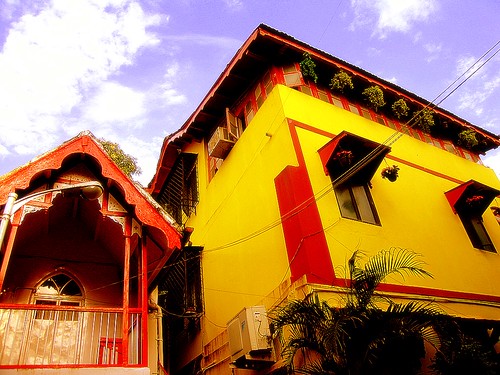
Dharavi Koliwada
Photo by Smita Dalvi, (c) 2009
|
When Dharavi grows up, it wants to be Khotachiwadi. Or Fontainhas. Certainly not Shanghai, nor Singapore, god forbid, with all its imposed hygiene and eugenic living.
The vast slums of Mumbai are blithely derided and dismissed. They suffer from a monomaniacal insistence from the upper city: that they are unwanted and should be removed. This wanton labeling ensures they remain under-appreciated. Even when condescended to as being vital to the city's services — that they provide Mumbai's manpower — an undertone of otherness separates them from the city that matters.
Slums in Mumbai, such as they are, have to be seen for themselves. Of course, many of them occupy plots whose ownership is contentious. But not all, having grown from earlier settlements that sometimes predate the city.
Easily ignored in this tarring and feathering is that slums are diverse: they are just being settled or undergoing transformation, young or old, random or well laid out. Despite this, they share one important trait with the city itself — they are in a state of becoming.
Slums, in their third stage of development, are not free from the threat of demolition. But they have ways to deal with it. What they cannot deal with is the finality of 'rehabilitation'.Reuters From their very rudimentary beginnings, one can notice a sense of order. Settled first as 'tent cities', slums begin their infancy as roofs, as mere shelters and little else. In their chrysalis stage, they get the 'slumdog' image that is so familiar — hutments with rough and ready enclosures of blue tarpaulin or flex movie hoardings, pattra or cement sheets held in place by brickbats. These are the settlements that suffer most in the rains, bear the brunt of frequent demolitions and fires, and have problematic sewerage and drainage.
In their third stage, however, they aspire to becoming pucca, properly rebuilt with services equivalent to the rest of the 'legitimate' city. Large areas of the so-called slums of Mumbai have already reached this stage. They are rarely noticed. From Dharavi to Deonar, from Cuffe Parade to Bhandup, these erstwhile settlements are now full-fledged urban neighborhoods that create value for themselves and their immediate surroundings. Once again, a sense of order and self-similarity prevails, with most issues of hygiene and public health already resolved.
These neighborhoods are hives of building activity. The houses here have long passed the hutment stage and are now as pucca as your own homes, albeit in constrained conditions. Unlike most flat owners (this means you), these homes occupy a plot on the ground and rise to a height that will not get them in trouble with the BMC. They are built in RCC and brick masonry, finished with ceramic tiles, both inside and outside, are clean and largely maintenance-free. They have electricity and piped water running to their kitchens and toilets. This is clearly seen by the miles of running pipes over ground, on both sides of the streets. The roads outside their homes are paved with interlocking tiles, just like any other part of the city.
Despite this, the Slum Rehabilitation Authority (SRA) chooses to name these localities as 'difficult' areas, and damn them to the eternal hell of rehabilitation.
The first impression one gets while walking through these localities is the humane scale of building, the coziness of homes, shops and production units nestling close to each other. You know the fortune of each dweller is dependent on their neighbor. This social network is a vast support system, fueled by proximity and circumstance. One is reminded of the Barrio das Fontainhas in Goa, with its similar architecture of narrow, sheltered alleys, quaint, colorful facades and outdoor living. Or of Khotachiwadi, an urban village in Mumbai, a well-knit community, so popular with tourists who love just to walk through its narrow streets and pocket plazas.
Matias Echanove and Rahul Srivastava of URBZ, located in Dharavi, study user-generated cities. They have interacted with various contractors and mistrys who build the houses in these 'slums' and have documented their work. They demonstrate that the construction is efficient and locally derived, based on such optimization of men, materials, processes and time as could give a few good lessons to professionals in building and management. Although untrained, these contractors develop on a bank of building lore, learning from precedent and experience, adjusting to the vagaries of budgets, climate and the ever looming threat of demolition. For example, their way of introducing toilets in places where underground infrastructure is absent is remarkable for its ingenuity. They are also true masters of recycling, nothing goes waste. Each house is built on the debris of its older avatar, which when demolished is compacted into a high plinth. Those organisations rating 'green' buildings for low carbon footprints and zero-energy construction would have a field day here.
These slums, in their third stage of development, are not free from the threat of demolition. But they have ways to deal with it. What they cannot deal with is the finality of 'rehabilitation'. Entire neighborhoods could be razed and reconstructed in a faux Singaporean image, with the inhabitants being 'rehoused' in zoo-cages of 300 square feet several feet above the ground. This is a strong possibility. This new model goes against the grain of every neighborhood as has developed organically over a period of several decades. The architect Richard Rogers has critiqued such models of rehabilitation: "If you can repair, it is so much more sustainable than starting again. We should reuse land and materials. Even slums can be renovated."
The short, sharp shock proposed by the SRA will result not only in gentrification, but in displacement. The social integration of currently thriving neighborhoods and the value, both material and intangible, that they have infused into the plots they currently occupy will be unraveled in no time. Connections, associations, inter-dependency, a strong shoulder to rest on in times of need will all get subsumed in a miasma of legitimacy. It is sad to contemplate that the only network that these communities would now have easy access would be Facebook.
The vast slums of Mumbai are blithely derided and dismissed. They suffer from a monomaniacal insistence from the upper city: that they are unwanted and should be removed. This wanton labeling ensures they remain under-appreciated. Even when condescended to as being vital to the city's services — that they provide Mumbai's manpower — an undertone of otherness separates them from the city that matters.
Slums in Mumbai, such as they are, have to be seen for themselves. Of course, many of them occupy plots whose ownership is contentious. But not all, having grown from earlier settlements that sometimes predate the city.
Easily ignored in this tarring and feathering is that slums are diverse: they are just being settled or undergoing transformation, young or old, random or well laid out. Despite this, they share one important trait with the city itself — they are in a state of becoming.
Slums, in their third stage of development, are not free from the threat of demolition. But they have ways to deal with it. What they cannot deal with is the finality of 'rehabilitation'.Reuters From their very rudimentary beginnings, one can notice a sense of order. Settled first as 'tent cities', slums begin their infancy as roofs, as mere shelters and little else. In their chrysalis stage, they get the 'slumdog' image that is so familiar — hutments with rough and ready enclosures of blue tarpaulin or flex movie hoardings, pattra or cement sheets held in place by brickbats. These are the settlements that suffer most in the rains, bear the brunt of frequent demolitions and fires, and have problematic sewerage and drainage.
In their third stage, however, they aspire to becoming pucca, properly rebuilt with services equivalent to the rest of the 'legitimate' city. Large areas of the so-called slums of Mumbai have already reached this stage. They are rarely noticed. From Dharavi to Deonar, from Cuffe Parade to Bhandup, these erstwhile settlements are now full-fledged urban neighborhoods that create value for themselves and their immediate surroundings. Once again, a sense of order and self-similarity prevails, with most issues of hygiene and public health already resolved.
These neighborhoods are hives of building activity. The houses here have long passed the hutment stage and are now as pucca as your own homes, albeit in constrained conditions. Unlike most flat owners (this means you), these homes occupy a plot on the ground and rise to a height that will not get them in trouble with the BMC. They are built in RCC and brick masonry, finished with ceramic tiles, both inside and outside, are clean and largely maintenance-free. They have electricity and piped water running to their kitchens and toilets. This is clearly seen by the miles of running pipes over ground, on both sides of the streets. The roads outside their homes are paved with interlocking tiles, just like any other part of the city.
Despite this, the Slum Rehabilitation Authority (SRA) chooses to name these localities as 'difficult' areas, and damn them to the eternal hell of rehabilitation.
The first impression one gets while walking through these localities is the humane scale of building, the coziness of homes, shops and production units nestling close to each other. You know the fortune of each dweller is dependent on their neighbor. This social network is a vast support system, fueled by proximity and circumstance. One is reminded of the Barrio das Fontainhas in Goa, with its similar architecture of narrow, sheltered alleys, quaint, colorful facades and outdoor living. Or of Khotachiwadi, an urban village in Mumbai, a well-knit community, so popular with tourists who love just to walk through its narrow streets and pocket plazas.
Matias Echanove and Rahul Srivastava of URBZ, located in Dharavi, study user-generated cities. They have interacted with various contractors and mistrys who build the houses in these 'slums' and have documented their work. They demonstrate that the construction is efficient and locally derived, based on such optimization of men, materials, processes and time as could give a few good lessons to professionals in building and management. Although untrained, these contractors develop on a bank of building lore, learning from precedent and experience, adjusting to the vagaries of budgets, climate and the ever looming threat of demolition. For example, their way of introducing toilets in places where underground infrastructure is absent is remarkable for its ingenuity. They are also true masters of recycling, nothing goes waste. Each house is built on the debris of its older avatar, which when demolished is compacted into a high plinth. Those organisations rating 'green' buildings for low carbon footprints and zero-energy construction would have a field day here.
These slums, in their third stage of development, are not free from the threat of demolition. But they have ways to deal with it. What they cannot deal with is the finality of 'rehabilitation'. Entire neighborhoods could be razed and reconstructed in a faux Singaporean image, with the inhabitants being 'rehoused' in zoo-cages of 300 square feet several feet above the ground. This is a strong possibility. This new model goes against the grain of every neighborhood as has developed organically over a period of several decades. The architect Richard Rogers has critiqued such models of rehabilitation: "If you can repair, it is so much more sustainable than starting again. We should reuse land and materials. Even slums can be renovated."
The short, sharp shock proposed by the SRA will result not only in gentrification, but in displacement. The social integration of currently thriving neighborhoods and the value, both material and intangible, that they have infused into the plots they currently occupy will be unraveled in no time. Connections, associations, inter-dependency, a strong shoulder to rest on in times of need will all get subsumed in a miasma of legitimacy. It is sad to contemplate that the only network that these communities would now have easy access would be Facebook.
 |
Dharavi Koliwada
Photo by Smita Dalvi (c) 2009
|
 |
Street in Fontainhas, Goa
Photo by MalenaN; posted in virtualtourist.com
|
 |
| Khotachiwadi |


