Showing posts with label Urban Bawl. Show all posts

Saturday, May 12, 2012

Urban Bawl 7: Hate Story

An edited version of this piece is the seventh in the series of my Urban Bawl columns in Time Out Mumbai for their 'Back of the Book' page.
This is published in the May 11-24 2012  (Vol 8 Issue 19) issue of Time Out Mumbai.


Hate Story

I don’t really hate my city, though-

I am concerned that we have more than enough resources to change the city, but hardly any to preserve it. That our urban memory does not seem to go deeper that our last Facebook update. That we have suddenly become hypersensitive about our rights as citizens but lackadaisical about our responsibilities.

I am worried that every square inch of our city is fair game for builder/speculators; including the house I live in. That it is acceptable to demolish a 5 storey building only 5 years old to build a 40 storey new one, thanks to the toppings provided by 33/7, rehab components, TDR and relaxed FSI.

I find it ironical we believe that the densest neighbourhood in the world, Kalbadevi, can be further densified by cluster development. That Chor Bazaar will inevitably become a thing of the past. That the balcony has already become a thing of the past.

I think it hypocritical that Mumbaikars complain about how filthy our slums are, when Mumbai itself does not have a culture of separating its garbage into wet and dry compartments.

I am outraged that a skywalk from CST to Churchgate could even be contemplated. That congestion on our streets can be resolved just by building another street over it. In fact, our general belief that all the problems of the city can be solved by more building.

I am filled with wonder that, on the one hand we hope that 3 compartment elevated trains with automatically closing doors will bring down overcrowding in trains, while at the same time older platforms are being extended to fit 15 dabba trains. That I live in that part of the city where rickshawallahs have never plied by the meter, yet go on strike each time the minimum fare needs to be raised.

I am disgusted that Churchgate station needed to be tarted up with public funds to become an ugly, blister-packed carbuncle. And yet, we still snigger at Antilla whenever it is mentioned.

I think it is silly that public art in our city can only be designated as such by fencing it off and putting a label on it. Come February, I dread seeing the pastiche soup of installations at Kala Ghoda that will inevitably send me into deep depression until approximately the same time next year. That the second most photographed building in the country, the Bombay Stock Exchange, needs a monstrous neon sign proclaiming that it is, in fact, the Bombay Stock Exchange.

I despair that it nearly impossible to get a couple of decent fried eggs in the city. That the local Udipi charges me Rs.16 for a cup of tea and Rs.50 for a Sada Dosa. That the Wayside Inn has already become a thing of the past.

I live for the day when cinema theatres will display slides in BIG BOLD letters that say: ‘Turn your f***ing phone off right now, Bhen****!’ before the movie begins. Same is true for announcements in local train compartments, instead of ‘Pudcha Station- Currey Road’ in 3 languages.

I am cross that I have to pass through at least three security filters before I can use the loo at the Taj, which has always been the convenience of choice when I am in the vicinity.

Sunday, April 1, 2012

Urban Bawl 6: Sniffing Books


An edited version of this piece is the sixth in the series of my Urban Bawl columns in Time Out Mumbai for their 'Back of the Book' page.
This is published in the March 30-April 12 2012  (Vol 8 Issue 16) issue of Time Out Mumbai.


Sniffing Books

The news that the final curtain was brought down on the print edition of the Encyclopaedia Britannica brought back memories of how central its weighty, leather-spined volumes were to libraries. My school library had a set, as did my college, the colleges I taught in and teach in now. The grand old public libraries of the city- the British Council and the American Centre had a set too; the American had Encyclopaedia Americana to boot.  Just as the Britannica was central to these libraries; these libraries were central to our city. Their recent passing into avatars that have left them but a shadow of their former selves has been a matter of great regret. What is a library if you cannot go there; books, if you cannot touch them and there are no pages left to sniff?

You need a library (or two) to bookend your life. You need the comfort of interminable shelving to know that all is right with this world. You need to smell the pages- tangy new ones and musty yellowed ones, the odour of familiarity wafting around while you immersed yourself. Even those corners of the libraries, where it seemed no one ventured (like the dusty shelves with the encyclopaedias), held a special place in your heart. 

All through the eighties and much of the nineties, the BCL and the American were my special vice. I was addicted enough to make weekly visits to these dens of intellectual stimulation. Having a sturdy jhola was as important to my existence then as a smartphone is today. I would walk from VT to the American Centre,  pick up four books; walk to the British Council (eat the best pav-bhaji in town just outside Maker Chambers), issue another four books and lug all eight all the way back to VT- the jhola strap slicing into my shoulder could not erase the smile on my face.

In those cycles of eight, I was to befriend Kurt Vonnegut Jr., John Irving, James Michener, Allen Drury, Arthur C. Clarke, Harlan Ellison, Tom Wolfe, Art Buchwald, Carl Sagan... where do I stop? It occurs to me that you can discover new authors only in libraries, through chance encounter and serendipity. The lack of lasting liabilities makes for easy friendships. In a bookshop one is much more deliberate and guarded; your wallet governs the spreading of affection to such books and authors that you have not been formally introduced to. Even the smaller lending libraries in the city- Abbas at King's Circle being the most loved, allowed you the illicit pleasure of spending time with those most addictive and prolific of writers- Stephen King, Tom Clancy or Lawrence Sanders. You see, a P G Wodehouse was for buying. Tom Clancy on the other hand was for a good read and return.

We are the sum total of all we read, or have read in our growing years. The passing of libraries have left us bereft and anchorless. They have, and that is some consolation, been replaced by some monster bookstores (like the one in 'You've Got Mail') - Landmark and Crossword. But, ask yourself this: are you more likely to read a book through if you borrowed it from a library or if you bought the book outright? 


Saturday, February 25, 2012

Urban Bawl 5: Glass Teat

An edited version of this piece is the fifth in the series of my Urban Bawl columns in Time Out Mumbai for their 'Back of the Book' page.
This is published in the Feb 17-March 1 2012  (Vol 8 Issue 13) issue of Time Out Mumbai.

Glass Teat
We are gathered here today, we motley few, in this small chamber of
600 words, to mourn the death of our foster mother- television.

Her glass teat nourished us through our impressionable years. Her
mortal remains still lactate a daily pint of sari-clad, big bindi
infidelities and perversions in patriarchies, but we never developed a
taste for that sort of thing. When she was alive, she nurtured us
through two golden ages- the single screen, multilingual Bombay
Doordarshan during the seventies and the first multiplex age of
satellite television in the early nineties.

Those were heady days; she came to us piped through cables that flew
across rooftops, down rainwater pipes and through our windows. Her
riches were bounteous, given freely in Star TV, MTv, BBC, TNT, the
forbidden fruits of Jain TV, and of course, latesht movies of every
genre that the cablewallahs themselves curated.

But now she is gone. We could see the decline coming, the morphing of
‘Yo! MTv’ to ‘Oye! MTv’ was the harbinger. We ignored these symptoms,
preoccupied with wolfing down channels by the hundreds. Her toxic
desi-fication, complicated by relentless proscriptions in the nouvelle
vague of branded dish-content made her terminal. Toward the end, we
kept her going by restricting ourselves only to the news and English
movie channels, but even these modest needs were soon confounded.

How expectations can be belied. We searched for news, but had to make
do with cookery. Or Bollynostalgia, advertisements, spiritual
discourses, car shows, advertisements, cellphone promos, talking heads
dissecting soap operas on other channels or Sachin’s hundredth hundred
and advertisements.  We wondered, wasn’t all this better suited to the
specialized channels? But our mother was past the stage of response.

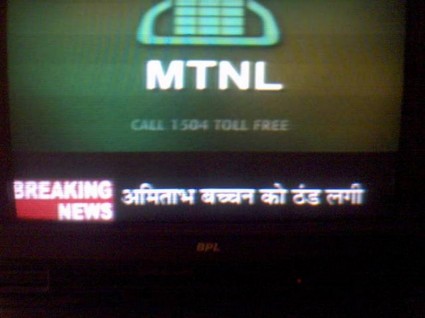
We turned to Hindi news channels and saw these headlines: ‘Shahrukh
Khan ne pahili baar shirt utaara!’ We clicked our remote for Breaking
News (all capitals and martial music) as it happened: ‘Deepika ne
Aishwarya ko Auntie kahaa!’ We felt elated. All was well with a world
where the younger peedhi showed such rispact for the elderly. News,
sans editorializing had been sublimated in a cacophony of bombastic
music and kitschy reconstructions. The bathos of Mumbaikars, who never
made news normally, was only reinforced when they surfaced briefly
from one terror attack to the next.

We sought relief in the superficiality of cinema and got Godard.
Jean-Luc invented the violation of continuity editing; fillum channels
emulated this grand tradition. Movies were downsized with ‘jump cut’
to pander to the tastes of ultraconservatives and babies. While our
Censor Board made cuts with surgical precision, the television
channels hacked though everything ‘deemed offensive’ with a machete.

Some progressive channels showed us cinema as it was made, and
preferred the middle-path of the blur and the bleep. Luis Bunuel was
outmatched, as ‘You Don’t Mess With the Zohan’ was remade into a
surrealist masterwork. The word ‘terrorist’ was bleeped out maybe a
zillion times, both in sound and subtitles. Cigarette smoke was
pixellated as per the government regulations. You could not see a
bleeding hand because your namby-pamby sensibilities would not take
it. We learn language in the laps of our mothers, so, appropriately
she taught us, replacing older words for new: ‘Prick’ was therefore a
no-no, we now use the more refined ‘testicle’. Thusly was our
vocabulary enriched, each day.

In passing, our foster mummy left us terminally infantilized. Her love
for us made her blind; she could never accept that we have grown up.
She has left behind a legacy of baby-talk and absences. God rest her
soul, as she looks down at us drooling mindlessly as we flit from
channel to channel to channel.

Saturday, January 7, 2012

Urban Bawl 4: Dead Spot

Here is the third in the series of my Urban Bawl columns in Time Out Mumbai for their 'Back of the Book' page.Some of my nostalgic ruminations on the 'forceclosed' Rang Bhavan and a clarion call for its return to active duty.
The Rang Bhavan at Dhobhi Talao, with an entrance from Badruddin Tyabji Marg next to St. Xaviers.
Image from Google Earth, accessed on 7.01.12
Dead Spot
(click on link above)
excerpt:
"I have my own trove of memories of this lovely place in the heart of the city. Being of congruent vintage and having studied in a college just a few steps down the road from Rang Bhavan (not St Xavier’s), I have marked my presence at several landmark events there. The hairs on my forearms still rise as I recall being pushed against bamboo barricades, within touching distance of Osibisa in the mid-’80s; in awe of the resonating drums of Daku Potato, who wielded a club rather than sticks to rock the joint. Now rarely remembered, Osibisa’s AfroCarib songs were more viral than “Kolaveri”."

Friday, November 25, 2011

Urban Bawl 3

Here is the third in the series of Urban Bawl columns in Time Out Mumbai for their 'Back of the Book' page.
Two small stories involving articles of clothing, centrifugally and centripetally engaged.

Two stories from a Mumbai Local


One
While returning home in the late afternoon, I am tired and sleepy and rush to find a window in the first class. I am lucky and soon, nearly nodding off. While I was alone to start with, now I notice a man come in, look around and leave. This doesn't register until it happens again. I pull myself up and look around. On the window seat opposite me, there is a white knitted skull-cap. You know, the kind worn by Muslims at the back of the head. The kind that Narendra Modi recently refused to accept.

Then another person come in, sees the cap, hesitates and moves to the opposite corner and sits near the window there. And then another, who winces visibly and finds a place as far away from this forgotten and forlorn object as is possible within the small enclosure of a railway compartment. I observe this silent opera, as the seats fill up one by one, all, except the one opposite me. Others prefer to remain standing. Finally, a commuter enters, sees this seat as the only empty one, and with two fingers gingerly lifts the cap, tucks it into a corner, and sits down. The train starts, and in its gentle sleep-inducing rhythms I am left to wonder, how much meaning gets invested in so ephemeral an object.

Two
6.30pm, Mumbai CST. Platform 1. The Harbour line.
It is the cusp before full-blown rush hour. A young couple, uncharacteristically entwined, walk the length of the platform towards where the first class compartments would arrive. The boy, almost all in black, encircles the girl’s waist with one arm. The girl is slim and short, a petiteness further enhanced by a really tight pair of jeans and a top that fits only too well. She has, over one shoulder a biggish ladies bag with several dangly bits. She wears fashionable heels, giving her an inch or two. With her free arm she clinches the boy back, tightly. It is unusual to see such a public display of affection, especially in a railway station in the evening.

The boy can only see her eyes.
The girl’s face and hair are obscured, wrapped completely, a dark dupatta forming a very makeshift naqaab. Both are engrossed; they bill and coo to each other as they wait for the train. Soon, the Vashi train trundles in, quite on time. The girl raises her head and gives the boy a peck on his cheek, right through the dupatta. The boy disentangles himself and gets into the general compartment. The girl walks a few steps down to the Ladies First Class.

Even before she finds a place to sit, with one smooth motion, she whips away the dupatta from her face, her hair falls to her shoulders, and once again she becomes Everywoman.


Saturday, October 15, 2011

Urban Bawl 2

Here is the second in the series of Urban Bawl columns in Time Out Mumbai for their 'Back of the Book' page. This piece is on city, memory and a set of installations by Jitish Kallat.


Sunday, September 4, 2011

Urban bawl

I have been invited by Time Out Mumbai to write a column for their 'Back of the Book' page with a frequency of six weeks or so. Being given a general carte blanche (other than the word count), I was delighted to accept. What is nice is that the column will be circulated every fortnight into Time Out Delhi and Time Out Bengaluru, hence the six week interval.

The first piece is published in the latest issue of Time Out, under the by-line 'Urban bawl'. This one, called 'English Class', is a reflection on our use of language in the city.


English Class

A newly married couple walk hand in hand amidst the venerable ruins of Nalanda in Bihar. She displays every post-marital semantic- green saree and bangles, elbow length mehendi and fluorescent sindoor. He wears well-fitted jeans, shades and a tee-shirt that screams in a loud font: ‘Show Me Your Hooters!’ After blinking several times in disbelief, it comes to me that neither really knows the difference between a car-horn and a large breast when encountered as slang. I concede (although I did not try) that, if I did speak to them, I could have had a comfortable tête-à-tête with both in English.

There was a time when we were taught English gratia English. Today, increasingly, it is a transactional tool, not language to revel in. In Mumbai, various ‘academies’ (‘classes’ are infra-dig) help you ‘overcome your English language problem’. One such advertises Business English as a ‘tailor made course to suit requirements of professionals travelling abroad, answering mails, business etiquettes and free flow conversation’. This poor English, taught by those who speak poor English, is far removed from the ‘exposing my talents’ or ‘removing photograph’ garden-variety Indianisms and has inflated into a full-blown Pavlovian call-and-response- adequate only to get a job done.

English is not spoken; it is used, the way most of us use technology, at the push-button-get-result level, unconcerned with any deus-ex-machina within. In public, words activate and deactivate like phone-apps, bypassing all known clichés into a different level of parole. Fill any given situation with some words; meaning gets conveyed as a form of gestalt. Just after the Zaveri Bazaar blasts, a television news reporter announces 'the police commissioner is taking toll of the blast area.' A bootleg DVD of ‘The Perfect Man’ has a byline (copy-pasted from any available review, because a byline must be given): 'It is to be endured rather than enjoyed.'

'narmean? Of course you do.

More and more people in our cities speak English, blithely ignorant of the language’s own culture, etymology and allusion. A commentator digresses from cricket to July’s riots in London and keeps referring to some black perpetrators as ‘African-American’, attempting political correctness with unintentional consequences. This unselfconscious use of English, to fill space, written or verbal, from smses (pls revaart asap 2 cust) to hoardings, variously deflates, decontextualises, and ultimately decimates sense, and yet, as in the immortal words from Namak Halaal: ‘I can talk English, I can walk English, I can laugh English, I can run English, because English is a phunny language.’ We nurse this as a paradigm in our post-globalized world.

I berate myself for such hoity-toity rantings, elitist bleddy Inglis speaker that I am, making phun of those challenged. I am contrite.

Then, last week, crossing the foot-over bridge outside the CST, I pass a young mother and son. She wears a quintessentially urban saree. The little boy, no more than seven, perhaps, wears a dark tee-shirt that says: ‘I pushed myself out through the vagina and all I got for it was this lousy T-shirt’... and I go: ‘What were you thinking, Mommy?’ But that’s just the point.

She wasn’t.